All Bytes (Trajectory Order)
1. Why are scientists interested in birds?
-
Avian-inspired engineering (/avianinspiredengineering/)
Learning Byte Summary ▾
Learning Objectives (LOs): Recognize how engineers take inspiration from birds and natureGrade level: Middle schoolDuration: ~3 minKey ideas: Biomimicry; Avian-inspired engineeringIntroduction to Avian Engineering
Look at the images below. What do you notice?
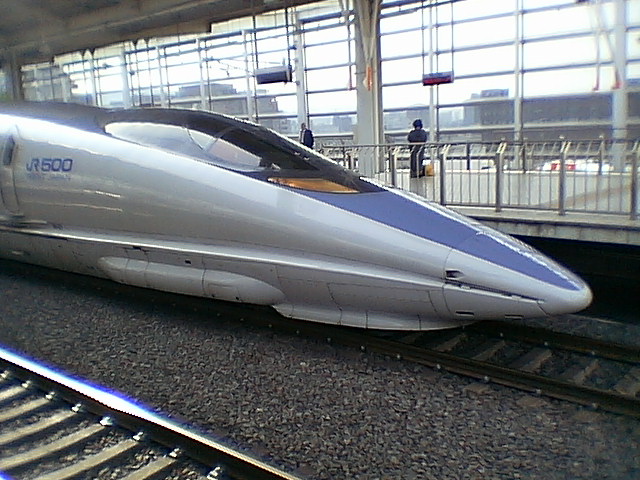
Shinkansen 500 series: High-speed train in Japan capable of reaching 320 km in an hour.M1 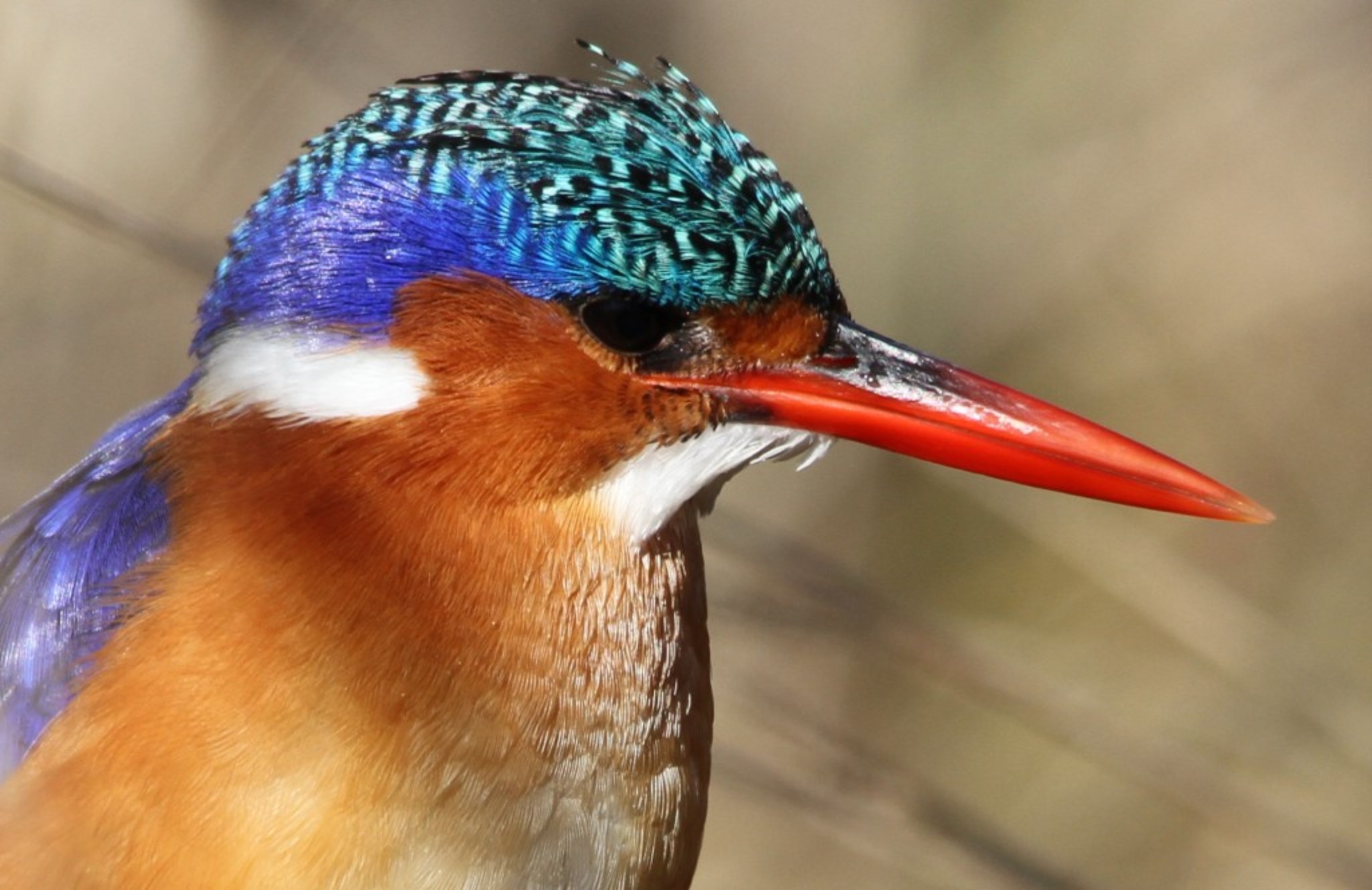
Malachite Kingfisher.M2 Scientists and engineers often take inspiration from nature to design and imagine new robots that can solve complex problems 1 . There are many examples of robots created by scientists and engineers that are inspired by nature. This field of engineering is called biomimicry or bio-inspired engineering or biomimetics. When engineers and scientists take inspiration from birds to design flying robots, this branch of engineering is called bird-inspired engineering, or avian-inspired engineering.
Do you know the latin for avis is “bird”, hence avian stands for related to or resembling birds.
Examples of future bird-inspired drones.M3 ReflectionDo you know examples of bird-inspired robots? Why do you think scientists are interested in birds?References
-
1.BiomimeticsWikipedia contributors · Wikipedia · · CC BY-SA 3.0
Media Credits
-
M1Shinkansen 500 Series inspired by kingfisher beakErcument Gorgul · Wikimedia Commons · 2005 · CC BY 2.5
-
M2Malachite Kingfisher (Alcedo cristata), South AfricaDerek Keats from Johannesburg, South Africa · Wikimedia Commons · 2013 · CC BY 2.0
-
M3Future dronesRavi Sinha · Amazing Birds (original) · 2026 · CC BY-NC-SA 4.0
How to Cite: Sinha, R. (2026). Avian-inspired engineering: Nature as inspiration. Amazing Birds. https://amazing-birds.gitlab.io/GenAI Assistance: Some content and materials on this page may have been developed with GenAI assistance; all content was reviewed, edited, and integrated by the author(s). This page is an open educational resource (OER) licensed under a Creative Commons Attribution-NonCommercial-ShareAlike 4.0 International License.Feel free to use, link, or embed this page for non-commercial educational purposes with attribution. Please share any adaptations under the same CC BY-NC-SA 4.0 license.This page may include third-party images, videos, and other materials that have their own licenses and terms of use. Please verify before reusing these materials.Feedback: If you notice any accessibility issues, incorrect information, or have suggestions for improvement, please use the feedback form.
 -
-
Amazing facts about birds (/amazing-bird-facts/)
Learning Byte Summary ▾
Learning Objectives (LOs): Identify bird abilities that can inspire engineering designGrade level: Middle schoolDuration: ~2 minKey ideas: Bird abilities; Engineering inspirationAmazing facts about birds!
Avian-inspired engineering involves learning from birds and implementing those insights in building robotic birds or drones. For example, we can take inspiration from several birds such as:
- Albatross are able fly long distances using ocean winds.
- Sparrows are able to move so easily and swiftly while navigating city buildings.
- Terns are able to fly fast and long distances effectively.
- Hummingbirds are able to hover in one place.
- Eagles are able to take sharp turns just by slightly changing the orientation of their features.
- Owls are able to perch on a branch by hugging it.
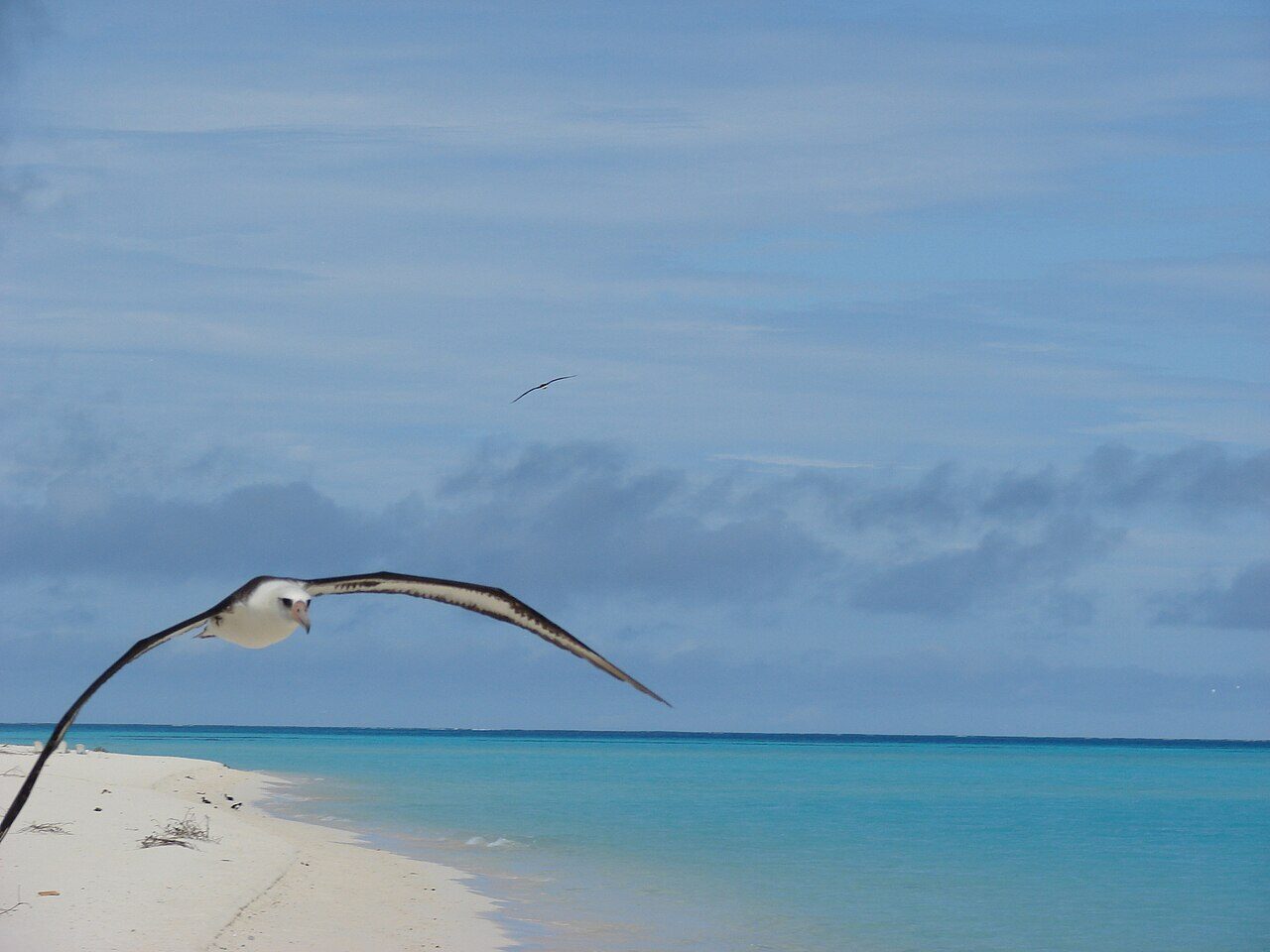
Laysan albatross with active soaring wings.M1 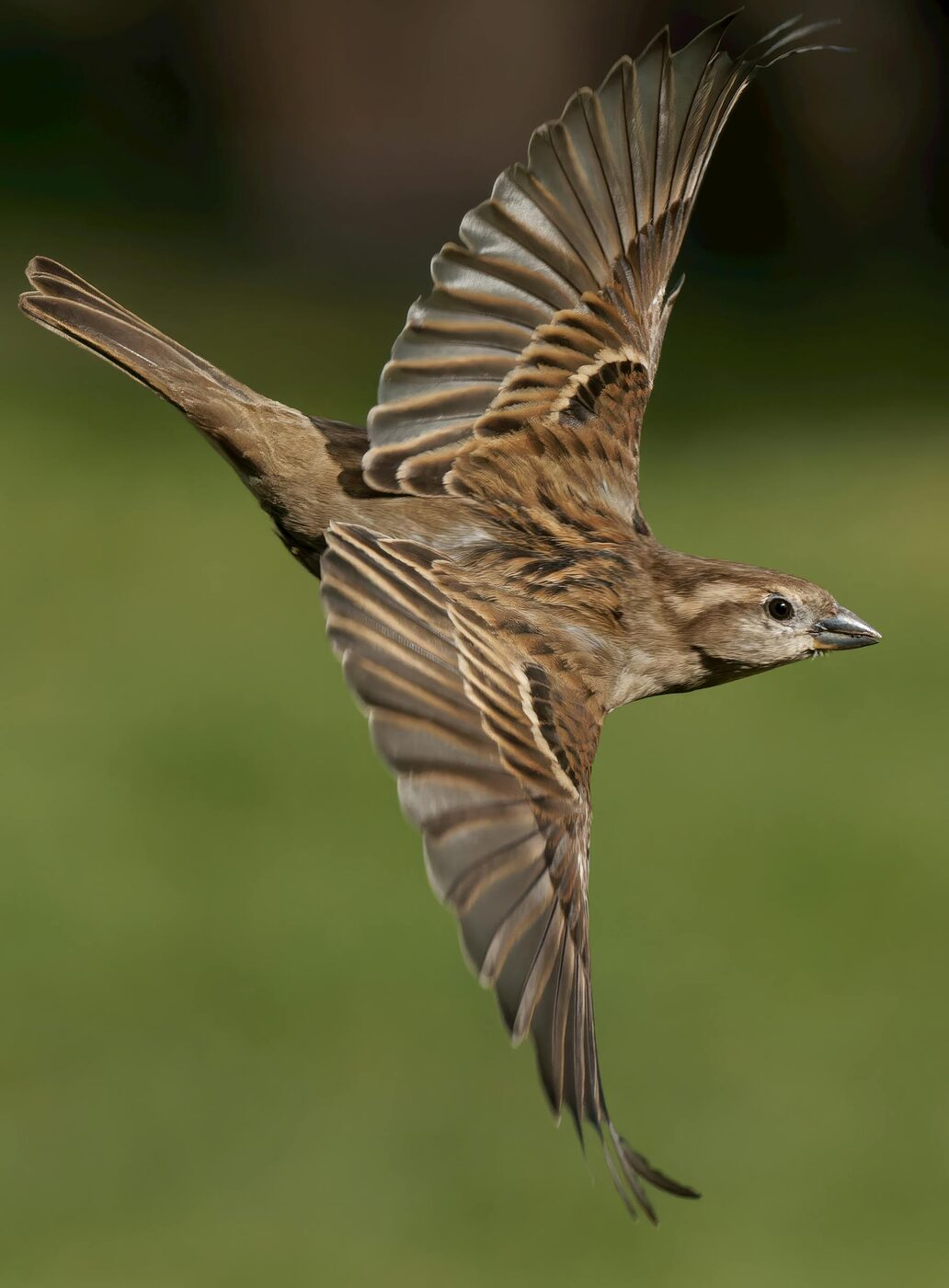
Close-up of a flying sparrow.M2 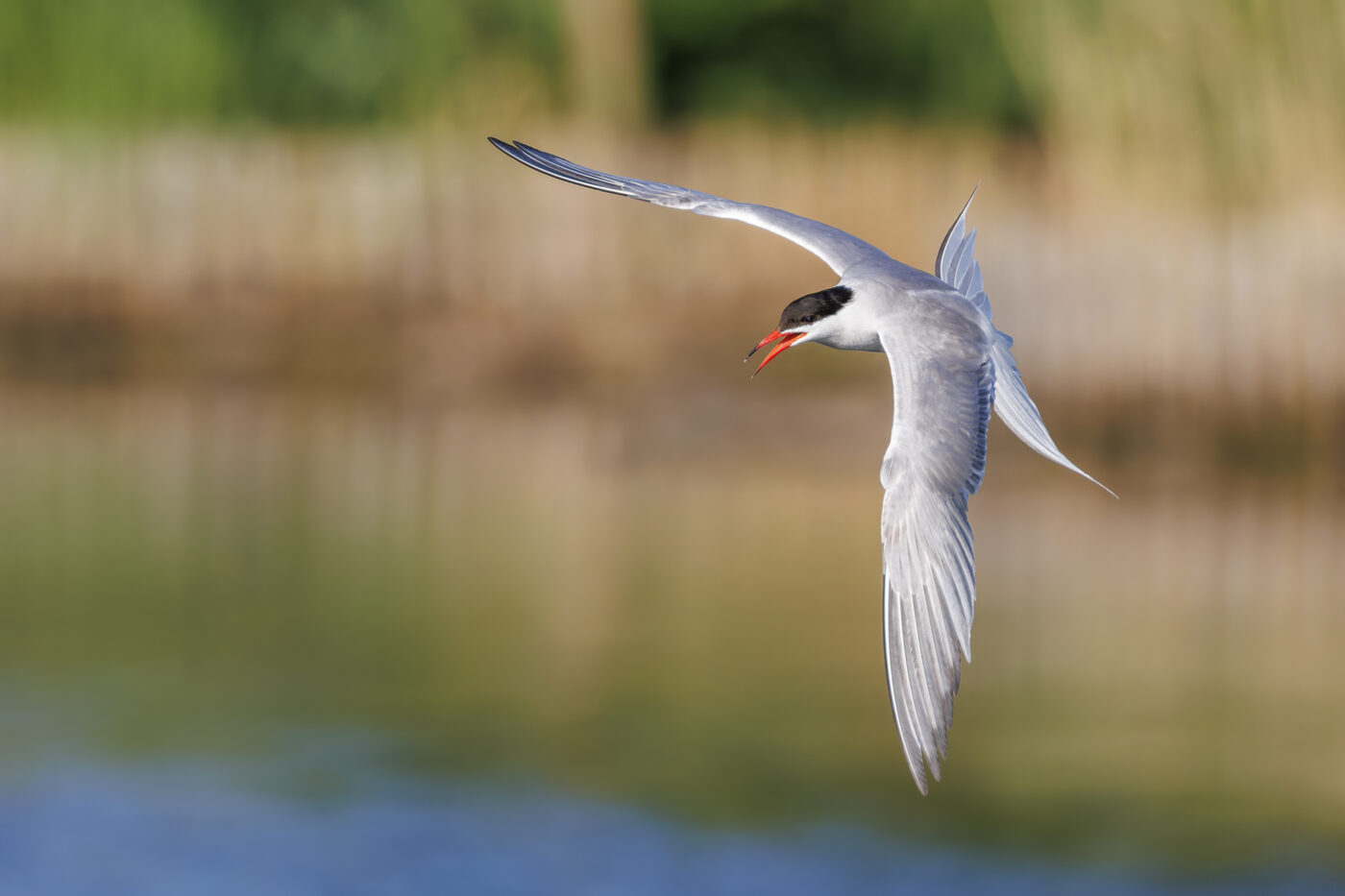
Common tern with high-speed wings.M3 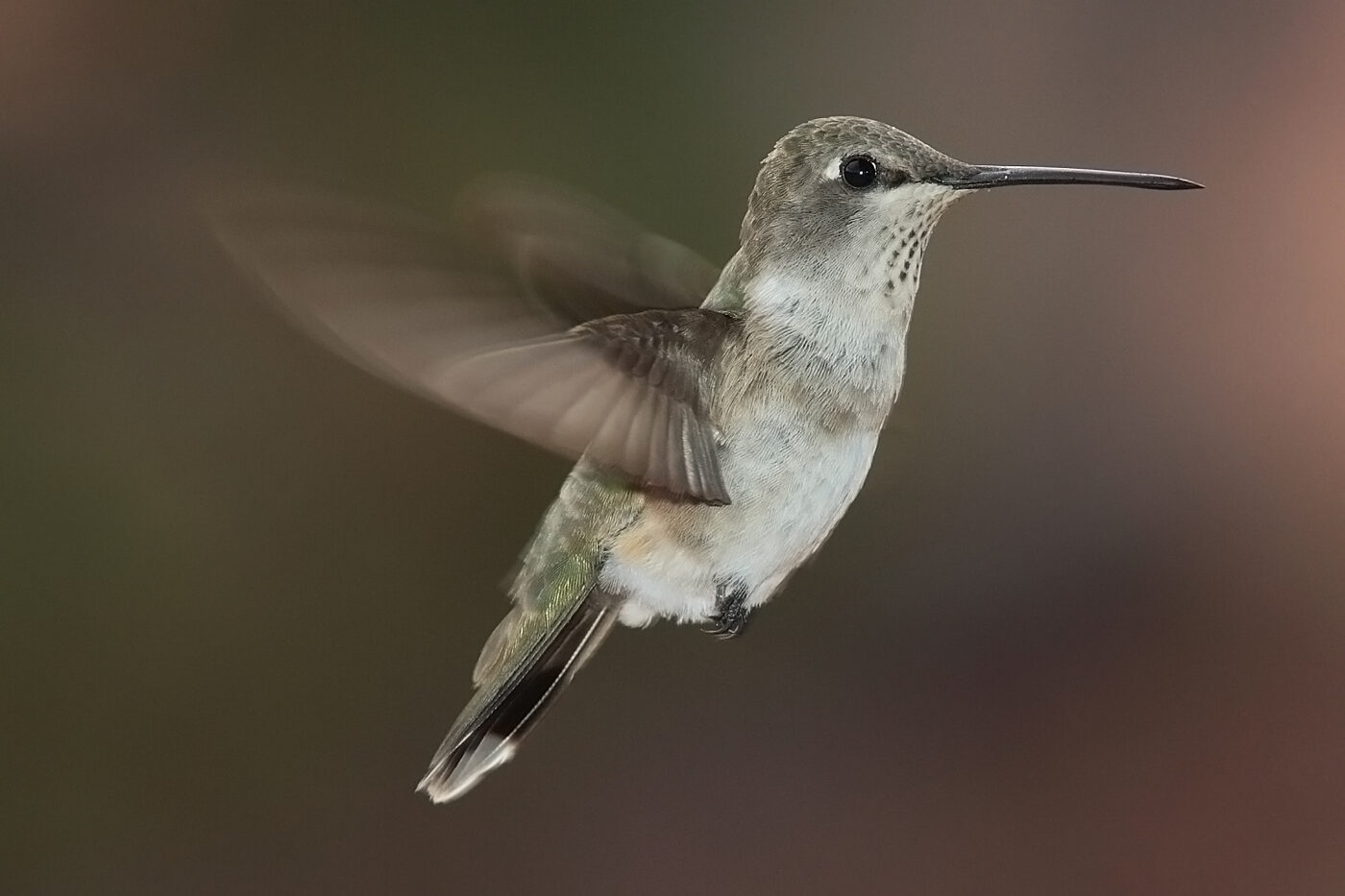
Black-chinned hummingbird hovering.M4 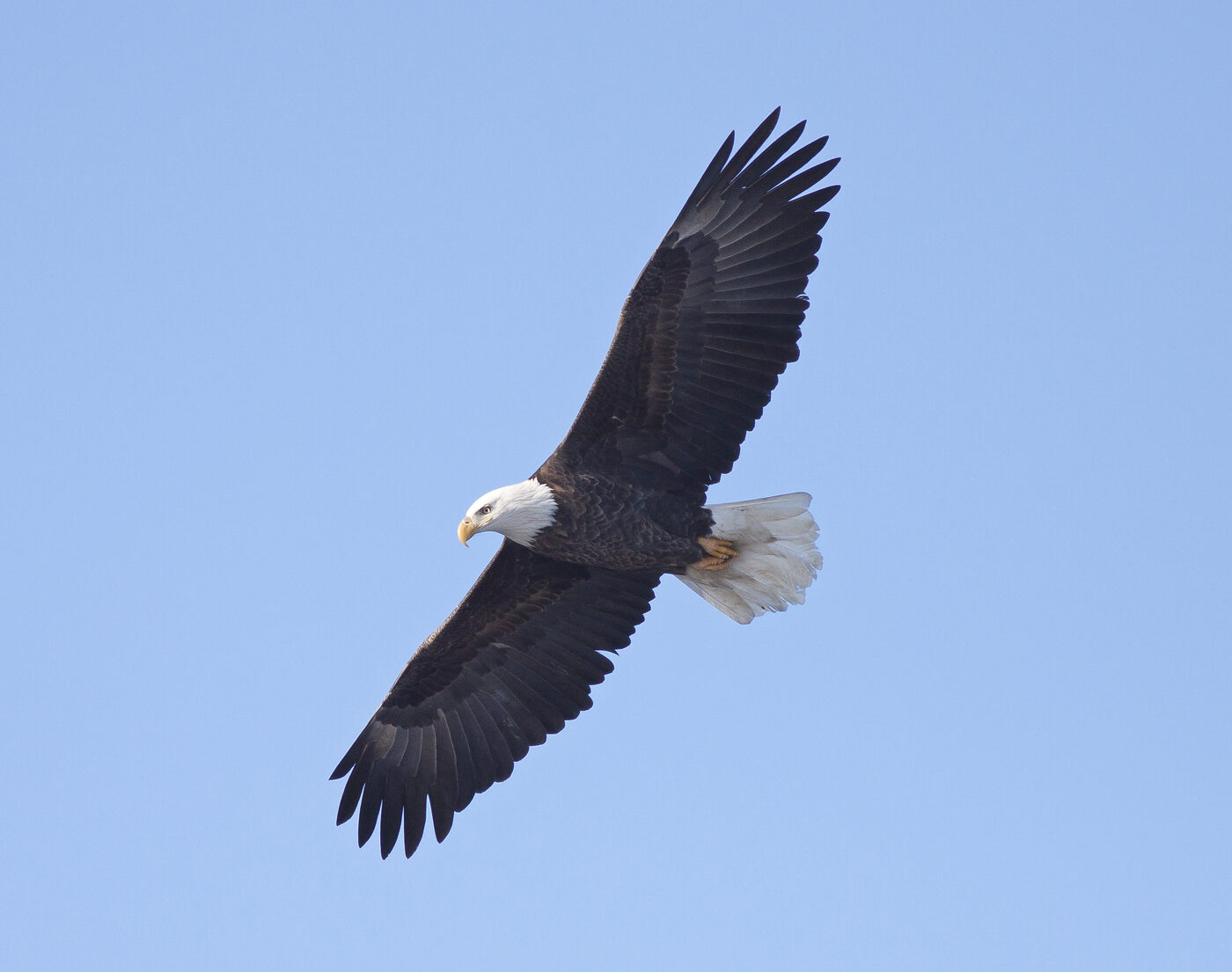
Bald eagle in flight.M5 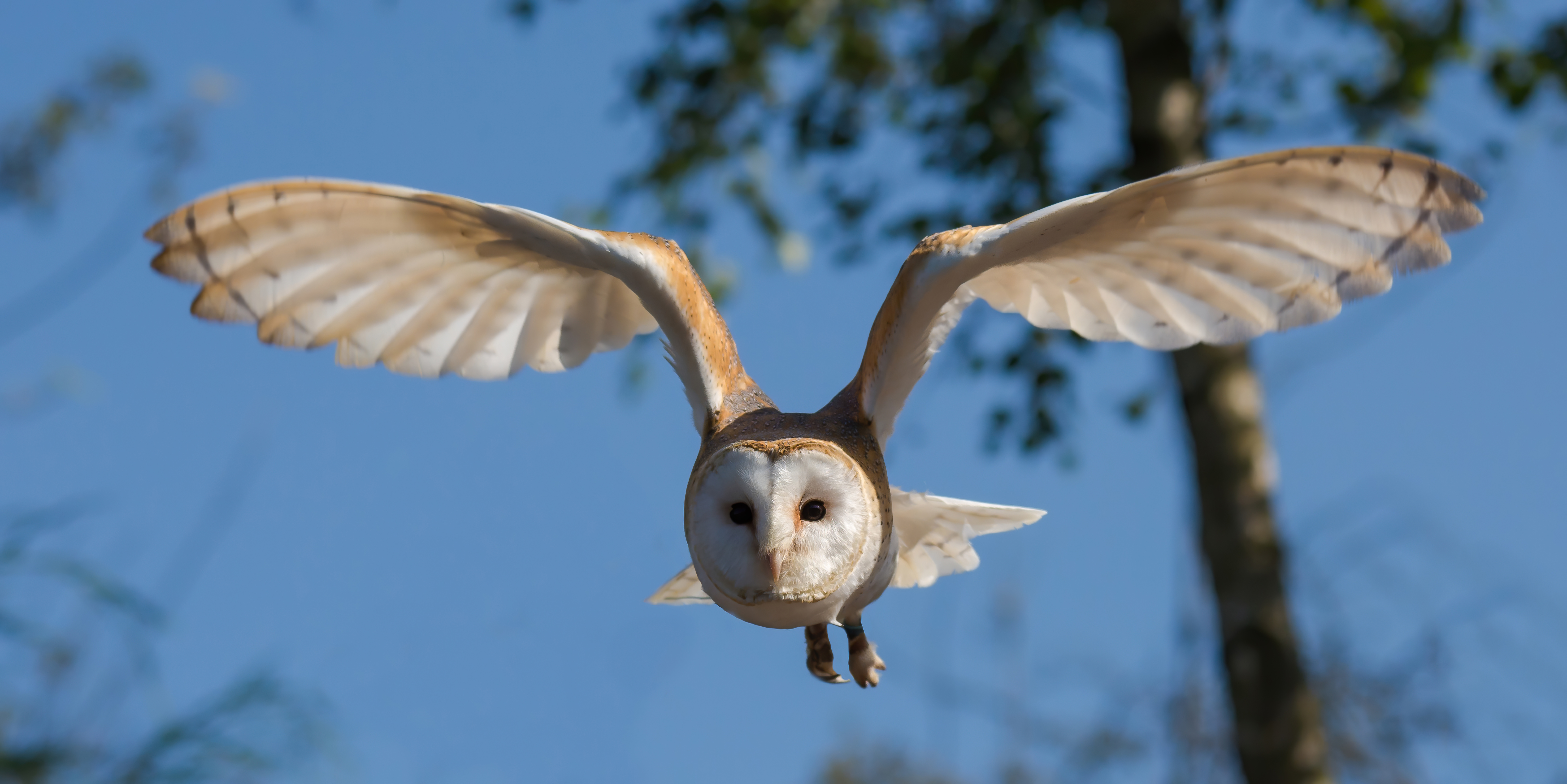
Front view of a barn owl in flight.M6 ReflectionWhich bird is your favorite? Do you know a special fact about a bird that you find really fascinating?Media Credits
-
M1Laysan albatross in flightForest & Kim Starr · Wikimedia Commons · 2008 · CC BY 3.0 US
-
M2Flying sparrowOdd Rune Falch · Pexels · 2023 · Pexels License
-
M3Common tern 2025 12Alexis Lours · Wikimedia Commons · 2025 · CC BY 4.0
-
M4Black-chinned hummingbirdUser:Mdf · Wikimedia Commons · 2006 · CC BY-SA 3.0
-
M5Bald eagle in flightSteve Berardi · Wikimedia Commons · 2010 · CC BY-SA 2.0
-
M6Front view of a barn owl in flightDannymoore1973& minor edits by Subsidiary account · Wikimedia Commons · 2015 · CC0
How to Cite: Sinha, R. (2026). Amazing facts about birds. Amazing Birds. https://amazing-birds.gitlab.io/GenAI Assistance: Some content and materials on this page may have been developed with GenAI assistance; all content was reviewed, edited, and integrated by the author(s).
This page is an open educational resource (OER) licensed under a Creative Commons Attribution-NonCommercial-ShareAlike 4.0 International License.Feel free to use, link, or embed this page for non-commercial educational purposes with attribution. Please share any adaptations under the same CC BY-NC-SA 4.0 license.This page may include third-party images, videos, and other materials that have their own licenses and terms of use. Please verify before reusing these materials.Feedback: If you notice any accessibility issues, incorrect information, or have suggestions for improvement, please use the feedback form. -
Examples of Bird-like robots (/bird-like-robots/)
Learning Byte Summary ▾
Learning Objectives (LOs): Explore examples of robotic birds made by engineering scientistsGrade level: Middle schoolDuration: ~4 minKey ideas: Bird-like robots; LisEagle; PercHugExamples of Bird-like robots
Bird-like robots are designed for various applications and are energy-efficient, agile, and adaptable to various flight conditions and environments. Next, we will explore some examples of robotic birds made by engineering scientists.
LisEagle
LisEagle is a robot inspired by a bird harris hawk. It can change the shape of its wings and tail to adjust to flying conditions, such as when wind speed changes 1 .
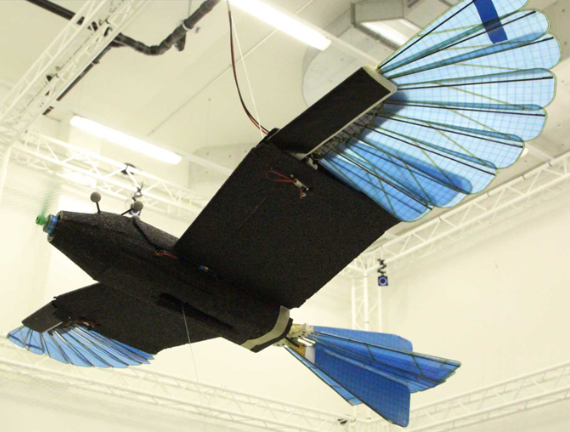
LisEagle in free flight.M1 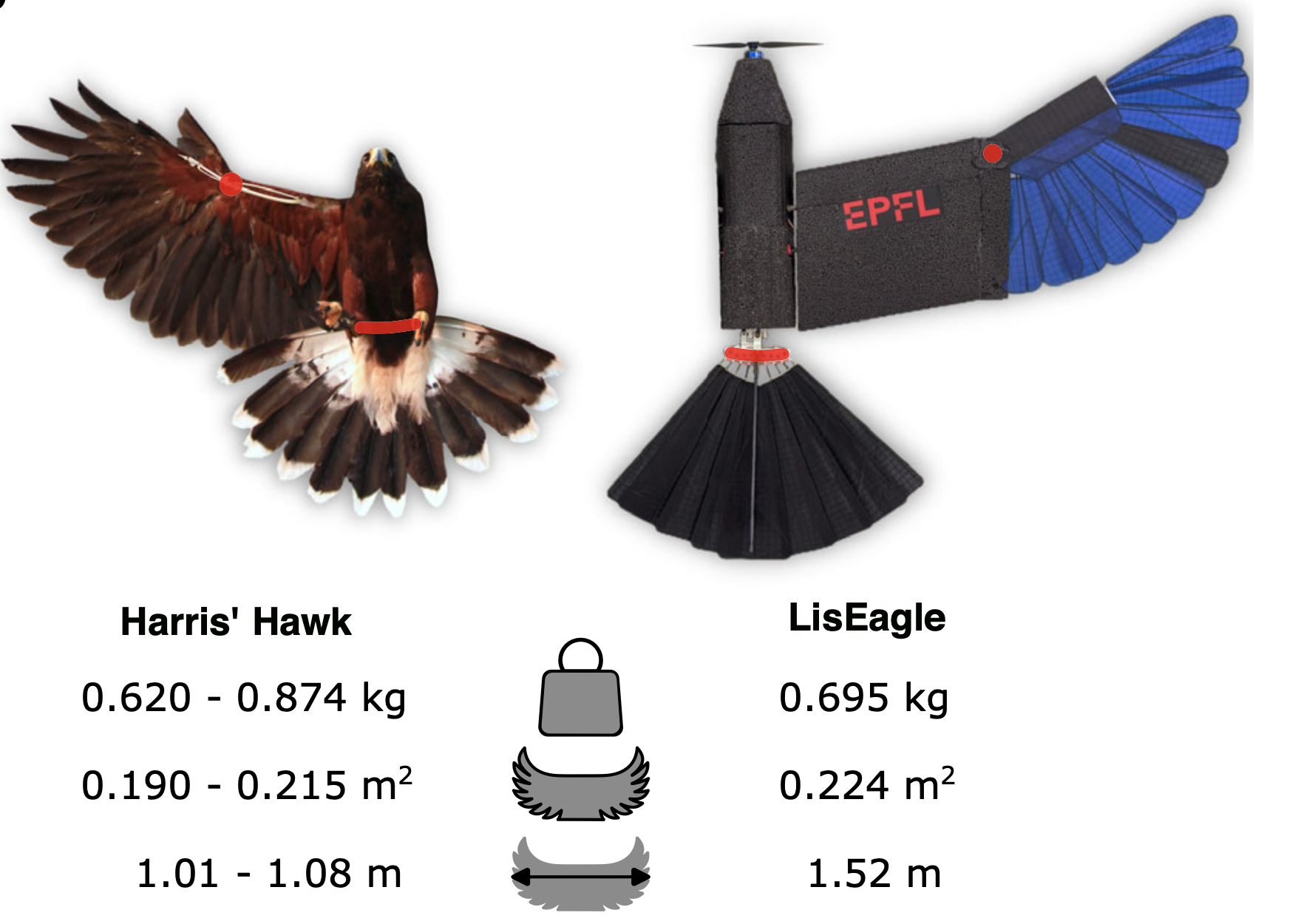
Harris' hawk vs LisEagle.M2 PercHug
PercHug is another bird-inspired robot that copies how some birds such as owl use their forelimbs to hold onto trees while landing. The comparison below shows a bat, an owl, and the PercHug robot using a similar hugging strategy 2 .
Interesting fact: Do you know bats are the only flying mammals, and their wings are more like modified, stretched, and extended hands, which allows them to be agile fliers?
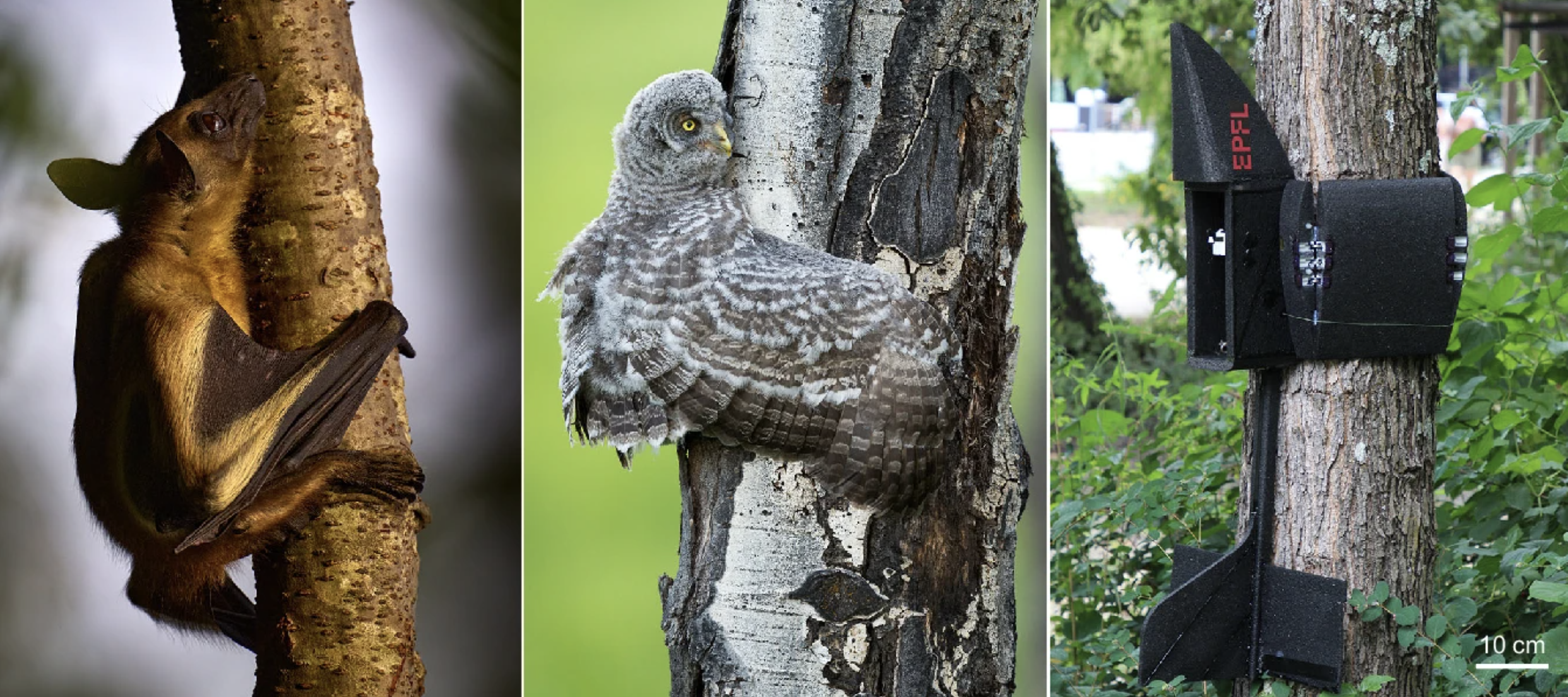
Bat, owl, and PercHug robot comparison.M3 ReflectionIf you were to design a bird-like robot, which bird would you copy and why?References
-
1.Adaptive Morphing of Wing and Tail for Stable, Resilient, and Energy-Efficient Flight of Avian-Inspired DronesSimon Luis Jeger and others · npj Robotics · 2024 · Vol. 2(1), p. 8
-
2.Crash-perching on vertical poles with a hugging-wing robotMohammad Askari and others · Communications Engineering · 2024 · Vol. 3(1), p. 98
Media Credits
-
M2LisEagle and Harris' hawk comparisonValentin Wuest and others · Nature Communications · 2024 · CC BY 4.0
How to Cite: Sinha, R. (2026). Examples of Bird-like robots. Amazing Birds. https://amazing-birds.gitlab.io/GenAI Assistance: Some content and materials on this page may have been developed with GenAI assistance; all content was reviewed, edited, and integrated by the author(s).
This page is an open educational resource (OER) licensed under a Creative Commons Attribution-NonCommercial-ShareAlike 4.0 International License.Feel free to use, link, or embed this page for non-commercial educational purposes with attribution. Please share any adaptations under the same CC BY-NC-SA 4.0 license.This page may include third-party images, videos, and other materials that have their own licenses and terms of use. Please verify before reusing these materials.Feedback: If you notice any accessibility issues, incorrect information, or have suggestions for improvement, please use the feedback form. -
-
Bird-inspired robot applications (/bird-inspired-robot-applications/)
Learning Byte Summary ▾
Learning Objectives (LOs): Describe possible applications of bird-inspired robotsGrade level: Middle schoolDuration: ~3 minKey ideas: Robot applications; Bio-inspired design; Engineering trade-offsBird-inspired robot applications
Bird-inspired robots could help people in lots of real-world situations!Birds can glide, flap, perch, hover, turn sharply, and adjust their wings in changing air. A robot does not need to copy every part of a bird, but it can borrow useful ideas from bird flight.
Bird Inspiration Robot Type What It Could Do Where It Could Help Albatross Long-endurance drone Collect data for hours without stopping Oceans, forests, and other hard-to-reach places Bald Eagle Forest monitoring drone Glide on warm air to cover large areas Disaster zones and search-and-rescue Tern Delivery drone Travel far distances quickly Delivering medicines, monitoring environments, search-and-rescue Sparrow Urban navigation drone Fly swiftly through tight spaces City streets, dense forests, and buildings Hummingbird Hovering micro-drone Stay perfectly still mid-air to inspect things Indoor spaces, bridges, and tall buildings 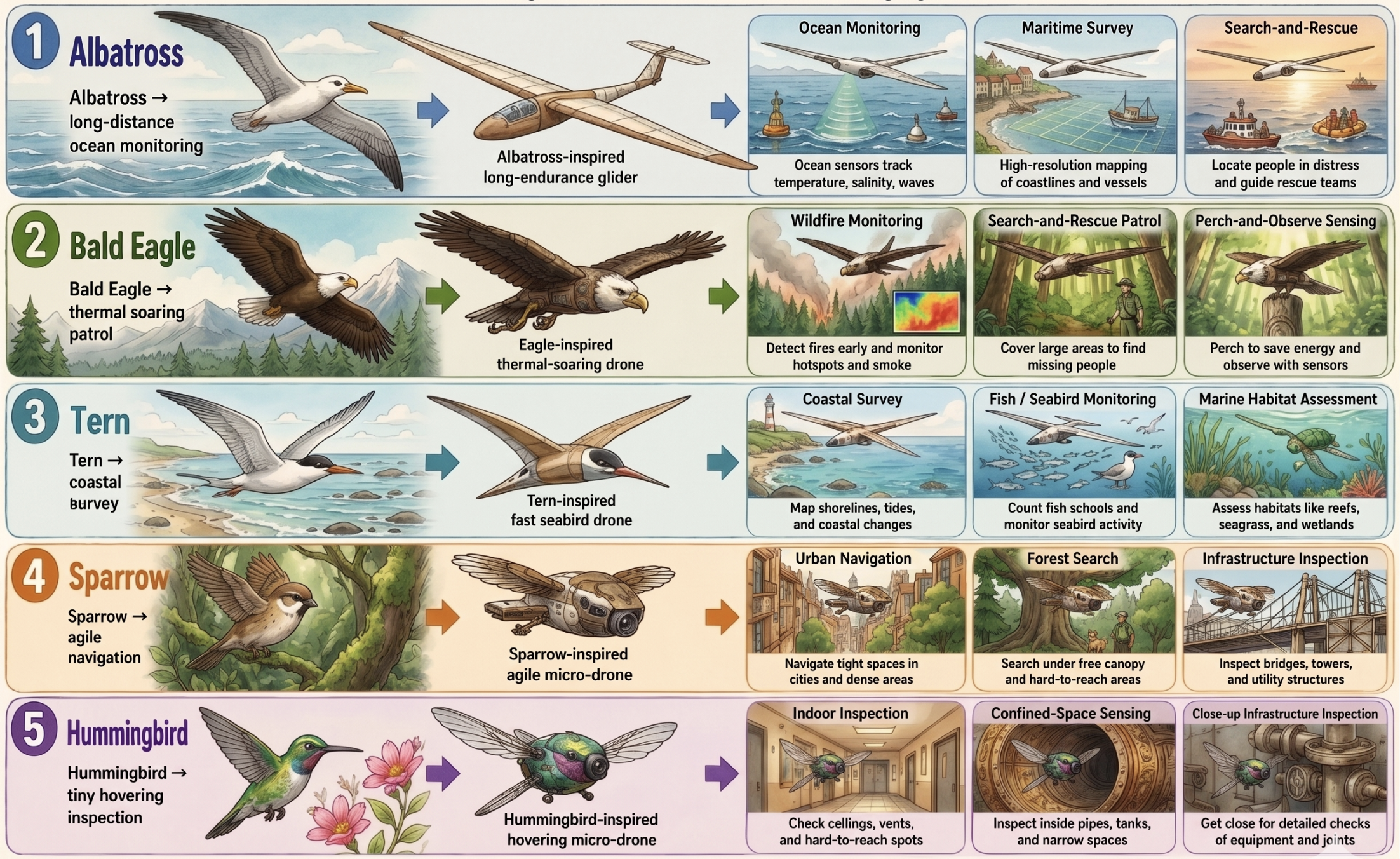
Bird robots application areasM1 ReflectionChoose one real-world use for a bird-inspired robot. What bird feature would help that robot do its job?Media Credits
-
M1Bird robots application areasRavi Sinha (AI-generated) · Amazing Birds (original) · 2026 · CC BY-NC-SA 4.0
How to Cite: Sinha, R. (2026). Bird-inspired robot applications. Amazing Birds. https://amazing-birds.gitlab.io/GenAI Assistance: Some content and materials on this page may have been developed with GenAI assistance; all content was reviewed, edited, and integrated by the author(s).
This page is an open educational resource (OER) licensed under a Creative Commons Attribution-NonCommercial-ShareAlike 4.0 International License.Feel free to use, link, or embed this page for non-commercial educational purposes with attribution. Please share any adaptations under the same CC BY-NC-SA 4.0 license.This page may include third-party images, videos, and other materials that have their own licenses and terms of use. Please verify before reusing these materials.Feedback: If you notice any accessibility issues, incorrect information, or have suggestions for improvement, please use the feedback form. -
-
Designing bird-like robots (/bird-like-robot-research/)
Learning Byte Summary ▾
Learning Objectives (LOs): Explain why designing bird-like robots is still an active research areaGrade level: Middle schoolDuration: ~2 minKey ideas: Future robots; Research questions; Design reflectionDesigning bird-like robots is an active area of research
Nature is full of fascinating ways birds have adapted to their environment and how they fly by changing their wings and tail under different conditions. However, there is still so much to learn about how they fly and apply the learnings to design future bird-like robots or drones.
Feedback
Was there any section that was difficult to understand?What is one new thing you learned?How to Cite: Sinha, R. (2026). Designing bird-like robots. Amazing Birds. https://amazing-birds.gitlab.io/GenAI Assistance: Some content and materials on this page may have been developed with GenAI assistance; all content was reviewed, edited, and integrated by the author(s).
This page is an open educational resource (OER) licensed under a Creative Commons Attribution-NonCommercial-ShareAlike 4.0 International License.Feel free to use, link, or embed this page for non-commercial educational purposes with attribution. Please share any adaptations under the same CC BY-NC-SA 4.0 license.This page may include third-party images, videos, and other materials that have their own licenses and terms of use. Please verify before reusing these materials.Feedback: If you notice any accessibility issues, incorrect information, or have suggestions for improvement, please use the feedback form.
2. Comparing how birds and planes fly
Basics of flight
-
Slow motion birds flight (/slowmotion/)
Learning Byte Summary ▾
Learning Objectives (LOs): In this learning byte, we will watch slow motion videos of bird flightGrade level: Middle schoolDuration: 8 minKey ideas: Observing flapping flight; Slow-motion video observationSlow motion bird flights
Watch the videos of birds flying in slow motion.
Albatross
Bald Eagle
Tern
Sparrow
Hummingbird
ObservationWhat are the similarities and differences you notice in how birds fly?Write down your observations below.ObservationHow do you think birds fly?Feedback
Was there any section that was difficult to understand?What is one new thing you learned?How to Cite: Sinha, R. (2026). Slow Motion Flights. Amazing Birds. https://amazing-birds.gitlab.io/GenAI Assistance: Some content and materials on this page may have been developed with GenAI assistance; all content was reviewed, edited, and integrated by the author(s).
This page is an open educational resource (OER) licensed under a Creative Commons Attribution-NonCommercial-ShareAlike 4.0 International License.Feel free to use, link, or embed this page for non-commercial educational purposes with attribution. Please share any adaptations under the same CC BY-NC-SA 4.0 license.This page may include third-party images, videos, and other materials that have their own licenses and terms of use. Please verify before reusing these materials.Feedback: If you notice any accessibility issues, incorrect information, or have suggestions for improvement, please use the feedback form. -
How planes fly? (/planeflight/)
Introduction
Take a look at the remote-controlled (RC) plane below,
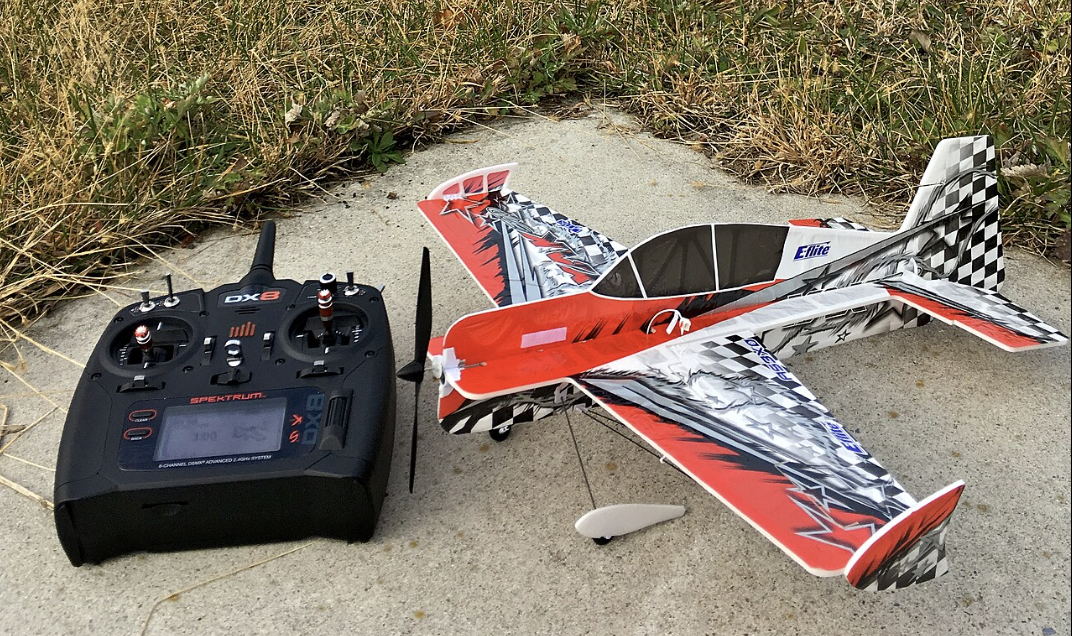
Graphic of radio-controlled (RC) plane with remote controllerM1 ReflectionHow do you think RC plane flies?Feedback
Was there any section that was difficult to understand?What is one new thing you learned?References
-
1.BiomimeticsWikipedia contributors · Wikipedia · · CC BY-SA 3.0
-
2.Adaptive Morphing of Wing and Tail for Stable, Resilient, and Energy-Efficient Flight of Avian-Inspired DronesSimon Luis Jeger and others · npj Robotics · 2024 · Vol. 2(1), p. 8
-
3.Agile Perching Maneuvers in Birds and Morphing-Wing DronesValentin Wuest and others · Nature Communications · 2024 · Vol. 15(1), p. 8330
-
4.Crash-perching on vertical poles with a hugging-wing robotMohammad Askari and others · Communications Engineering · 2024 · Vol. 3(1), p. 98
Media Credits
-
M1Radio-controlled (RC) planeFred Hsu · Wikimedia Commons · 2017 · CC BY-SA 3.0
How to Cite: Sinha, R. (2026). How planes fly?. Amazing Birds. https://amazing-birds.gitlab.io/GenAI Assistance: Some content and materials on this page may have been developed with GenAI assistance; all content was reviewed, edited, and integrated by the author(s).
This page is an open educational resource (OER) licensed under a Creative Commons Attribution-NonCommercial-ShareAlike 4.0 International License.Feel free to use, link, or embed this page for non-commercial educational purposes with attribution. Please share any adaptations under the same CC BY-NC-SA 4.0 license.This page may include third-party images, videos, and other materials that have their own licenses and terms of use. Please verify before reusing these materials.Feedback: If you notice any accessibility issues, incorrect information, or have suggestions for improvement, please use the feedback form. -
-
Aerodynamic forces (/aeroforces/)
Learning Byte Summary ▾
Learning Objectives (LOs):- describe how planes fly
- explain the four forces: lift, weight (gravity), drag, and thrust
Grade level: Middle schoolDuration: 10 minKey ideas: Lift; Weight (gravity); Drag; ThrustIntroduction to aerodynamic forces
What keeps a plane up in the air?
Graphic of radio-controlled (RC) plane with remote controllerM1 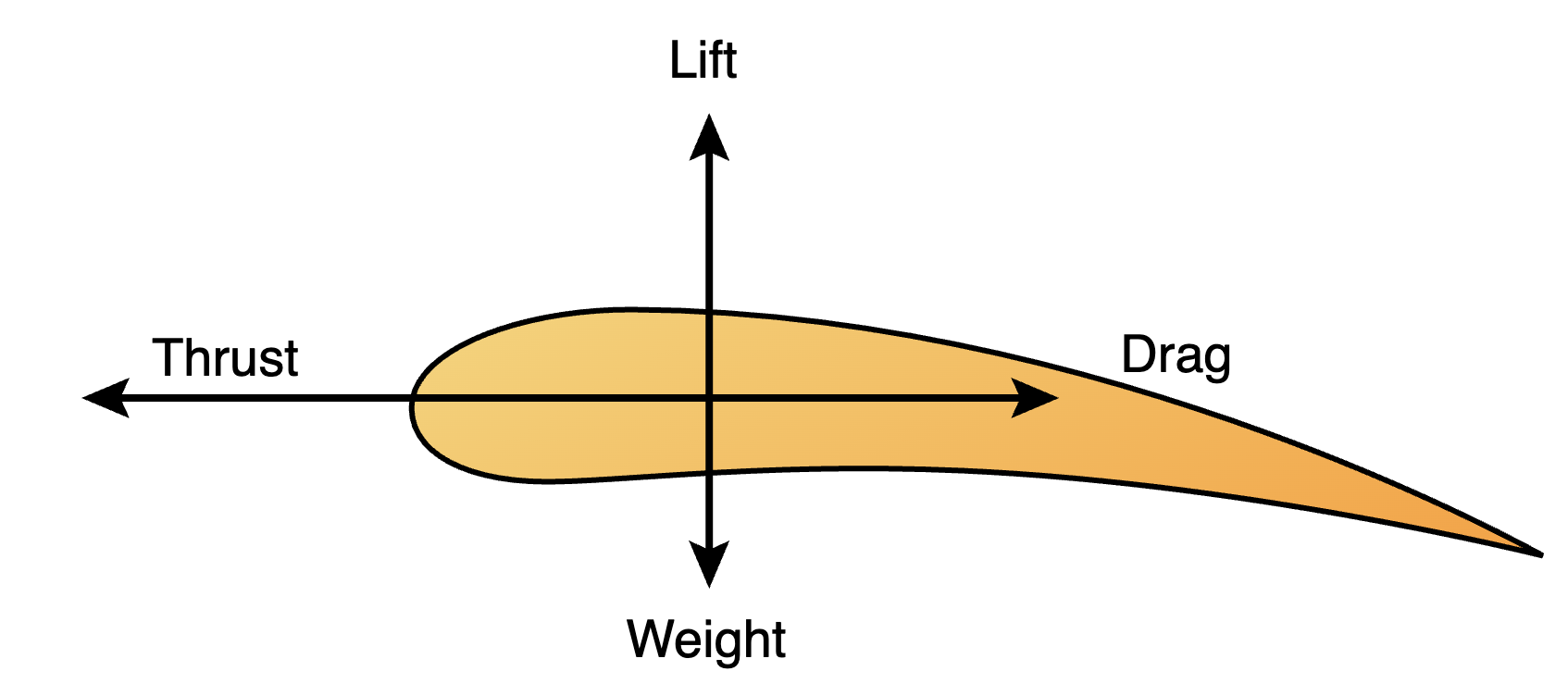
The four forces on an aircraftM2 There are four forces that act on a plane in the air. These forces are:
- Lift: the upward force from air that helps an object rise.
- Weight (gravity): the downward pull of Earth.
- Thrust: the forward push from engines, flapping, or a propeller.
-
Drag: the backward force from air resistance.
- Lift, weight, thrust, and drag are known as aerodynamic forces.
- The propeller provides the force (thrust) that moves the plane forward.
- The wing surface is curved. It pushes the air downward. This creates the lift force that makes the plane rise.
- Gravity (weight) is constantly pulling the plane downward.
- As a plane moves through the air, it experiences air resistance (drag), which tries to slow it down.
- When lift is greater than weight, the plane goes up!
- When thrust is greater than drag, it moves forward.
Control surfaces of a plane
Have you ever wondered how a plane is able to move in the air? It has three main control surfaces that allow it to change its motion: ailerons, the rudder, and the elevator.
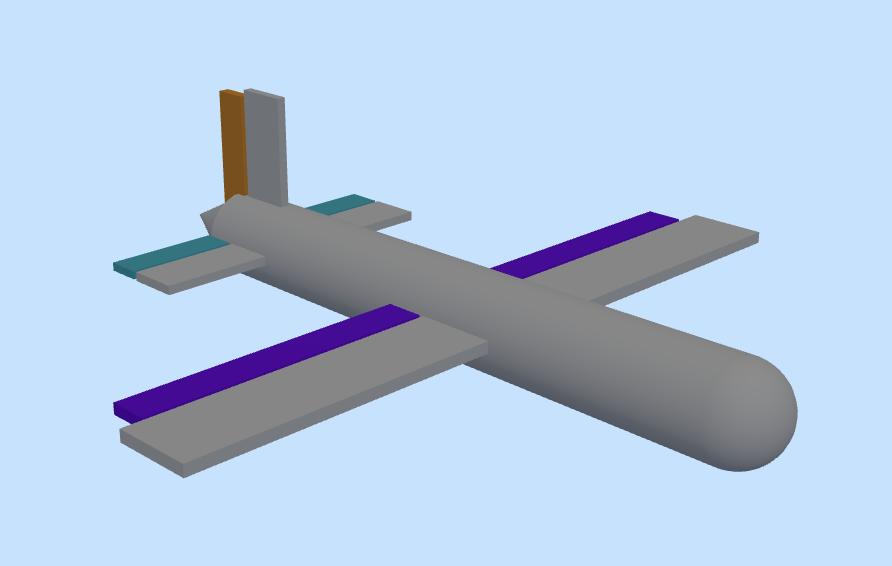
Plane control surfacesM4 - Planes have three main control surfaces: ailerons for roll, rudder for yaw, and elevator for pitch.
- Roll motion is controlled by ailerons; moving one up causes the plane to roll in the opposite direction.
- Yaw motion is controlled by the rudder; moving it left or right causes the plane to turn in the direction of the rudder.
- Pitch motion is controlled by the elevator; moving it up causes the nose of the plane to go up, and moving it down causes the plane’s nose to dip.
Feedback
Was there any section that was difficult to understand?What is one new thing you learned?References
- Missing reference registry entry: .
Media Credits
-
M1Radio-controlled (RC) planeFred Hsu · Wikimedia Commons · 2017 · CC BY-SA 3.0
-
M2The four forces on an aircraftAmada44 · Wikimedia Commons · 2007 · Public Domain
-
M3Domestic pigeon flightDerivative work Tony Wills, rearragned by Toby Hudson · Wikimedia Commons · 2009 · CC BY-SA 3.0
-
M4Plane control surfacesRavi Sinha · Amazing Birds · 2026 · CC BY-NC-SA 4.0
How to Cite: Sinha, R. (2026). Aerodynamic Forces. Amazing Birds. https://amazing-birds.gitlab.io/GenAI Assistance: Some content and materials on this page may have been developed with GenAI assistance; all content was reviewed, edited, and integrated by the author(s).
This page is an open educational resource (OER) licensed under a Creative Commons Attribution-NonCommercial-ShareAlike 4.0 International License.Feel free to use, link, or embed this page for non-commercial educational purposes with attribution. Please share any adaptations under the same CC BY-NC-SA 4.0 license.This page may include third-party images, videos, and other materials that have their own licenses and terms of use. Please verify before reusing these materials.Feedback: If you notice any accessibility issues, incorrect information, or have suggestions for improvement, please use the feedback form. -
Forces on a falling object (/fallingobjectforces/)
Learning Byte Summary ▾
Learning Objectives (LOs): Force on free falling object; how drag balances weightGrade level: Middle schoolDuration: 5 minKey ideas: Drag force; Weight; Terminal velocityDrag Force & Terminal Velocity
As an object falls faster, it experiences more resistance from the air. This resistance, or pushback, is called drag force. The drag force continues to grow until it becomes large enough to balance the object’s weight. At that point, the upward drag force and the downward weight of the falling object balance each other out, so there is no net force acting on the object. The object stops accelerating; that is, its speed no longer increases. It continues to fall smoothly at a constant speed. This final constant falling speed is called terminal velocity. 1
Parachutes
Paper Copter
References
-
1.Falling Object with Air ResistanceNancy Hall, Glenn Research Center · Glenn Research Center, NASA · 2024
How to Cite: Sinha, R. (2026). Forces on a falling object. Amazing Birds. https://amazing-birds.gitlab.io/GenAI Assistance: Some content and materials on this page may have been developed with GenAI assistance; all content was reviewed, edited, and integrated by the author(s).
This page is an open educational resource (OER) licensed under a Creative Commons Attribution-NonCommercial-ShareAlike 4.0 International License.Feel free to use, link, or embed this page for non-commercial educational purposes with attribution. Please share any adaptations under the same CC BY-NC-SA 4.0 license.This page may include third-party images, videos, and other materials that have their own licenses and terms of use. Please verify before reusing these materials.Feedback: If you notice any accessibility issues, incorrect information, or have suggestions for improvement, please use the feedback form. -
-
Control Surfaces (/controlsurfaces/)
Learning Byte Summary ▾
Learning Objectives (LOs): describe roll, yaw, and pitch and identify the control surfaces that create themGrade level: Middle schoolDuration: ~12 minKey ideas: Roll, yaw, pitch; Ailerons, rudder, elevator; Control surfacesPlane control surfaces
Do you ever wonder how a plane flies? A plane has three parts that are used to control its movements. Let’s learn about the primary motions of planes—roll, yaw, and pitch. Experiment with both the paper plane and the simulation to better understand these movements!
Roll motion
Let’s start with the paper plane. With its nose straight, make it go around. This move is called a roll. Roll movement is controlled by ailerons, which are part of the plane’s wings. Let’s visualize this in the simulation.
- What do you notice when you change the aileron slider? When one goes up, does the other go in the same direction or the opposite?
- What happens when the left wing aileron is up and the right one is down? Which direction does the plane roll?
- What happens when the right wing aileron is up and the left one is down? Which direction does the plane roll?
Play with the roll motion in the simulation below.
Learning Checkpoints — Roll
When one aileron goes up, does the other go in the same direction or the opposite?
Left wing aileron up and right wing aileron down. Which direction does the plane roll?
Right wing aileron up and left wing aileron down. Which direction does the plane roll?
Yaw motion
Now, we can also take our paper plane and make it move sideways. This is called yaw motion. Yaw motion is controlled by the part on the tail of the plane, known as a rudder. Now, jump back to the simulation below.
- What happens when you move the rudder to the left? Which direction does the plane go? Why do you think it moves that way?
- Now, move the rudder to the right. Which direction does the plane go? Why do you think it moves this way?
Learning Checkpoints — Yaw
Move the rudder to the left. Which direction does the plane go?
Move the rudder to the right. Which direction does the plane go?
Pitch motion
The final move is easy. Imagine a plane flying at a certain height and now wanting to land. It will slowly start descending. This movement is primarily controlled by another part on the tail of the plane known as the elevator. It’s perhaps called an elevator because it takes the plane up and down! Now jump back to the simulation.
- Change the elevator up. Which direction does the plane move—up or down? Why do you think it moves this way?
- Now change the elevator down. Which direction does the plane move—up or down? Why do you think it moves this way?
Learning Checkpoints — Pitch
Elevator up. Does the nose go up or down?
Elevator down. Does the nose go up or down?
Going forward!
- Explore and take your notes! Hope you had fun learning about the plane’s movements.
- Do you think birds also perform these movements—roll, yaw, and pitch? Have you ever wondered how birds fly?
Recap of top ideas
- Planes have three control surfaces: ailerons for roll, rudder for yaw, and elevator for pitch.
- Roll motion is controlled by ailerons; moving one up causes the plane to roll in the opposite direction.
- Yaw motion is controlled by the rudder; moving it left or right causes the plane to turn in the direction of the rudder.
- Pitch motion is controlled by the elevator; moving it up causes the nose of the plane to go up, and moving it down causes the plane’s nose to dip.
ReflectionIn your own words, what is the main idea of How does a plane fly?ReflectionSummarize what you have learned today.ReflectionWhat did you find most surprising or intriguing in this learning byte?Understanding CheckHow well do you understand: describe roll, yaw, and pitch and identify the control surfaces that create them?1 out of 5How to Cite: Sinha, R. (2026). How does a plane fly?. Amazing Birds. https://amazing-birds.gitlab.io/GenAI Assistance: Some content and materials on this page may have been developed with GenAI assistance; all content was reviewed, edited, and integrated by the author(s).
This page is an open educational resource (OER) licensed under a Creative Commons Attribution-NonCommercial-ShareAlike 4.0 International License.Feel free to use, link, or embed this page for non-commercial educational purposes with attribution. Please share any adaptations under the same CC BY-NC-SA 4.0 license.This page may include third-party images, videos, and other materials that have their own licenses and terms of use. Please verify before reusing these materials.Feedback: If you notice any accessibility issues, incorrect information, or have suggestions for improvement, please use the feedback form. -
Control Surfaces Simulation (/simulations/pitch-yaw-roll/mechanism.html)
Content not embedded. See /simulations/pitch-yaw-roll/mechanism.html.
-
Lift force (/liftforce/)
Learning Byte Summary ▾
Learning Objectives (LOs):- describe how planes fly
- explain the four forces: lift, weight (gravity), drag, and thrust
Grade level: Middle schoolDuration: 10 minKey ideas: Lift; Weight (gravity); Drag; ThrustLift force
The four forces on an aircraftM4 So, we know that lift: the upward force from air that helps an object rise. Planes fly because they generate an upward force called lift.
ReflectionHow the plane generates lift force?Explanation 1: How planes generating lift?
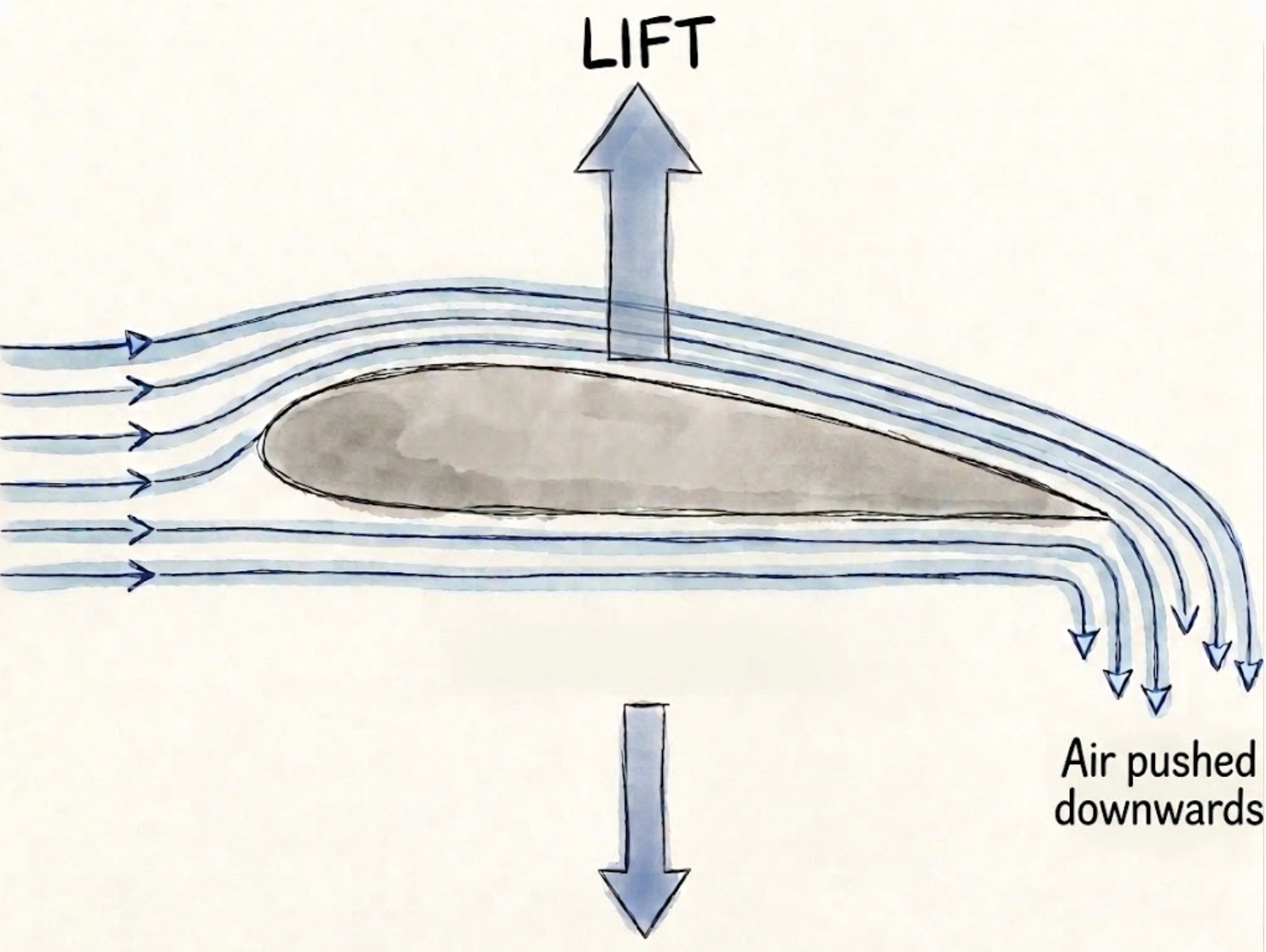
Air is a fluid like water, just less dense. For planes, the lift force is mostly generated by the wings. As the plane moves forward, the air passes over the top and bottom surfaces of the wings. Due to the wing’s curve, the air going over the upper surface experiences centripetal acceleration, like the feeling of being pushed outward in a car taking a sharp turn. This causes the air above the wing to gain more speed than the air traveling below. This increased speed leads to a decrease in pressure above the wing. The air flowing across the lower surface, meanwhile, experiences less of a change in direction and speed. So while the faster air above the wing experiences a decrease in pressure, the pressure across the wing’s lower surface remains higher than that above the upper surface. This pressure difference, higher below and lower above, results in the upward force of lift. The faster the plane travels, the greater the pressure difference, and the greater that force. Once it overcomes the downward force of gravity, the plane takes off. 1 .
Explanation 2: How planes generating lift?
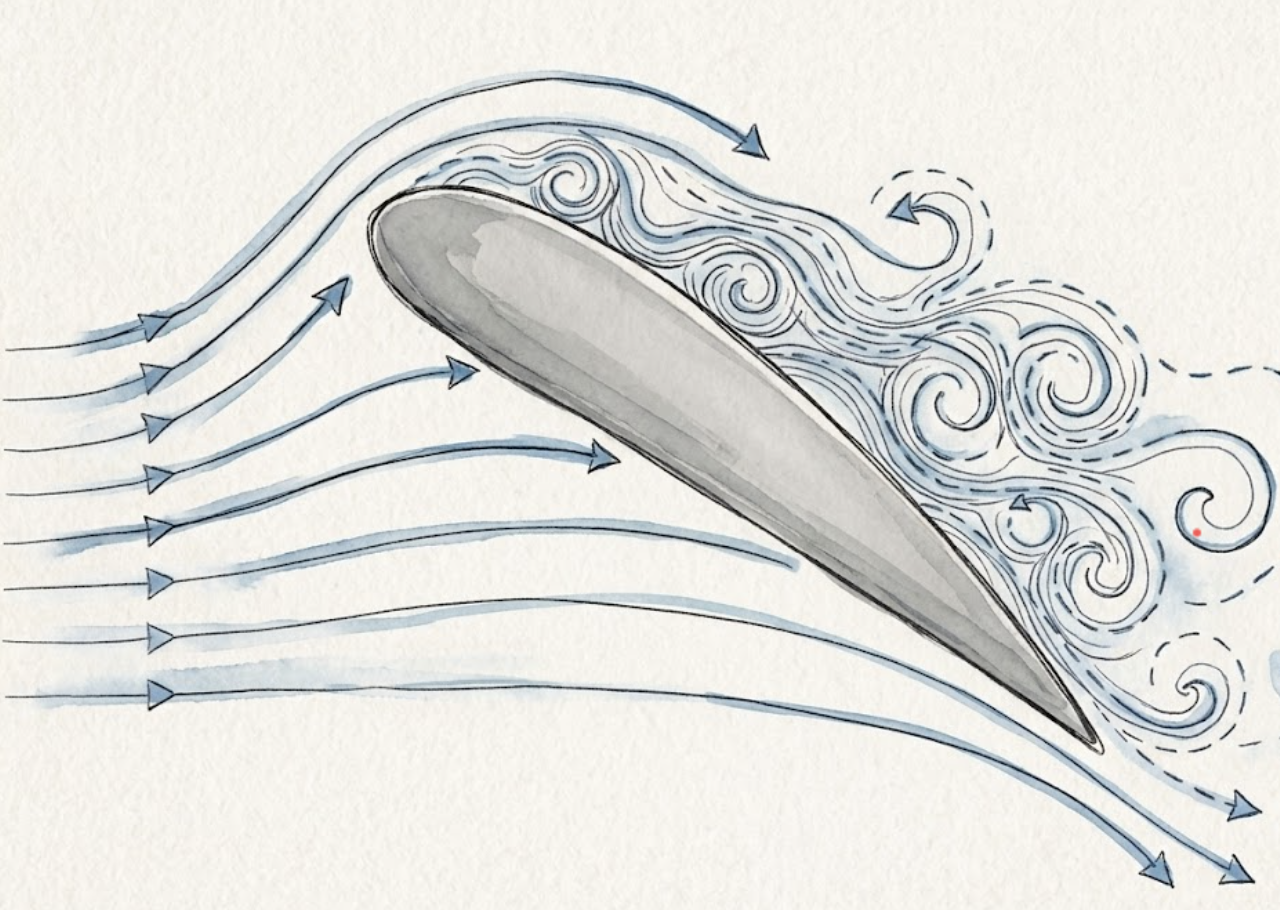
Another way to think about lift starts with the Coanda effect, which says that air will follow the shape of whatever object it encounters. As a wing moves forward, the air sticks to the wing’s curved surface and follows its curve. The airflow over the wing gets pushed downward at the back of the wing. By Newton’s Third Law, that downward push of the air pushes the wing upward. This upward force is called lift. So, does that mean the more the curve, the more the lift? Not really — if the wing’s angle is too steep, the air can no longer stick to the surface of the wing and lift is lost. This is called a stall, caused either by too slow an airspeed or too high an angle of incidence. 2
Feedback
Was there any section that was difficult to understand?What is one new thing you learned?References
-
1.How Do Airplanes Actually Fly?Raymond Adkins · TED-Ed · 2023
-
2.Aerodynamics Explained by a World Record Paper Airplane DesignerJohn Collins · YouTube · 2020
Media Credits
-
M1Lift generationRavi Sinha (AI-generated) · Amazing Birds · 2026 · CC BY-NC-SA 4.0
-
M2StallRavi Sinha (AI-generated) · Amazing Birds · 2026 · CC BY-NC-SA 4.0
-
M3Radio-controlled (RC) planeFred Hsu · Wikimedia Commons · 2017 · CC BY-SA 3.0
-
M4The four forces on an aircraftAmada44 · Wikimedia Commons · 2007 · Public Domain
-
M5Domestic pigeon flightDerivative work Tony Wills, rearragned by Toby Hudson · Wikimedia Commons · 2009 · CC BY-SA 3.0
-
M6Plane control surfacesRavi Sinha · Amazing Birds · 2026 · CC BY-NC-SA 4.0
How to Cite: Sinha, R. (2026). Lift force. Amazing Birds. https://amazing-birds.gitlab.io/GenAI Assistance: Some content and materials on this page may have been developed with GenAI assistance; all content was reviewed, edited, and integrated by the author(s).
This page is an open educational resource (OER) licensed under a Creative Commons Attribution-NonCommercial-ShareAlike 4.0 International License.Feel free to use, link, or embed this page for non-commercial educational purposes with attribution. Please share any adaptations under the same CC BY-NC-SA 4.0 license.This page may include third-party images, videos, and other materials that have their own licenses and terms of use. Please verify before reusing these materials.Feedback: If you notice any accessibility issues, incorrect information, or have suggestions for improvement, please use the feedback form. -
Comparing birds and planes flight? (/compareflight/)
Learning Byte Summary ▾
Learning Objectives (LOs): In this learning byte, we will compare flight of bird and planeGrade level: Middle schoolDuration: 10 minKey ideas: Flapping flight; Comparing how birds and planes flyIntroduction
A swallow flying in slow motionM1 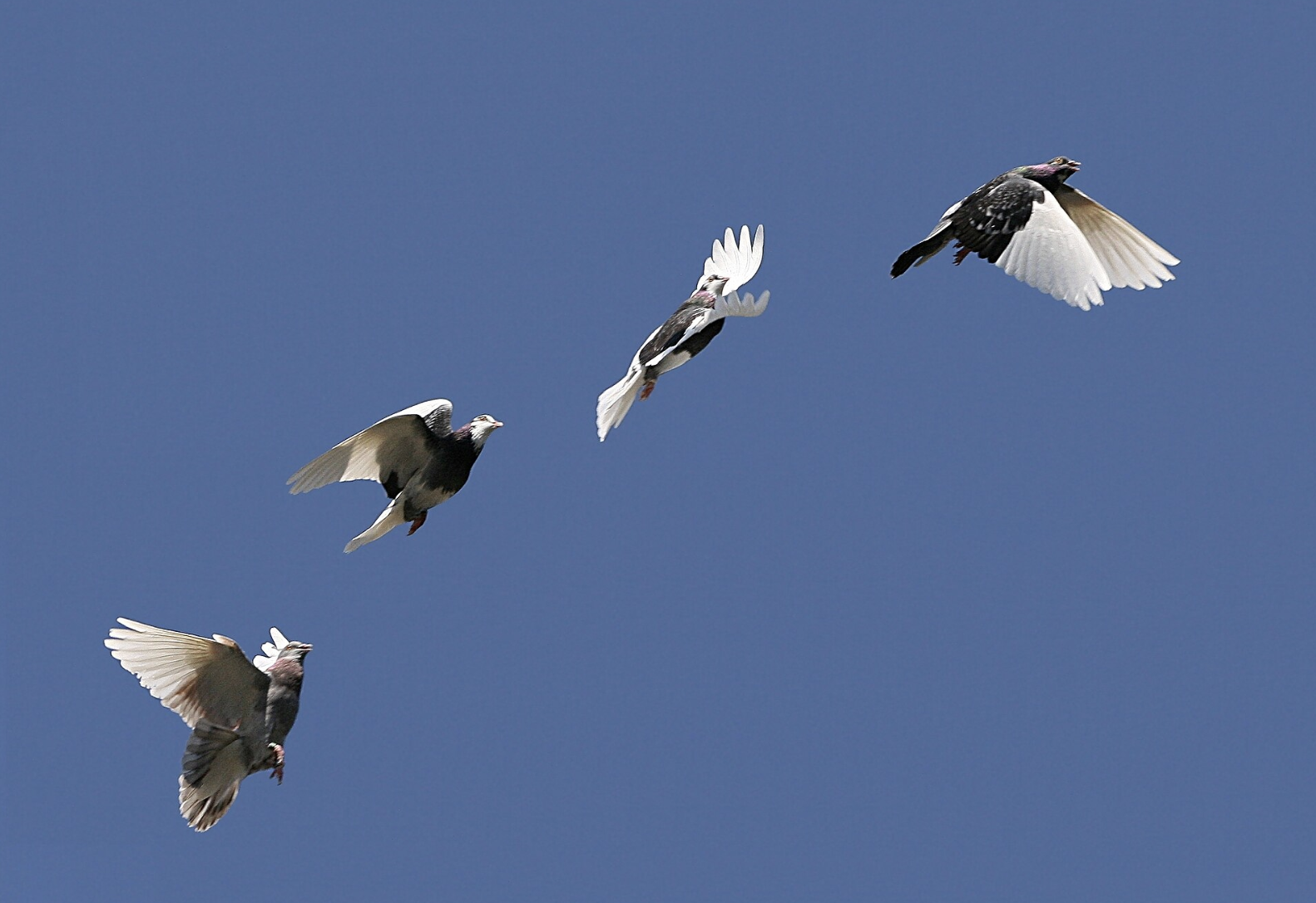
Domestic pigeon flightM2 Graphic of radio-controlled (RC) plane with remote controllerM3 Do birds birds fly differently than planes? How are they able to move so swiftly in air?
How do birds fly?
Birds do not fly in just one way. Some birds flap quickly, some birds glide for long distances, and some switch back and forth between flapping and gliding depending on flight conditions to conserve energy. Researchers are trying to understand how birds control airflow to lift themselves off the ground. A bird’s wing is curved so that air is pushed downwards, which generates lift. Birds flap their wings. Wing flapping has two parts: the downstroke (wings pushing down) and the upstroke (wings going back up). Prof. David Lentink points out that on the downstroke, a bird generates enough lift to support twice its own body weight. On the upstroke, it produces almost no lift at all, which means birds are in free fall for a moment and then the cycle repeats. However, not all birds fly this way. Hummingbirds are the exception. Most birds only generate lift on the downstroke, but hummingbirds generate lift on both the down and up strokes, which partly explains their ability to hover in place for a long time. 1
Comparing bird and plane flight
- Whether we are looking at a bird or a plane, successful flight depends on a few core jobs being done well. The flyer must create enough lift to stay in the air, move forward through the air, stay balanced, and change direction when needed.
- That means both birds and planes have to deal with the same basic challenge: they must manage airflow around the body so they can rise, steer, and keep control.
- Birds do this with flexible wings, feathers, and body motion. A plane does it with fixed wings, engines or propellers, and control surfaces. So the physics problem is similar, but the solutions look different
- Birds solve flight with living materials that can bend and adjust moment by moment. Planes solve it with engineered structures that are more rigid and predictable.
What is similar?
Birds and planes both need to:
- produce lift so they can stay in the air
- move forward through the air
- stay balanced and stable
- change direction by rolling, yawing, and pitching
These similarities are important because they remind us that birds and planes are both working with the same air. Lift still has to support weight. Forward motion still has to overcome drag. Steering still depends on changing forces around the body.
What is different?
Question Birds Planes How do they move forward? By flapping wings and using body motion By engines or propellers How do they change wing shape? Wings bend, fold, twist, and spread feathers Wings are mostly fixed How do they control motion? Wings and tail change continuously Control surfaces such as ailerons, rudder, and elevator - Biggest different? Birds are flexible while planes are specialized. A bird can slightly change wing shape, spread feathers, or shift body posture in the middle of flight, making birds are more responsive and adaptable.
- Birds are not just flying objects. They are active control systems. They can change wing posture, feather arrangement, and body orientation almost instantly. A bird’s body is always sensing and adjusting.
- That is one reason bird flight is so interesting to engineers who want to design machines that can move more naturally through changing conditions.
- In a plane, these motions are tied to specific control surfaces. In birds, the same motions happen through coordinated movement of the wings, tail, and body.
- Engineers look to birds for ideas about adaptability, efficiency, and control.
- Birds and planes both must lift, move, and steer.
- Planes use fixed structures plus control surfaces.
- Birds use flexible wings, tail motion, and body coordination.
- Comparing both systems helps us design better flying machines.
- Engineering scientists study birds because birds are excellent examples of controlled, energy-efficient flight. If we understand how birds fly, we can design robotic birds that move in more flexible ways.
What’s role of flapping?
When you watch a flying bird, during flapping:
- the downstroke, when the wing pushes strongly through the air
- the upstroke, when the wing returns and may fold slightly
- the wingtip path, or the arc made by the wing
- whether the left and right wings stay symmetric
- how the tail helps with balance and steering
References
-
1.The Magic of Bird Flight with David LentinkDavid Lentink · YouTube · 2020
Media Credits
-
M1A swallow flying in slow motionZachzr · Wikimedia Commons · 2022 · CC BY-SA 4.0
-
M2Domestic pigeon flightDerivative work Tony Wills, rearragned by Toby Hudson · Wikimedia Commons · 2009 · CC BY-SA 3.0
-
M3Radio-controlled (RC) planeFred Hsu · Wikimedia Commons · 2017 · CC BY-SA 3.0
-
M5LisEagle and Harris' hawk comparisonValentin Wuest and others · Nature Communications · 2024 · CC BY 4.0
How to Cite: Sinha, R. (2026). How do birds and planes fly?. Amazing Birds. https://amazing-birds.gitlab.io/GenAI Assistance: Some content and materials on this page may have been developed with GenAI assistance; all content was reviewed, edited, and integrated by the author(s).
This page is an open educational resource (OER) licensed under a Creative Commons Attribution-NonCommercial-ShareAlike 4.0 International License.Feel free to use, link, or embed this page for non-commercial educational purposes with attribution. Please share any adaptations under the same CC BY-NC-SA 4.0 license.This page may include third-party images, videos, and other materials that have their own licenses and terms of use. Please verify before reusing these materials.Feedback: If you notice any accessibility issues, incorrect information, or have suggestions for improvement, please use the feedback form. -
Flapping flight (/flappingflight/)
Learning Byte Summary ▾
Learning Objectives (LOs): How flapping works?Grade level: Middle schoolDuration: 10 minKey ideas: Flapping flight; Lift and thrust force; WingbeatIntroduction
Pacific parrotlet foraging flight with visualized net force, lift, and drag during takeoff and landing.M1 What you might notice?
What is a parrotlet doing when it flies?
- A parrotlet’s entire flight, launch to landing takes less than one second.
- During that time, it cleaverly reassigns lift and drag just by tilting its wings.
Phase 1 — Launch (wings tilt forward)
- You’d normally expect lift to hold the bird up and drag to slow it down. Not here.
- Drag points upward — it’s holding the bird up.
- Lift points forward — it’s helping bird take-off.
Phase 2 — Cruise (wings level out)
- Now things look “normal.”
- Lift goes back to holding the bird up.
- Drag goes back to pointing backward, slowing the bird slightly.
Phase 3 — Brake (wings tilt backward)
- Both lift and drag now point backward together.
- Together it slows the bird down before landing.
- The bird uses its own wings as a built-in parachute.
The big idea
- Lift and drag aren’t locked into one job the bird chooses what they do by changing its wing angle, body and tail shape.
Feedback
References
-
1.How Do Airplanes Actually Fly?Raymond Adkins · TED-Ed · 2023
Media Credits
-
M1Birds repurpose the role of drag and lift to take off and land (Supplementary Movie 1)Diana D. Chin & David Lentink · Nature Communications 10, Article 5354 (2019) · 2019 · CC BY 4.0
How to Cite: Sinha, R. (2026). Lift force. Amazing Birds. https://amazing-birds.gitlab.io/GenAI Assistance: Some content and materials on this page may have been developed with GenAI assistance; all content was reviewed, edited, and integrated by the author(s).
This page is an open educational resource (OER) licensed under a Creative Commons Attribution-NonCommercial-ShareAlike 4.0 International License.Feel free to use, link, or embed this page for non-commercial educational purposes with attribution. Please share any adaptations under the same CC BY-NC-SA 4.0 license.This page may include third-party images, videos, and other materials that have their own licenses and terms of use. Please verify before reusing these materials.Feedback: If you notice any accessibility issues, incorrect information, or have suggestions for improvement, please use the feedback form. -
Compare bird plane flight (/flappingplanecompare/)
Learning Byte Summary ▾
Learning Objectives (LOs): How flapping works?Grade level: Middle schoolDuration: 10 minKey ideas: Flapping flight; Lift and thrust force; WingbeatIntroduction
Pacific parrotlet foraging flight with visualized net force, lift, and drag during takeoff and landing.M1 What you might notice?
- A parrotlet launches off its perch and immediately tilts its wings at a steep forward angle. Watch the black arrow — it swings upward and forward, showing the wing is pushing the bird up and accelerating it away from the perch at the same time. Break that black arrow apart and you see why: the red drag arrow is pointing upward — drag is holding the bird up. The blue lift arrow is pointing forward — lift is pushing the bird ahead. Everything is flipped from what you’d expect. As the bird reaches the middle of its flight, the wings level out. The black arrow straightens upward, lift takes over holding the bird up, and drag settles into its usual backward direction. Then, approaching the landing perch, the wings tilt backward. The black arrow swings rearward — the bird is braking. Now both the red and blue arrows point backward together, sharing the job of slowing the bird down before touchdown. The whole flight lasts less than a second. But in that time, the bird quietly reassigned lift and drag to three completely different jobs — launching, cruising, and braking — just by tilting its wings.
How Flapping Wings Generate Lift
First: Your Plane Understanding Is Correct
-
Plane wings generate lift because:
- The plane moves forward.
- Air flows over the wing.
- The wing is tilted at an [angle of attack].
- The wing pushes air downward.
- The air pushes the wing upward.
Air pushed down: ↓ Wing pushed up: ↑- So for a normal airplane:
Plane motion: → Drag: ← Lift: ↑- This feels simple because the plane mostly moves forward in a straight line.
The Important Difference
- In an airplane, the wing’s motion is mostly:
Forward →- But in a flapping bird, the wing is moving in a more complicated path:
Down Forward Backward Diagonal Twisting- So the direction of [lift] and [drag] changes during the wingbeat.
The Key Rule
- [Drag] points opposite the wing’s motion through the air.
- [Lift] points 90° to the wing’s motion through the air.
So:
Wing motion = reference direction
Drag = opposite wing motion
Lift = 90° to wing motion
Example 1: Plane Wing
- A plane wing moves forward:
Wing motion: →- Drag points opposite:
Drag: ←- Lift points 90° to the motion:
Lift: ↑Full picture:
Lift ↑ | Drag ←---------•--------→ Wing motion- This is why we usually think:
Lift = up Drag = backward- But that is only because the plane’s wing motion is mostly horizontal.
Example 2: Bird Wing During Downstroke
- A bird wing may move diagonally downward:
Wing motion: ↘- Drag points opposite that motion:
Drag: ↖- Lift points 90° to the wing motion:
Lift:
        ↗
Full picture:
Lift ↗ / / Drag ↖ • \ \ ↘ Wing motion- The dot
•is the wing.
Why the Blue Lift Arrow Can Point Right
-
In your screenshot, the wing looks like it is moving downward and diagonally.
-
If the wing motion is something like:
Wing motion: ↘- Then lift can point:
Lift: ↗-
That means lift has a forward/rightward part.
-
So the blue lift arrow pointing right is not wrong.
-
It just means:
Lift is not always straight up.
Lift is 90° to the wing’s motion.
How This Connects to the Paper
-
The paper’s main idea is that birds can [repurpose lift and drag].
-
During takeoff:
- The wing stroke is tilted.
- [Drag] points partly upward.
- [Lift] points partly forward.
During takeoff: Lift ↗ = helps bird accelerate forward Drag ↖ = helps support body weight- This is surprising because we usually expect:
Lift = support weight Drag = slow down- But in flapping flight, the forces can be redirected.
The Best Mental Model
Do not start with:
Lift = up
Drag = bad/backward
Start with:
What direction is the wing moving through the air?Then apply:
Drag = opposite that motion
Lift = 90° to that motion
Then ask:
Where do those arrows point in the room?
Final Takeaway
- Plane wings and bird wings both generate aerodynamic force by moving through air at an angle.
- The wing redirects air.
- The air pushes back on the wing.
- Scientists split that total air force into:
[drag] = force opposite wing motion [lift] = force 90° to wing motion- For planes, lift usually points upward because the wing moves forward.
- For flapping birds, lift can point forward, backward, or upward because the wing moves diagonally and changes direction during each flap.
Birds can let some air pass through their feathers because the feathers are not one solid sheet. During the upstroke, the long feathers near the wingtip can spread apart a little, like opening your fingers. Air slips through the gaps, so the wing does not push as much air upward. This helps the bird avoid being pushed downward and makes the upstroke easier. During the downstroke, the feathers press together more tightly, acting like a stronger surface to push air downward and lift the bird up.
Feedback
References
-
1.How Do Airplanes Actually Fly?Raymond Adkins · TED-Ed · 2023
Media Credits
-
M1Birds repurpose the role of drag and lift to take off and land (Supplementary Movie 1)Diana D. Chin & David Lentink · Nature Communications 10, Article 5354 (2019) · 2019 · CC BY 4.0
How to Cite: Sinha, R. (2026). Lift force. Amazing Birds. https://amazing-birds.gitlab.io/GenAI Assistance: Some content and materials on this page may have been developed with GenAI assistance; all content was reviewed, edited, and integrated by the author(s).
This page is an open educational resource (OER) licensed under a Creative Commons Attribution-NonCommercial-ShareAlike 4.0 International License.Feel free to use, link, or embed this page for non-commercial educational purposes with attribution. Please share any adaptations under the same CC BY-NC-SA 4.0 license.This page may include third-party images, videos, and other materials that have their own licenses and terms of use. Please verify before reusing these materials.Feedback: If you notice any accessibility issues, incorrect information, or have suggestions for improvement, please use the feedback form. -
Front View (/birdfrontview/)
Front view of a barn owl in flight.M1 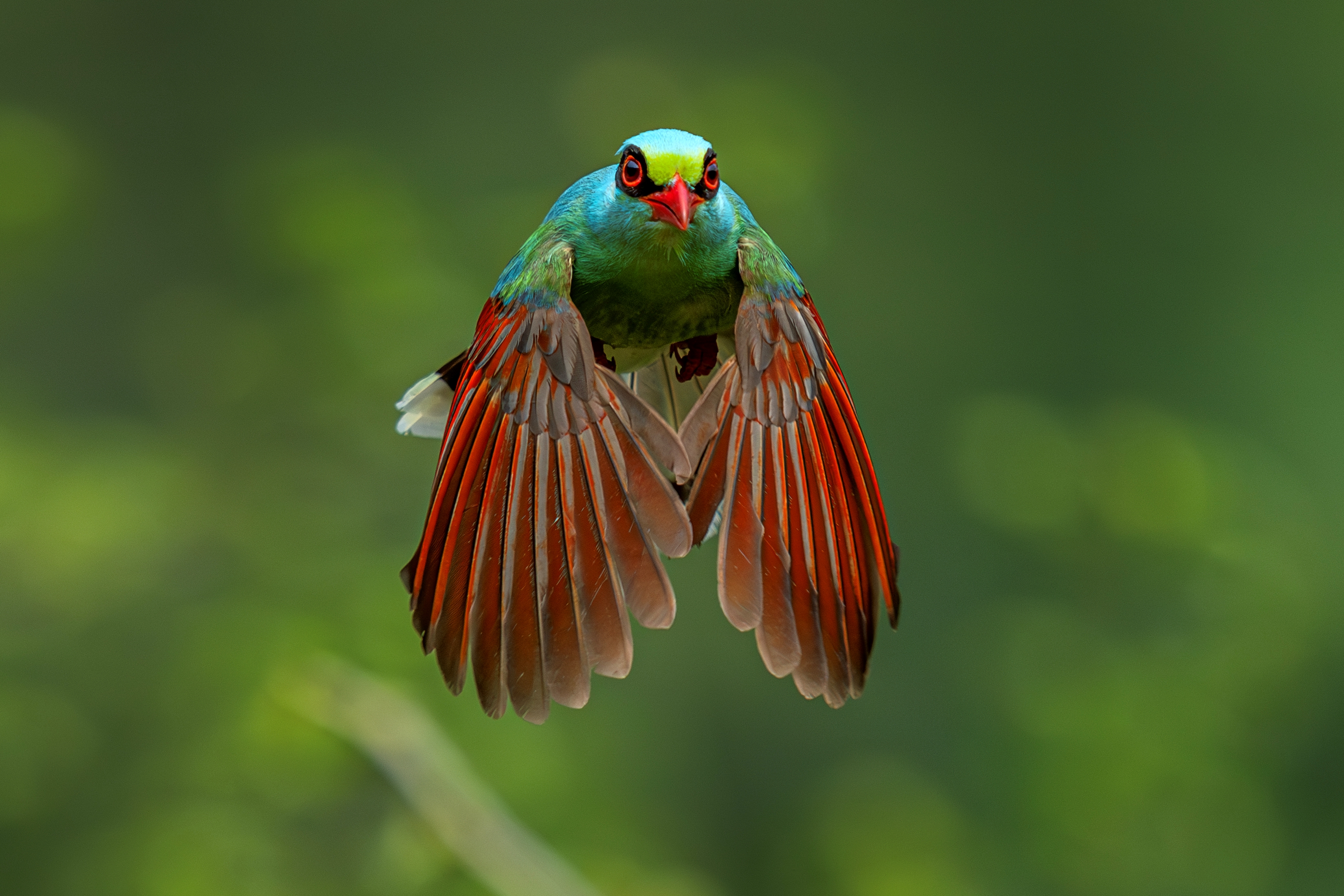
Common green magpie flying towards the camera.M2 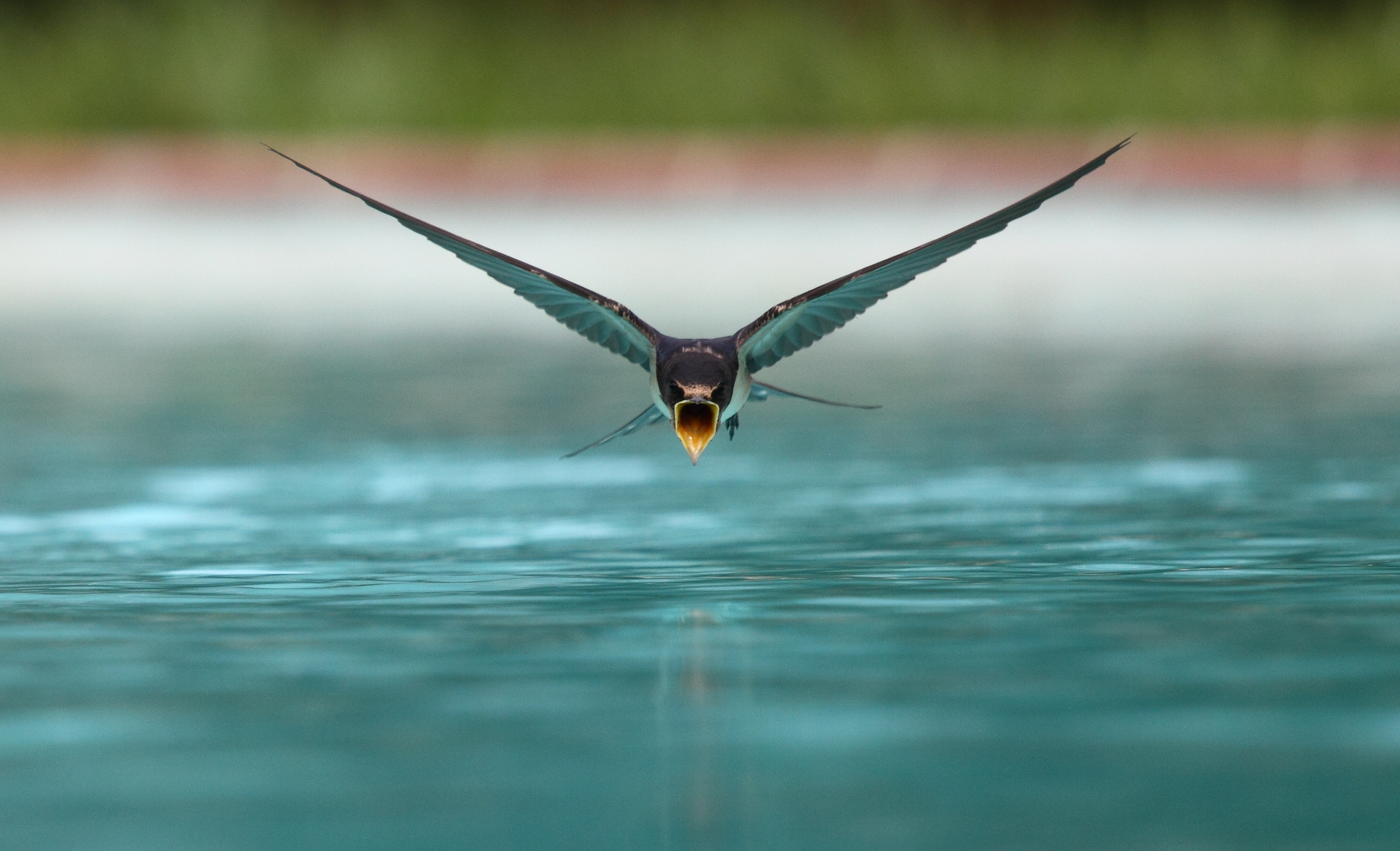
Swallow flying while drinking.M3 Feedback
References
-
1.How Do Airplanes Actually Fly?Raymond Adkins · TED-Ed · 2023
Media Credits
-
M1Front view of a barn owl in flightDannymoore1973& minor edits by Subsidiary account · Wikimedia Commons · 2015 · CC0
-
M2Common green magpie in flightDasrath Shrestha Beejukchhen · Wikimedia Commons · 2024 · CC BY-SA 4.0
-
M3Swallow flying drinkingsanchezn · Wikimedia Commons · 2012 · CC BY-SA 3.0
How to Cite: Sinha, R. (2026). Bird front view. Amazing Birds. https://amazing-birds.gitlab.io/GenAI Assistance: Some content and materials on this page may have been developed with GenAI assistance; all content was reviewed, edited, and integrated by the author(s).
This page is an open educational resource (OER) licensed under a Creative Commons Attribution-NonCommercial-ShareAlike 4.0 International License.Feel free to use, link, or embed this page for non-commercial educational purposes with attribution. Please share any adaptations under the same CC BY-NC-SA 4.0 license.This page may include third-party images, videos, and other materials that have their own licenses and terms of use. Please verify before reusing these materials.Feedback: If you notice any accessibility issues, incorrect information, or have suggestions for improvement, please use the feedback form. -
-
Wing Beat (/wingbeat/)
Learning Byte Summary ▾
Learning Objectives (LOs):- Explain the difference between wingbeat frequency and wingbeat amplitude
- Describe why scientists measure both flap speed and flap size
- Connect bird wingbeat patterns to energy use during flight
Grade level: Middle schoolDuration: 8 minKey ideas: Wingbeat frequency; Wingbeat amplitude; Flight power; Bio-logging sensorsThe big idea
When a bird flies, it does not always flap its wings in the same way. Sometimes it needs a small, steady flap. Other times, such as during takeoff or climbing, it needs a much more powerful flap.
Scientists study wingbeats because wing motion gives clues about how much energy a bird is using in flight 1 .
Domestic pigeon flightM1 Two parts of a wingbeat
A wingbeat has two important parts:
Term Simple meaning What to imagine Wingbeat frequency How fast the wings flap Counting how many flaps happen each second Wingbeat amplitude How big each flap is Looking at whether the wings move through a small or large stroke Frequency is about speed.
Amplitude is about size.
Faster is not always the whole answer
It might seem like a bird can get more flight power by only flapping faster. But the research shows that this is not always enough.
For demanding flight, birds often change the size of the wingbeat too. During actions like takeoff, climbing, hovering, or carrying extra weight, a bird may use a deeper and wider flap. That bigger flap can help produce more force.
How scientists measure wingbeats
Measuring a flying bird in the wild is difficult. Scientists cannot easily use high-speed cameras for every bird in every place.
Instead, researchers can use tiny body-mounted sensors called accelerometers. These sensors are like the motion sensors inside a phone or smartwatch. They measure how the bird’s body moves up and down during each wingbeat.
When a bird makes a bigger wing stroke, its body often moves with a stronger up-and-down signal. Scientists use that body-motion signal as a clue, or proxy, for wingbeat amplitude.
What researchers found
Researchers studied data from 14 bird species flying in the wild, plus pigeons and a dunlin flying in wind tunnels.
They found three important things:
-
Flap speed and flap size are related, but not perfectly. Birds that flap faster often flap bigger too, but the connection is not strong enough to use speed alone.
-
Bigger flaps matter during hard flight. When flight needs more power, birds often increase wingbeat amplitude.
-
Better energy estimates need both measurements. To understand flight effort, scientists should look at both wingbeat frequency and wingbeat amplitude.
Why this matters
Wingbeats help scientists understand how much energy birds spend while migrating, foraging, climbing, or taking off.
This also matters for engineering. If engineers want to design better flapping drones or bird-inspired robots, they need to think about both parts of a flap: how fast the wing moves and how far it moves.
Quick check
If two birds flap at the same speed, could one still be using more flight power than the other? Yes. One bird might be using a larger wingbeat amplitude, which can require more effort and produce more force.
References
-
1.The role of wingbeat frequency and amplitude in flight powerKrishnamoorthy Krishnan and others · Journal of the Royal Society Interface · 2022 · Vol. 19(193), p. 20220168 · CC BY 4.0
Media Credits
-
M1Domestic pigeon flightDerivative work Tony Wills, rearragned by Toby Hudson · Wikimedia Commons · 2009 · CC BY-SA 3.0
How to Cite: Sinha, R. (2026). Wing Beat. Amazing Birds. https://amazing-birds.gitlab.io/GenAI Assistance: Some content and materials on this page may have been developed with GenAI assistance; all content was reviewed, edited, and integrated by the author(s).
This page is an open educational resource (OER) licensed under a Creative Commons Attribution-NonCommercial-ShareAlike 4.0 International License.Feel free to use, link, or embed this page for non-commercial educational purposes with attribution. Please share any adaptations under the same CC BY-NC-SA 4.0 license.This page may include third-party images, videos, and other materials that have their own licenses and terms of use. Please verify before reusing these materials.Feedback: If you notice any accessibility issues, incorrect information, or have suggestions for improvement, please use the feedback form.
4. Meet LisEagle
A special bird-like drone
-
Research Case 1: Story of LisEagle (/researchcase/)
Learning Byte Summary ▾
Learning Objectives (LOs): summarize the LisEagle research case and why adaptive morphing mattersGrade level: Middle schoolDuration: ~10 minKey ideas: Adaptive morphing; Control complexity; Efficiency gainsResearch Case — Adaptive Morphing in Birds
Meet LisEagle
LisEagle is an avian-inspired drone designed to use many degrees of freedom in its wings and tail, much like a real bird.
Real birds can adapt the shape of their wings and tail to stay stable in gusty air. LisEagle is interesting because researchers tried to give a drone some of that same adaptability.
LisEagle robustness against physical perturbations, turbulent airflow, and control loss on some DoFM1 Why is LisEagle challenging to control?
LisEagle is not a simple flying machine with only a few controls. It has many moving parts that can change shape during flight.
That creates two big challenges:
- the drone has many degrees of freedom
- the effect of one actuator can depend on what the other actuators are doing
This means the system has coupling effects. A change in one part of the drone can influence roll, yaw, pitch, and stability at the same time.
What did the researchers propose?
The researchers proposed a new control method that uses all of the drone’s degrees of freedom instead of simplifying the drone into a smaller set of easy controls.
Their method was designed to:
- use the full shape-changing ability of the drone
- account for state dependencies
- handle coupling between actuators
- keep the drone stable in a controlled indoor setting
What could LisEagle do?
With this control approach, LisEagle was able to:
- maintain stable flight in turbulent airflow
- use wing and tail shape changes to stay steady
- recover from physical perturbations around roll, yaw, and pitch
- remain airborne even when two control surfaces were blocked midair
That last result is especially important. It shows that the drone could compensate for failures in a way that starts to resemble how birds adapt in changing conditions.
Why does this matter for efficiency?
The work was not only about stability. The researchers also explored energy efficiency.
Using Bayesian Optimization onboard, the drone learned which wing and tail configuration used the least power. This improved energy efficiency by up to 11.5%.
So the project shows that shape-changing flight is not only about control. It can also help a drone fly more efficiently.
Key ideas from LisEagle
- Birds use wing and tail shape changes to remain stable.
- Avian-inspired drones can be given similar flexibility.
- More flexibility creates more control complexity.
- Good controllers must handle coupling and state-dependent behavior.
- Adaptive morphing can improve both stability and energy efficiency.
Why this is an important research case
LisEagle is a strong example of engineering science because it combines:
- observation from nature
- modeling and control design
- testing in realistic flight conditions
- robustness against failure
- efficiency through learning and optimization
This work helps show why birds are such powerful inspirations for future flying machines.
ReflectionIn your own words, what is the main idea of Research Case?ReflectionSummarize what you have learned today.ReflectionWhat did you find most surprising or intriguing in this learning byte?Understanding CheckHow well do you understand: summarize the LisEagle research case and why adaptive morphing matters?1 out of 5Media Credits
-
M1Adaptive morphing of wing and tail for stable, resilient, and energy-efficient flight of avian-inspired drones (Supplementary Video 10)Simon Luis Jeger, Valentin Wüest, Charbel Toumieh & Dario Floreano · npj Robot 2, 8 (2024) · 2024 · CC BY 4.0
How to Cite: Sinha, R. (2026). Research Case. Amazing Birds. https://amazing-birds.gitlab.io/GenAI Assistance: Some content and materials on this page may have been developed with GenAI assistance; all content was reviewed, edited, and integrated by the author(s).
This page is an open educational resource (OER) licensed under a Creative Commons Attribution-NonCommercial-ShareAlike 4.0 International License.Feel free to use, link, or embed this page for non-commercial educational purposes with attribution. Please share any adaptations under the same CC BY-NC-SA 4.0 license.This page may include third-party images, videos, and other materials that have their own licenses and terms of use. Please verify before reusing these materials.Feedback: If you notice any accessibility issues, incorrect information, or have suggestions for improvement, please use the feedback form.
5. Designing a Bird Automaton
Wearing Avian Engineer's hat
-
Introduction to Design Challenge (/designchallenge/)
Learning Byte Summary ▾
Learning Objectives (LOs): describe the design challenge steps and pick a bird movement to prototypeGrade level: Middle schoolDuration: ~10 minKey ideas: Design challenge steps; Observing bird motion; Choosing a target movementWe learnt that engineering scientists are interested in learning about birds so that they can learn from them and design drones or robotic birds that can be used for various applications.
What are the areas do you think bird-like drones will be more useful than the drones we have now?
How do birds fly?
Let’s observe the video and image of birds below. How do you think birds fly?
Observe closely how they are flapping their wings.Video: "Flyingswallow" by Zachzr (CC BY-SA 4.0), via Wikimedia Commons
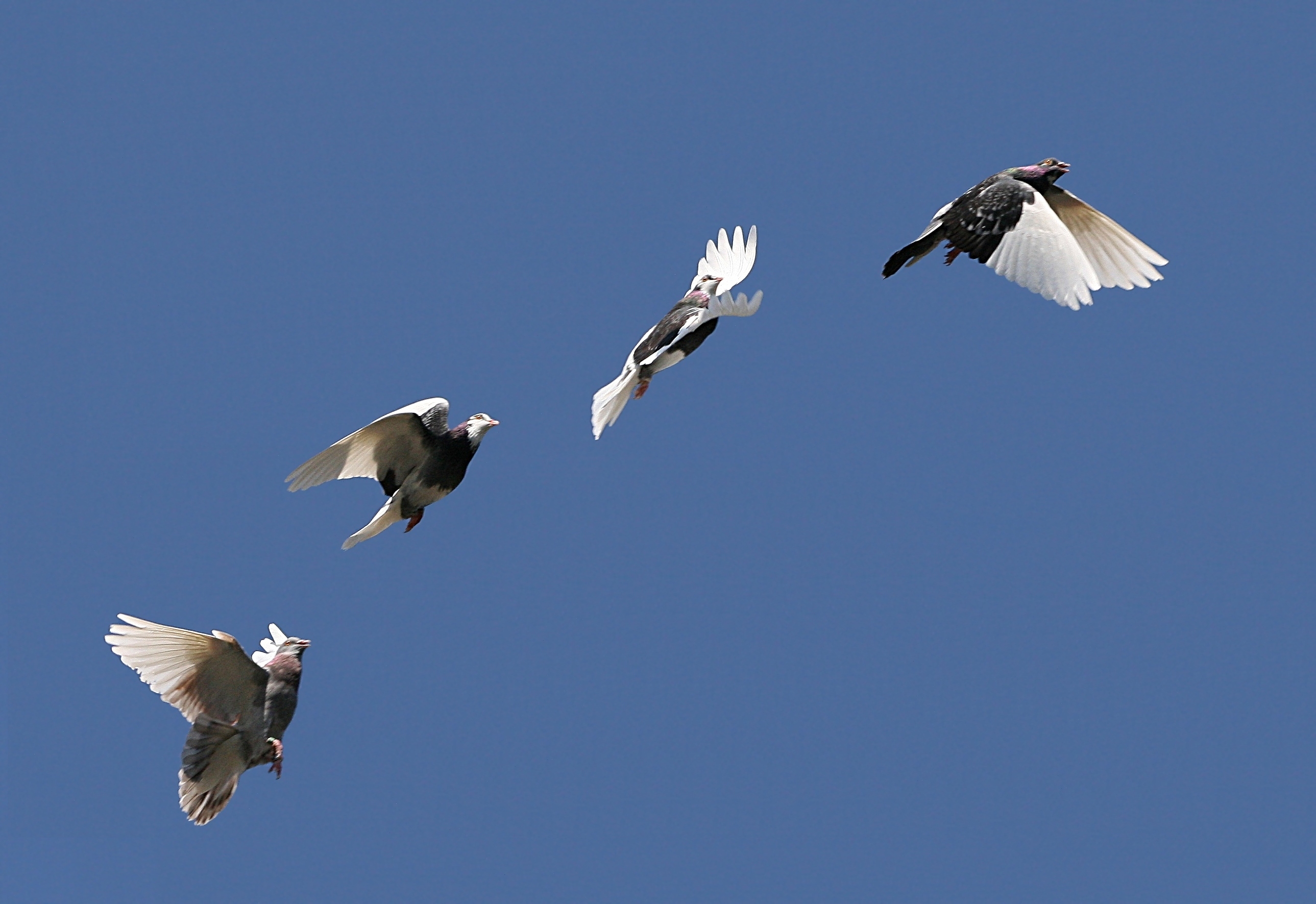
Image: "Domestic pigeon flight" by Toby Hudson; derivative work by Tony Wills (CC BY-SA 3.0), via Wikimedia Commons
Design Challenge
Now, let’s wear the hats of engineering scientists for a day!
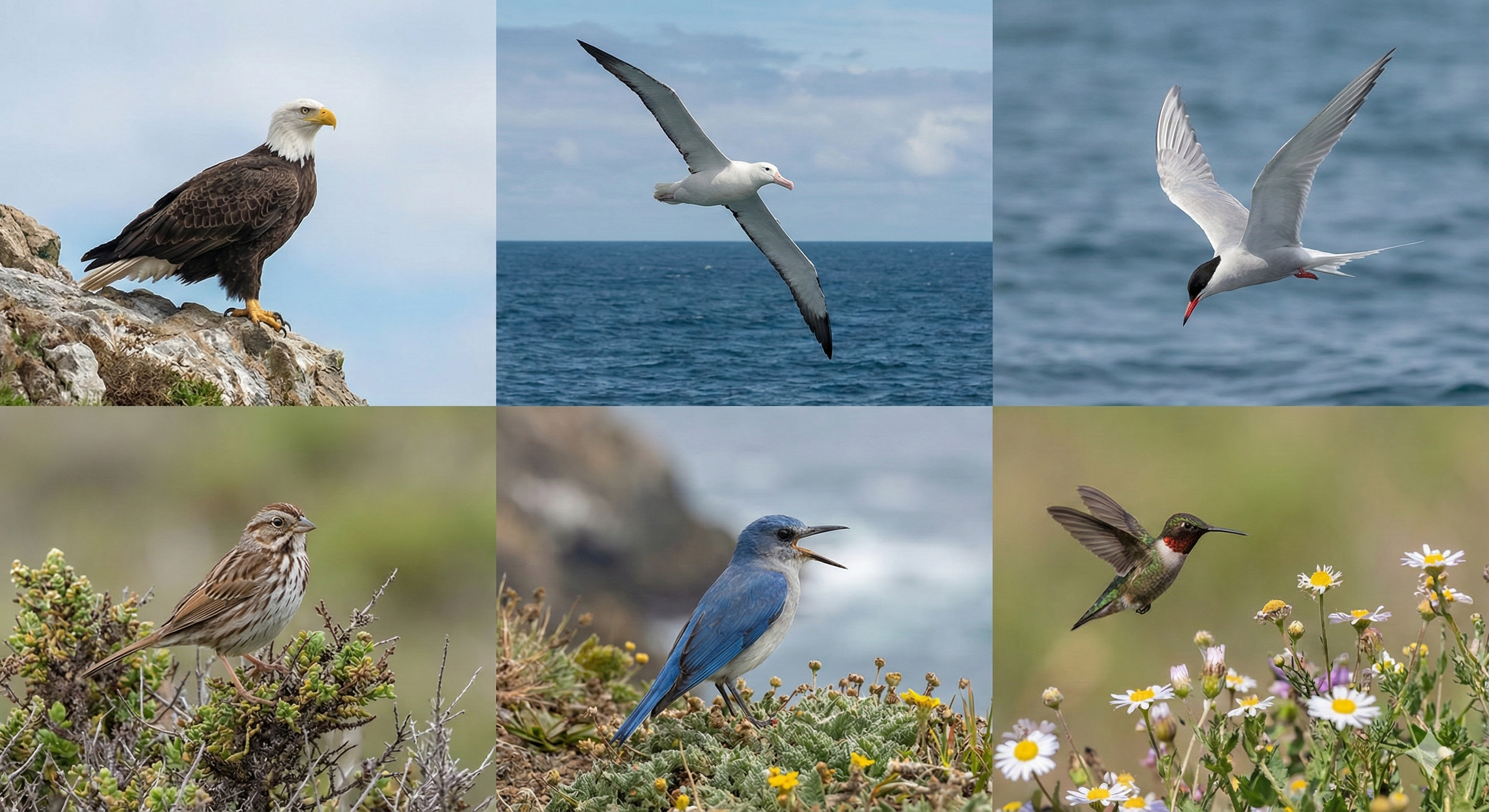
Pick a bird of your choice!
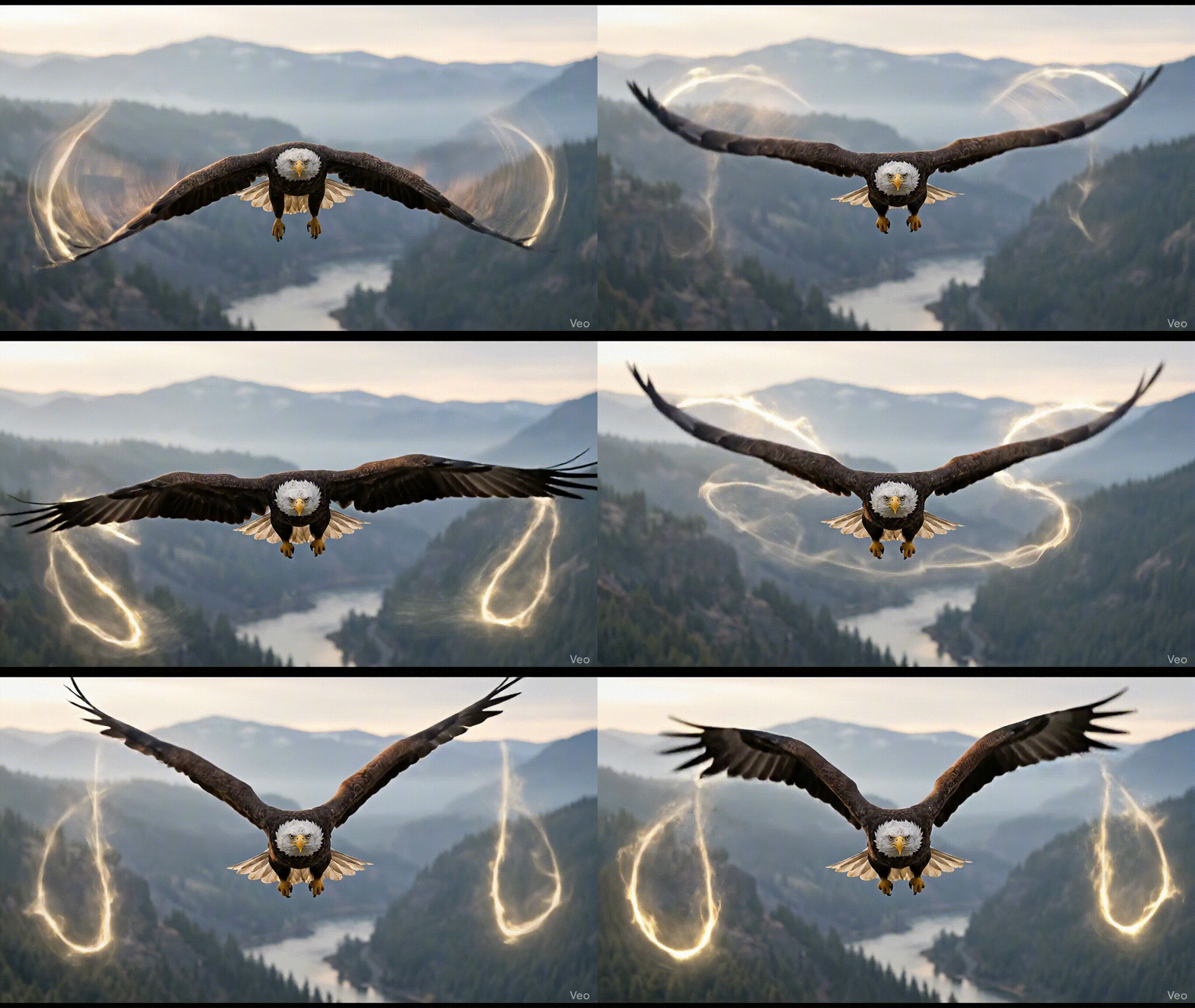
Observe how it flaps its wings!
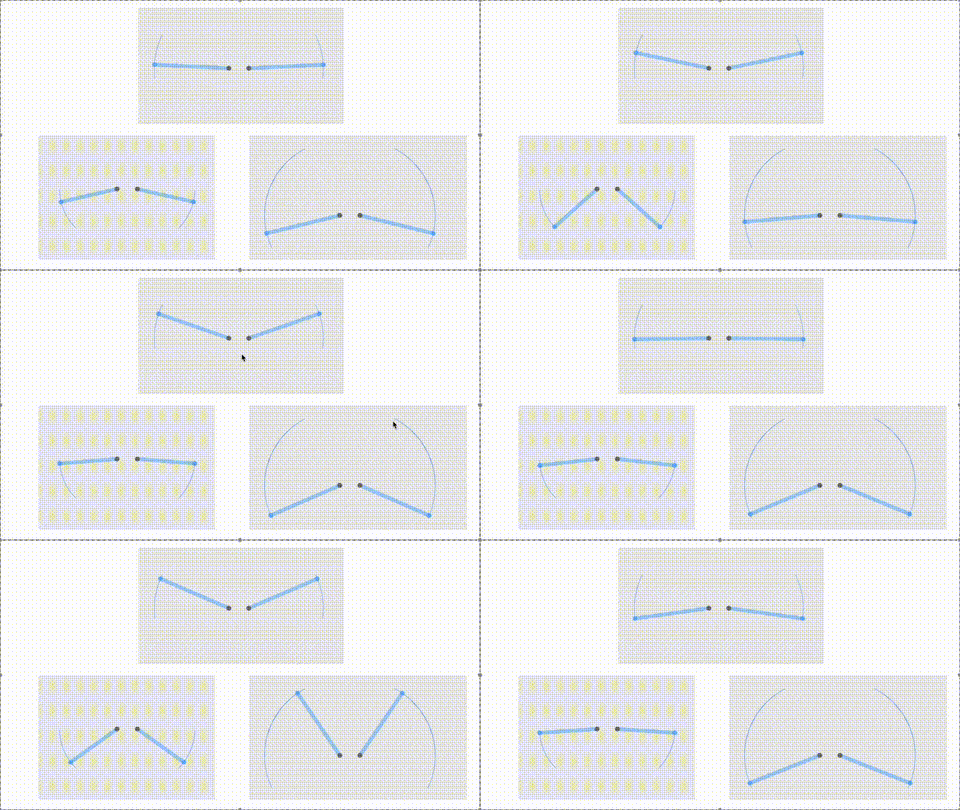
Decide your target movement to copy!
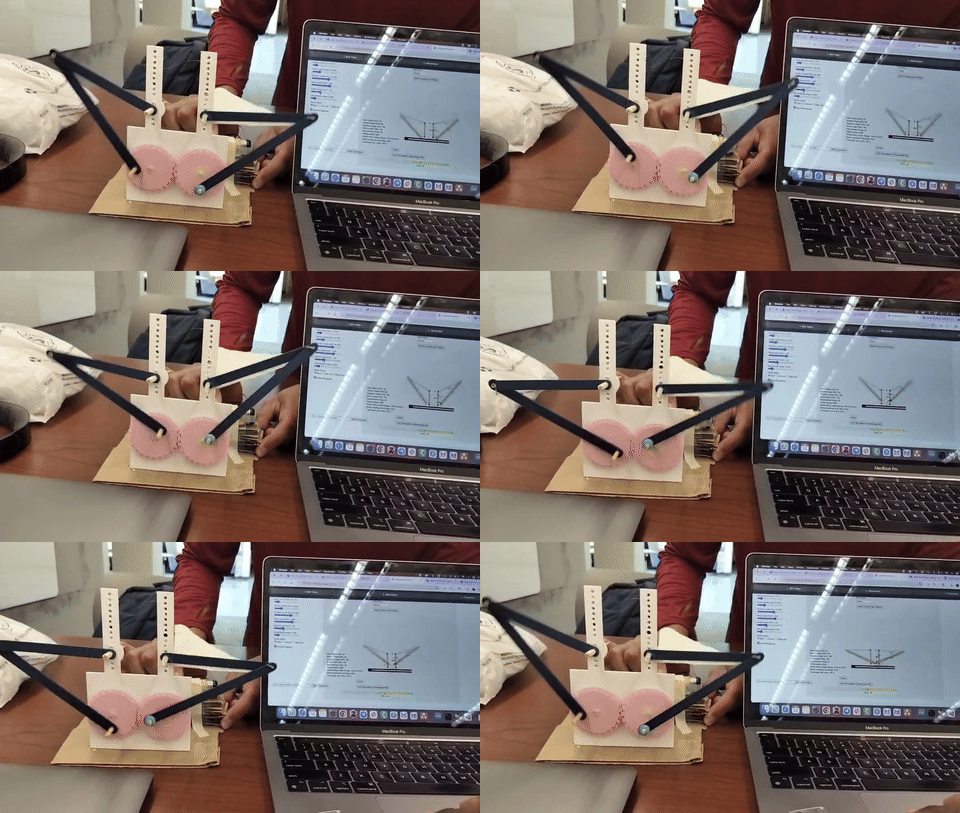
Design a robotic prototype that copies your chosen bird’s wing movement!
Brainstorm and sketch your ideas: What are the different ways you could make your robot flap its wings?
Overview of our design process!
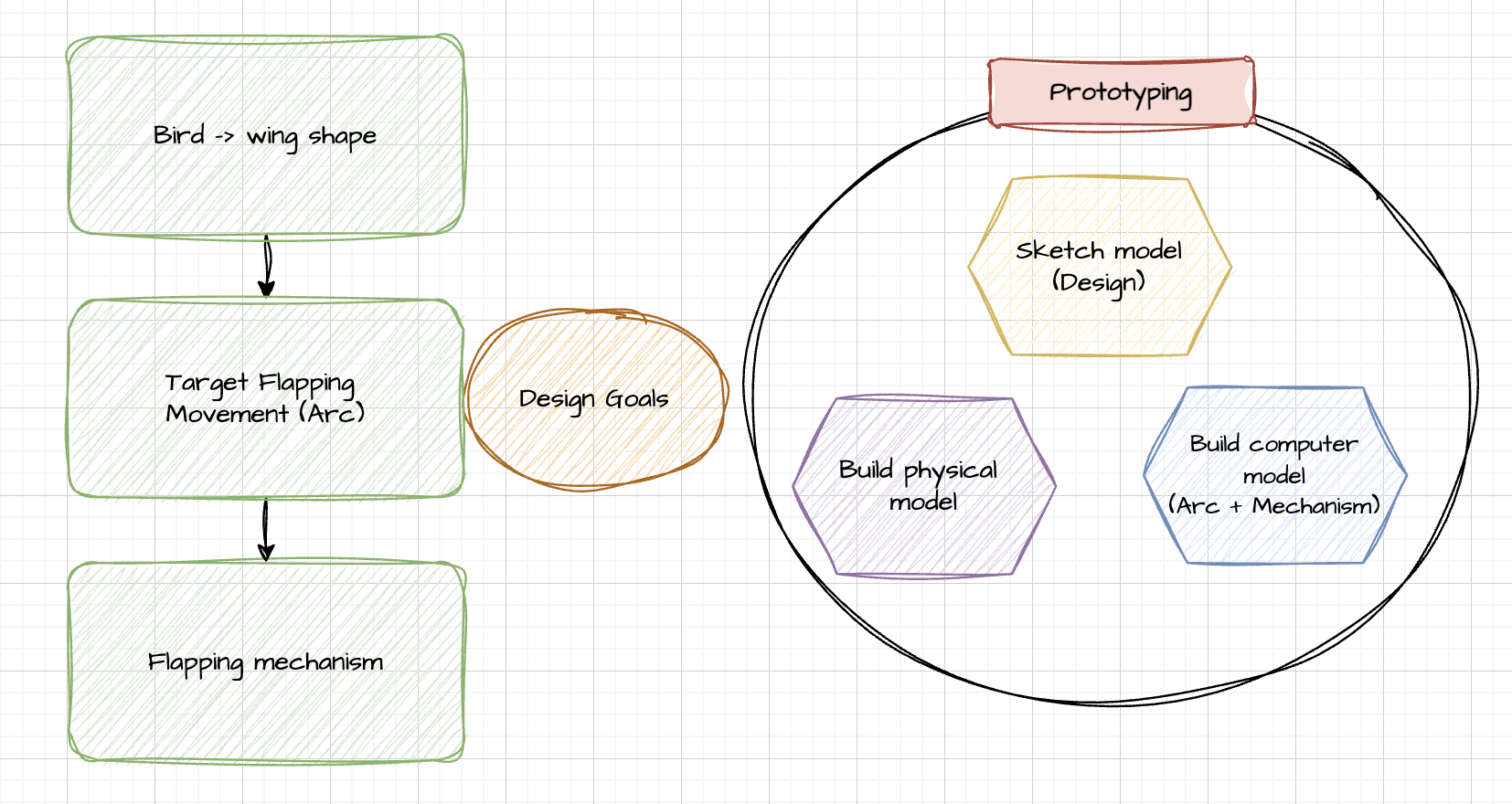 ReflectionIn your own words, what is the main idea of Design Challenge?ReflectionSummarize what you have learned today.ReflectionWhat did you find most surprising or intriguing in this learning byte?Understanding CheckHow well do you understand: describe the design challenge steps and pick a bird movement to prototype?1 out of 5How to Cite: Sinha, R. (2026). Design Challenge. Amazing Birds. https://amazing-birds.gitlab.io/GenAI Assistance: Some content and materials on this page may have been developed with GenAI assistance; all content was reviewed, edited, and integrated by the author(s).
This page is an open educational resource (OER) licensed under a Creative Commons Attribution-NonCommercial-ShareAlike 4.0 International License.Feel free to use, link, or embed this page for non-commercial educational purposes with attribution. Please share any adaptations under the same CC BY-NC-SA 4.0 license.This page may include third-party images, videos, and other materials that have their own licenses and terms of use. Please verify before reusing these materials.Feedback: If you notice any accessibility issues, incorrect information, or have suggestions for improvement, please use the feedback form.
ReflectionIn your own words, what is the main idea of Design Challenge?ReflectionSummarize what you have learned today.ReflectionWhat did you find most surprising or intriguing in this learning byte?Understanding CheckHow well do you understand: describe the design challenge steps and pick a bird movement to prototype?1 out of 5How to Cite: Sinha, R. (2026). Design Challenge. Amazing Birds. https://amazing-birds.gitlab.io/GenAI Assistance: Some content and materials on this page may have been developed with GenAI assistance; all content was reviewed, edited, and integrated by the author(s).
This page is an open educational resource (OER) licensed under a Creative Commons Attribution-NonCommercial-ShareAlike 4.0 International License.Feel free to use, link, or embed this page for non-commercial educational purposes with attribution. Please share any adaptations under the same CC BY-NC-SA 4.0 license.This page may include third-party images, videos, and other materials that have their own licenses and terms of use. Please verify before reusing these materials.Feedback: If you notice any accessibility issues, incorrect information, or have suggestions for improvement, please use the feedback form. -
Meet Mochi - the Albatross (/mochi/)
Learning Byte Summary ▾
Learning Objectives (LOs): explain how an albatross uses long, narrow wings to glide efficiently and why that matters for designGrade level: Middle schoolDuration: 10 minKey ideas: Albatross flight; Wing shape and glide; Dynamic soaring; Energy-efficient flightMochi is our albatross inspiration for the design challenge. Albatrosses are famous for their long wings, efficient gliding, and graceful flight over long distances with a very interesting flight technique, known as active soaring.
Watch an Albatross take-off
Meet Mochi
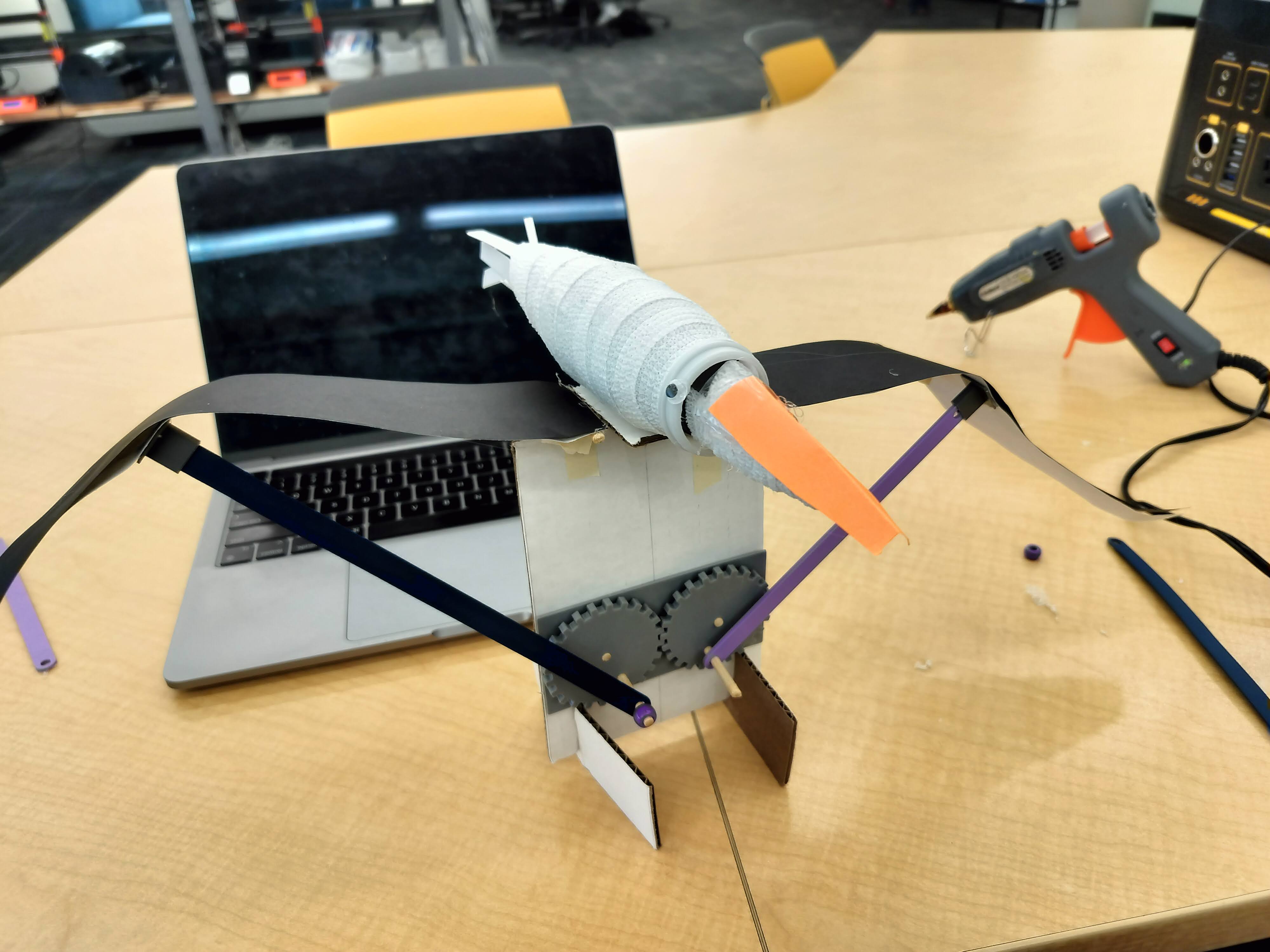
Short Reflection Sheet
Take a moment to jot down a quick response to each question.
- What do you notice first about Mochi’s wing design or the way an albatross moves through the air?
- How could that design idea help engineers build a better drone?
Let’s learn about Albatross!
- Seabird: Albatrosses spend most of their lives over open ocean.
- Longest wingspan: The wandering albatross reaches about 10–12 ft (3–3.7 m).
- Wing lock: They can lock their wings during flight. This keeps the wings spread for soaring and gliding with little effort. They can travel 500+ km in a single day while searching for food.
- Diet: Squid is a favorite food.
- Range: Mostly found in the southern oceans, using wind and waves to travel long distances.
- Wing design: Sleek, narrow wings with a very long length compared to width—built to save energy.
- Speed: Can fly around 70 mph with good winds.
- Calm days: If winds are weak, they may wait and fly when conditions improve.
Quick Check
Which wing shape helps an albatross glide efficiently over long distances?
Pause and think:
- Why would a long, narrow wing be more useful over the ocean than a short, wide wing?
Dynamic soaring (how they use wind to fly long distance)
- Extracts energy from winds above ocean waves.
- Near the surface, wind speed is close to 0.
- About 10–20 m above the ocean, wind speed increases (a wind gradient).
- The bird flies a repeating S‑shaped path: windward ascent → turn → leeward descent → sharp turn → repeat.
- They trade potential energy for kinetic energy, then convert it back to climb again.
- No flapping needed during the cycle.
Quick Check
Dynamic soaring helps an albatross because it:
What comes right after a windward ascent in the dynamic soaring cycle?
Pause and think:
- Why is it helpful that wind speed changes between the ocean surface and the air above it?
- What would happen to this flight strategy on a calm day with very little wind?
Takeoff and glide efficiency
- Takeoff: They need to run and face the wind to get airborne.
- Glide ratio: About 22:1 (roughly 22 m forward for 1 m of descent).
- Wing adaptation: High glide ratio is a key adaptation for long‑distance travel.
Quick Check
A glide ratio of 22:1 means the bird can:
Why is wing lock useful during long flights?
Pause and think:
- If a drone copied this kind of glide efficiency, what might it save during a long trip?
Color pattern and why it matters
- Adults: Dark upper wings with white patterns.
- Counter‑shading: Dark above and light below.
- Camouflage: blends with dark sea from above and bright sky from below.
- Mechanical strength and UV protection from melanin‑rich dark feathers.
- Thermal effect: darker upper wings can be ~10° warmer than the underside, heating air above the wing and supporting low‑pressure lift.
What do you think?
- Which albatross idea seems most useful for future drones: wing shape, wing lock, dynamic soaring, or camouflage?
- What is one design feature you would borrow from Mochi if you were sketching your own drone?
Learning Checkpoint
Try a few different checkpoint styles below. These are here to help us test how the worksheet captures different kinds of responses across the same resource.
Multiple ChoiceWhich idea best explains why albatrosses can travel far with very little flapping?
Fill in the BlanksFill in the missing words from the Mochi page.Albatross wings are long and ____.Dynamic soaring helps the bird gain energy from changing ____ speeds.A glide ratio of 22:1 means the bird moves far ____ while losing little height.True or False-
Albatrosses usually need strong ocean winds to make long-distance soaring easier.
-
Dynamic soaring requires continuous flapping during the whole cycle.
OrderingPut the dynamic soaring cycle in the correct order.-
Windward ascent
-
Turn
-
Leeward descent
-
Sharp turn
MatchingMatch the flight idea to what it helps the bird do.Wing lockHigh glide ratioDynamic soaringReflectionWhat did you find most surprising or intriguing in this learning byte?ReflectionSummarize what you have learned today.Understanding CheckHow well do you understand: explain how an albatross uses long, narrow wings to glide efficiently and why that matters for design?1 out of 5ReflectionImagine you are designing a drone inspired by Mochi. Which one feature would you borrow first, and why?How to Cite: Sinha, R. (2026). Meet Mochi - the Albatross. Amazing Birds. https://amazing-birds.gitlab.io/GenAI Assistance: Some content and materials on this page may have been developed with GenAI assistance; all content was reviewed, edited, and integrated by the author(s).
This page is an open educational resource (OER) licensed under a Creative Commons Attribution-NonCommercial-ShareAlike 4.0 International License.Feel free to use, link, or embed this page for non-commercial educational purposes with attribution. Please share any adaptations under the same CC BY-NC-SA 4.0 license.This page may include third-party images, videos, and other materials that have their own licenses and terms of use. Please verify before reusing these materials.Feedback: If you notice any accessibility issues, incorrect information, or have suggestions for improvement, please use the feedback form. -
Versa Wing (/versa-wing/)
Learning Byte Summary ▾
Learning Objectives (LOs): observe a Versa Wing design and connect wing shape to flight behaviorGrade level: Middle schoolDuration: ~8 minKey ideas: Wing design; Flight observation; Prototype testing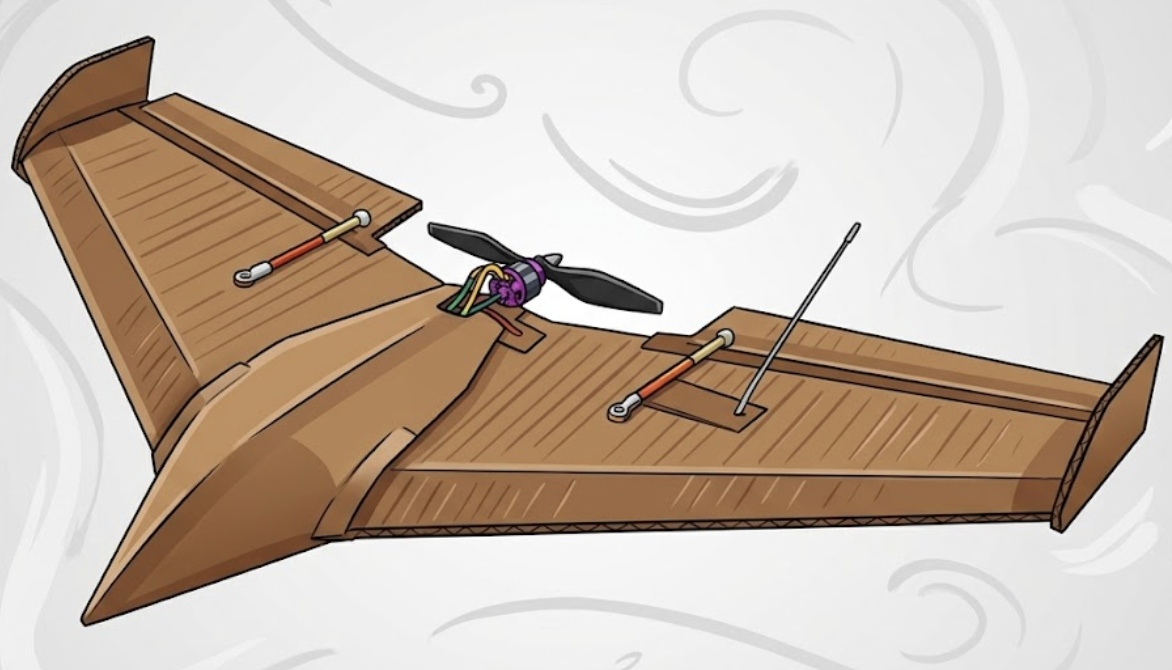
Graphic of a Versa Wing prototype.M1 Versa Wing video
Watch the Versa Wing segment and look for how the wing shape, balance, and launch affect the flight path.
Observe
- What do you notice about the wing shape?
- How does the design seem to stay balanced?
- What would you change if you were testing the next version?
Media Credits
-
M1Graphic of a Versa Wing prototypeRavi Sinha · Amazing Birds (original) · 2026 · CC BY-NC-SA 4.0
How to Cite: Sinha, R. (2026). Versa Wing. Amazing Birds. https://amazing-birds.gitlab.io/GenAI Assistance: Some content and materials on this page may have been developed with GenAI assistance; all content was reviewed, edited, and integrated by the author(s).
This page is an open educational resource (OER) licensed under a Creative Commons Attribution-NonCommercial-ShareAlike 4.0 International License.Feel free to use, link, or embed this page for non-commercial educational purposes with attribution. Please share any adaptations under the same CC BY-NC-SA 4.0 license.This page may include third-party images, videos, and other materials that have their own licenses and terms of use. Please verify before reusing these materials.Feedback: If you notice any accessibility issues, incorrect information, or have suggestions for improvement, please use the feedback form.
6. Choose your bird
Let's learn about birds and their wing forms
-
Bird Sound (/birdsound/)
Learning Byte Summary ▾
Learning Objectives (LOs): compare bird sizes and sounds and connect size to flight behaviorGrade level: Middle schoolDuration: ~6 minKey ideas: Bird size comparison; Wing span scale; Sound cues
SlvrHwk, CC BY-SA 4.0, via Wikimedia Commons 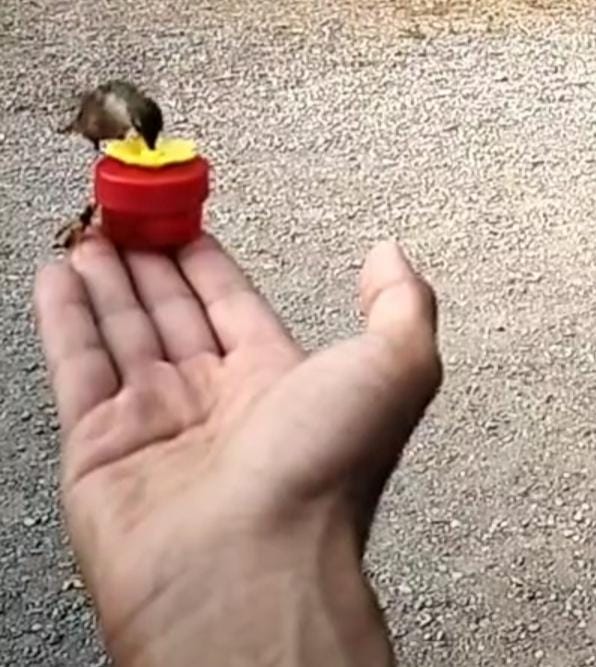
Hummingbird drinking sugar water. 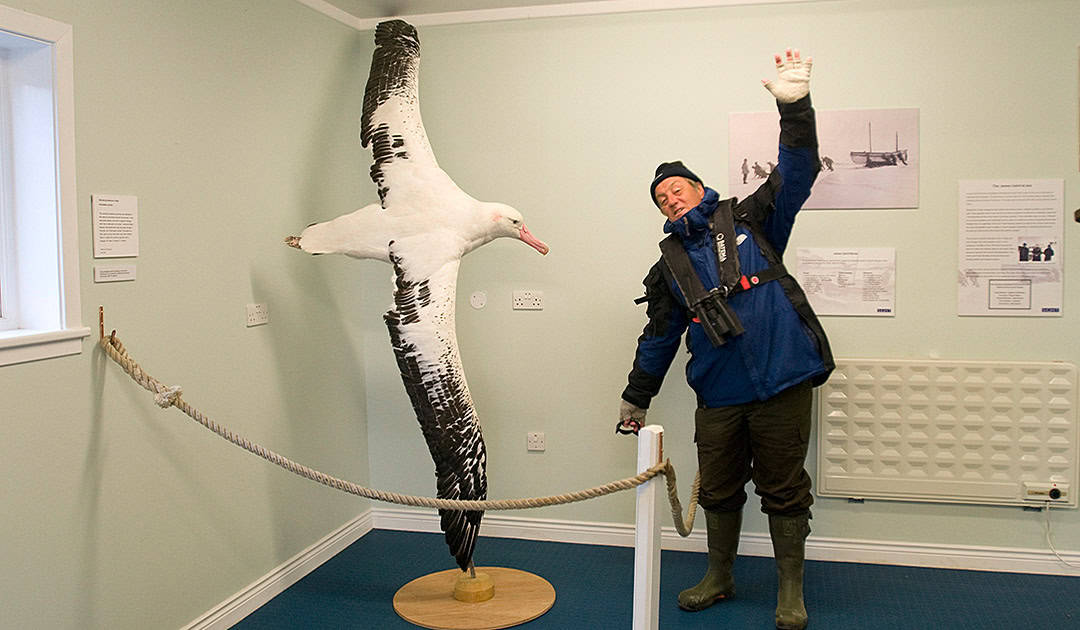
Photo courtesy: Wandering albatross at Museum of Grytviken. Credits: Heiner Kubny. Source: Polar Journal ReflectionIn your own words, what is the main idea of Bird Sound and Size?ReflectionSummarize what you have learned today.ReflectionWhat did you find most surprising or intriguing in this learning byte?Understanding CheckHow well do you understand: compare bird sizes and sounds and connect size to flight behavior?1 out of 5How to Cite: Sinha, R. (2026). Bird Sound and Size. Amazing Birds. https://amazing-birds.gitlab.io/GenAI Assistance: Some content and materials on this page may have been developed with GenAI assistance; all content was reviewed, edited, and integrated by the author(s).
This page is an open educational resource (OER) licensed under a Creative Commons Attribution-NonCommercial-ShareAlike 4.0 International License.Feel free to use, link, or embed this page for non-commercial educational purposes with attribution. Please share any adaptations under the same CC BY-NC-SA 4.0 license.This page may include third-party images, videos, and other materials that have their own licenses and terms of use. Please verify before reusing these materials.Feedback: If you notice any accessibility issues, incorrect information, or have suggestions for improvement, please use the feedback form. -
Bird Card (/birdcard/)
Learning Byte Summary ▾
Learning Objectives (LOs): match birds to wing types and explain how wing shape connects to flight styleGrade level: Middle schoolDuration: ~8 minKey ideas: Wing types; Bird comparisons; Flight stylesCheck your understanding
Albatross
What wing type is typical of the Albatross?
Albatrosses primarily use winds over the ocean to...
Bald Eagle
What wing type characterizes the Bald Eagle?
Bald eagles typically stay aloft by riding...
Tern
Terns are best matched with which wing type?
Which behavior is common for terns during foraging?
Sparrow
Sparrows have which wing type?
Elliptical wings help sparrows primarily with...
Hummingbird
Hummingbirds are known for which wing type?
What unique flight ability do hummingbirds have?
ReflectionIn your own words, what is the main idea of Know the Birds?ReflectionSummarize what you have learned today.ReflectionWhat did you find most surprising or intriguing in this learning byte?Understanding CheckHow well do you understand: match birds to wing types and explain how wing shape connects to flight style?1 out of 5How to Cite: Sinha, R. (2026). Know the Birds!. Amazing Birds. https://amazing-birds.gitlab.io/GenAI Assistance: Some content and materials on this page may have been developed with GenAI assistance; all content was reviewed, edited, and integrated by the author(s).
This page is an open educational resource (OER) licensed under a Creative Commons Attribution-NonCommercial-ShareAlike 4.0 International License.Feel free to use, link, or embed this page for non-commercial educational purposes with attribution. Please share any adaptations under the same CC BY-NC-SA 4.0 license.This page may include third-party images, videos, and other materials that have their own licenses and terms of use. Please verify before reusing these materials.Feedback: If you notice any accessibility issues, incorrect information, or have suggestions for improvement, please use the feedback form. -
Wing Shape (/wingshape/)
Learning Byte Summary ▾
Learning Objectives (LOs): describe common wing types and connect each shape to a flight behaviorGrade level: Middle schoolDuration: ~12 minKey ideas: Wing types; Soaring vs. flapping; Shape and functionDid you know that different birds have different wing shapes that help them fly in different ways? In general, there are four common wing types:

Common bird wing shape silhouettes.M1 Passive soaring wings
- These wing shapes are wide and have slots at the ends.
- Bald eagles have this wing type. These wings help them catch thermal updrafts and fly for long periods without much flapping. 1
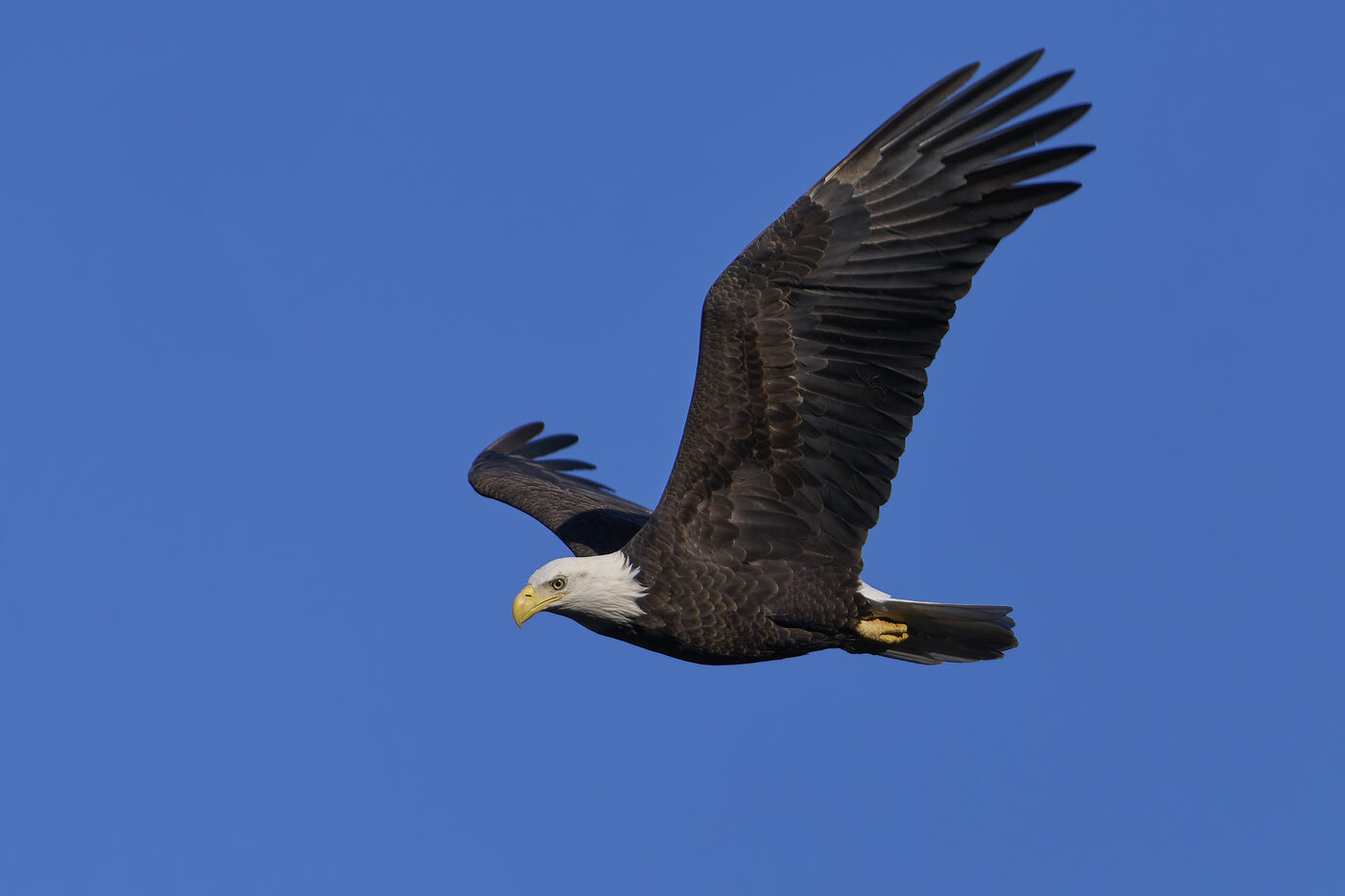
Bald eagle with passive soaring wings.M2 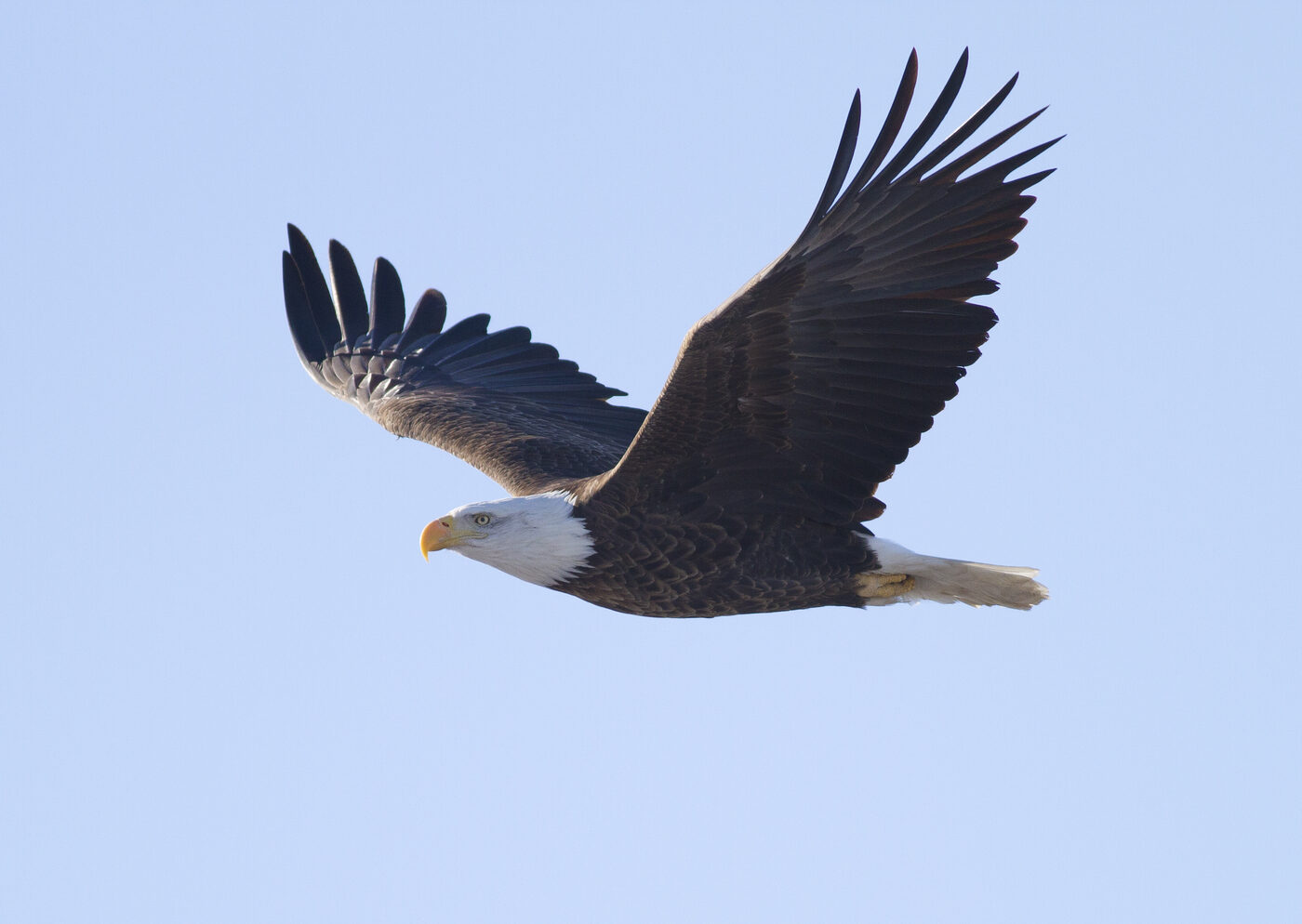
Bald eagle portrait.M3 Bald eagle in flight.M4 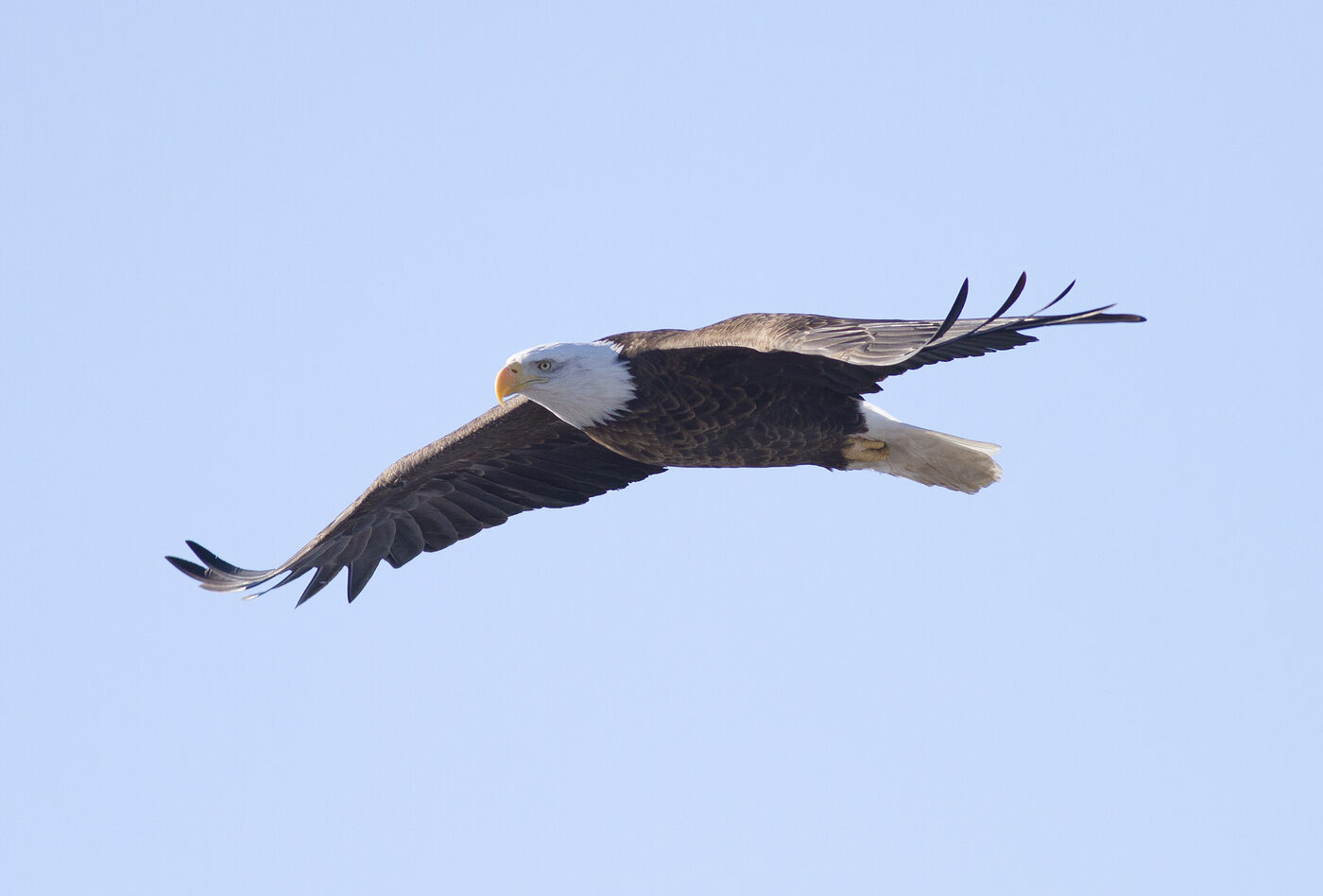
Bald eagle soaring.M5 Active soaring wings
- These wings are long and narrow.
- Albatrosses have this wing shape. It helps them fly long distances during migration without using much energy. These wings also help them use horizontal air currents, such as sea breezes. 2
Laysan albatross with active soaring wings.M6 Elliptical wings
- These wings are more rounded and broad. They help birds make quick turns and escape when attacked by predators.
- Sparrows and turkeys have this wing type. To stay in the air, these birds need to spend a lot of energy because they flap their wings often. 1 2
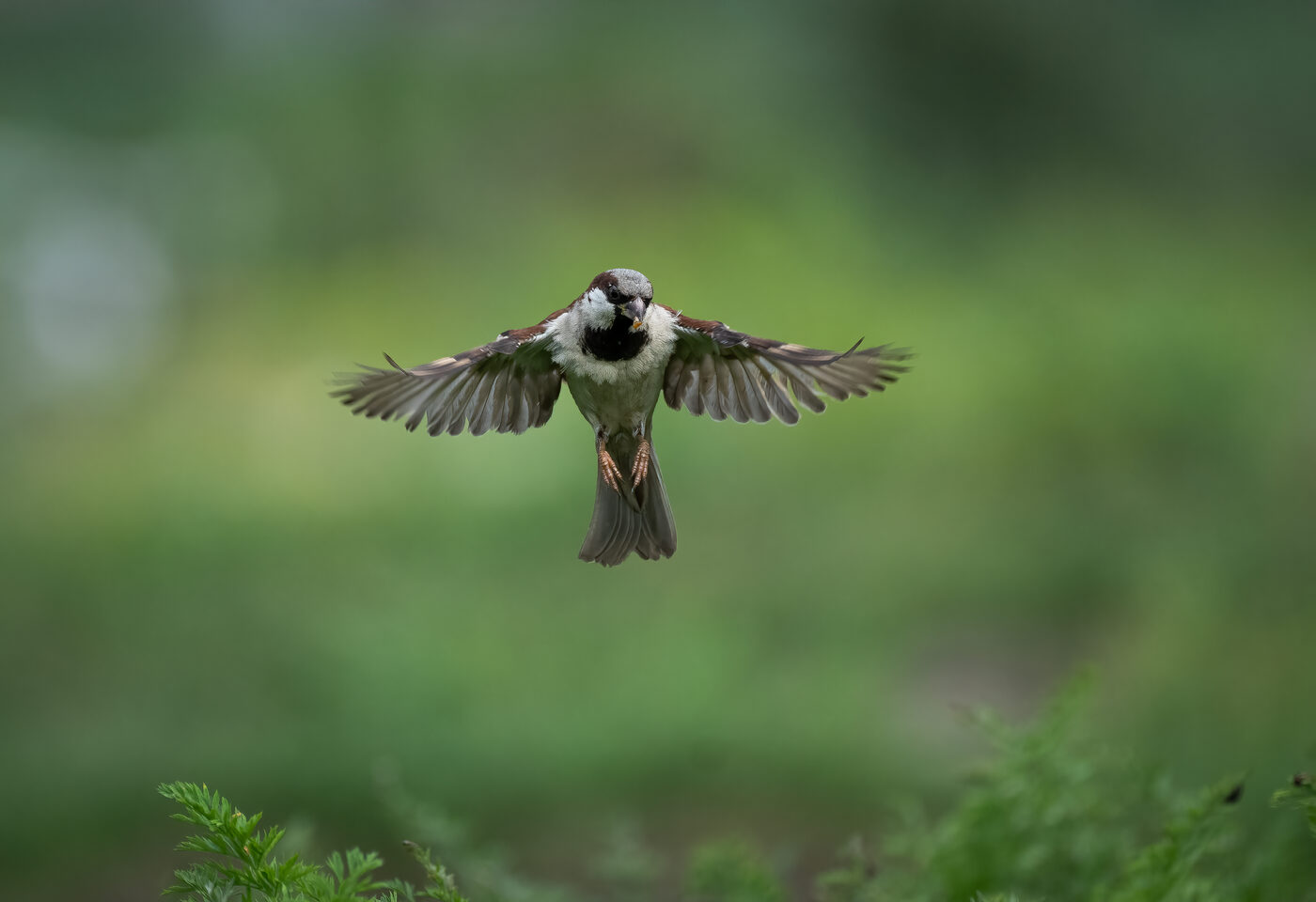
Sparrow showing elliptical wings.M7 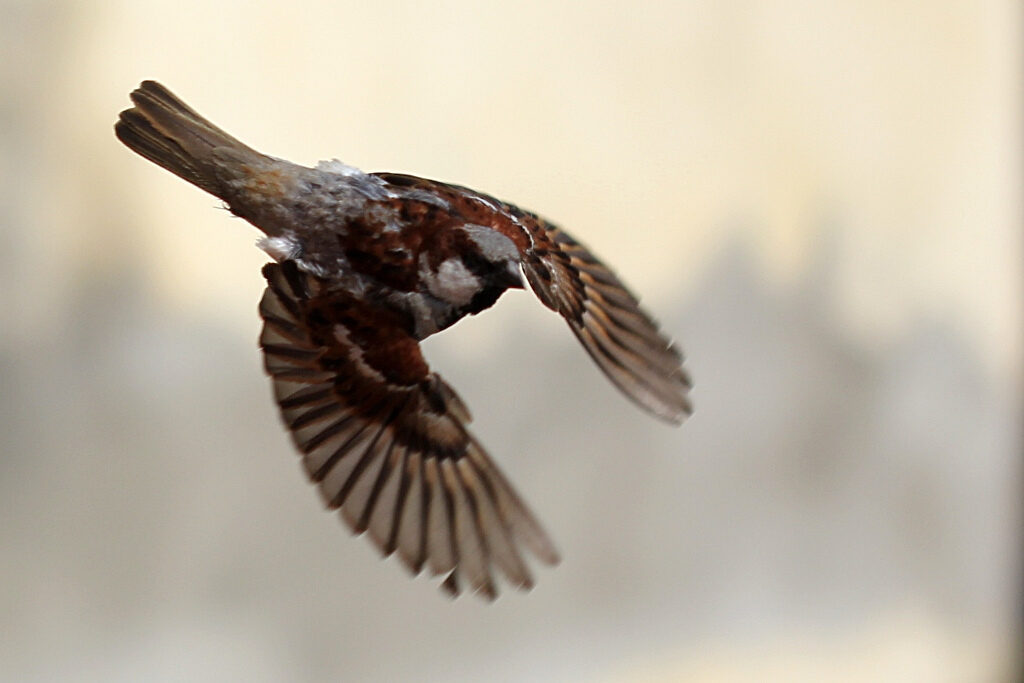
Sparrow wings in motion.M8 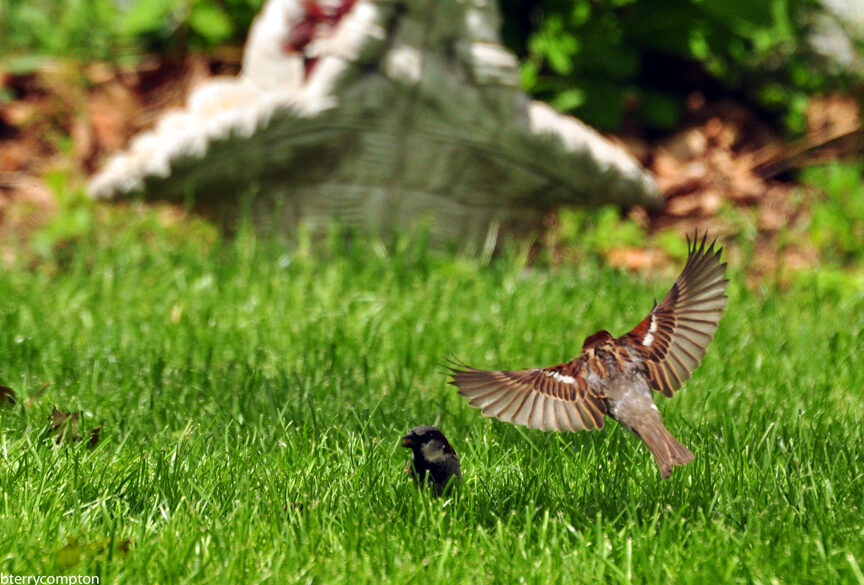
Sparrow in flight.M9 Close-up of a flying sparrow.M10 High-speed wings
- These wings are not as long as passive or active soaring wings, but they are still pointed at the ends. They help birds fly very fast. Like the name implies, high-speed wings are great for rapid movement. However, birds must spend lots of energy flapping to reach high speeds. This makes these wings useful for short bursts of speed, such as chasing flying prey or insects.
Common tern with high-speed wings.M11 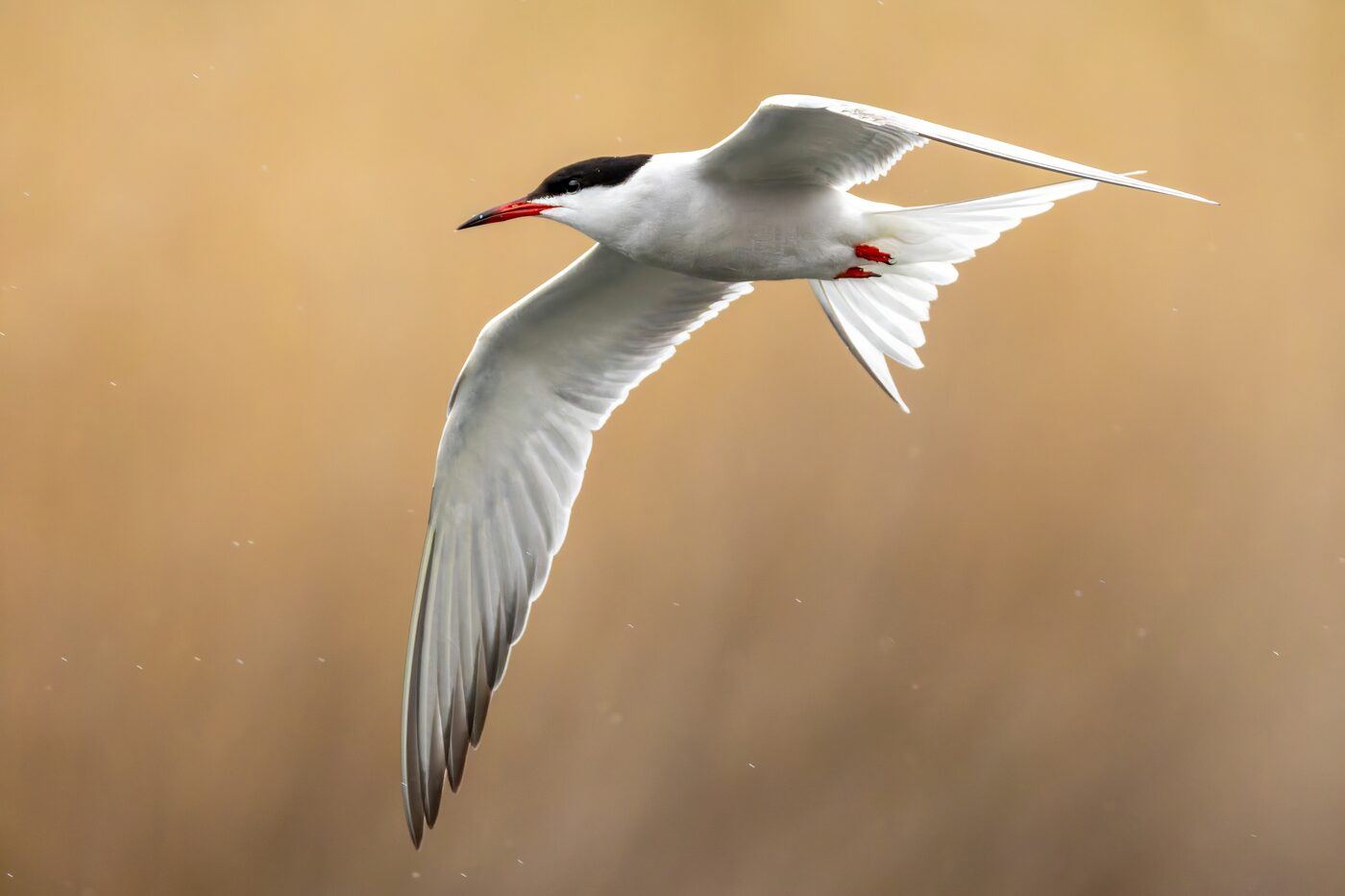
Common tern in flight.M12 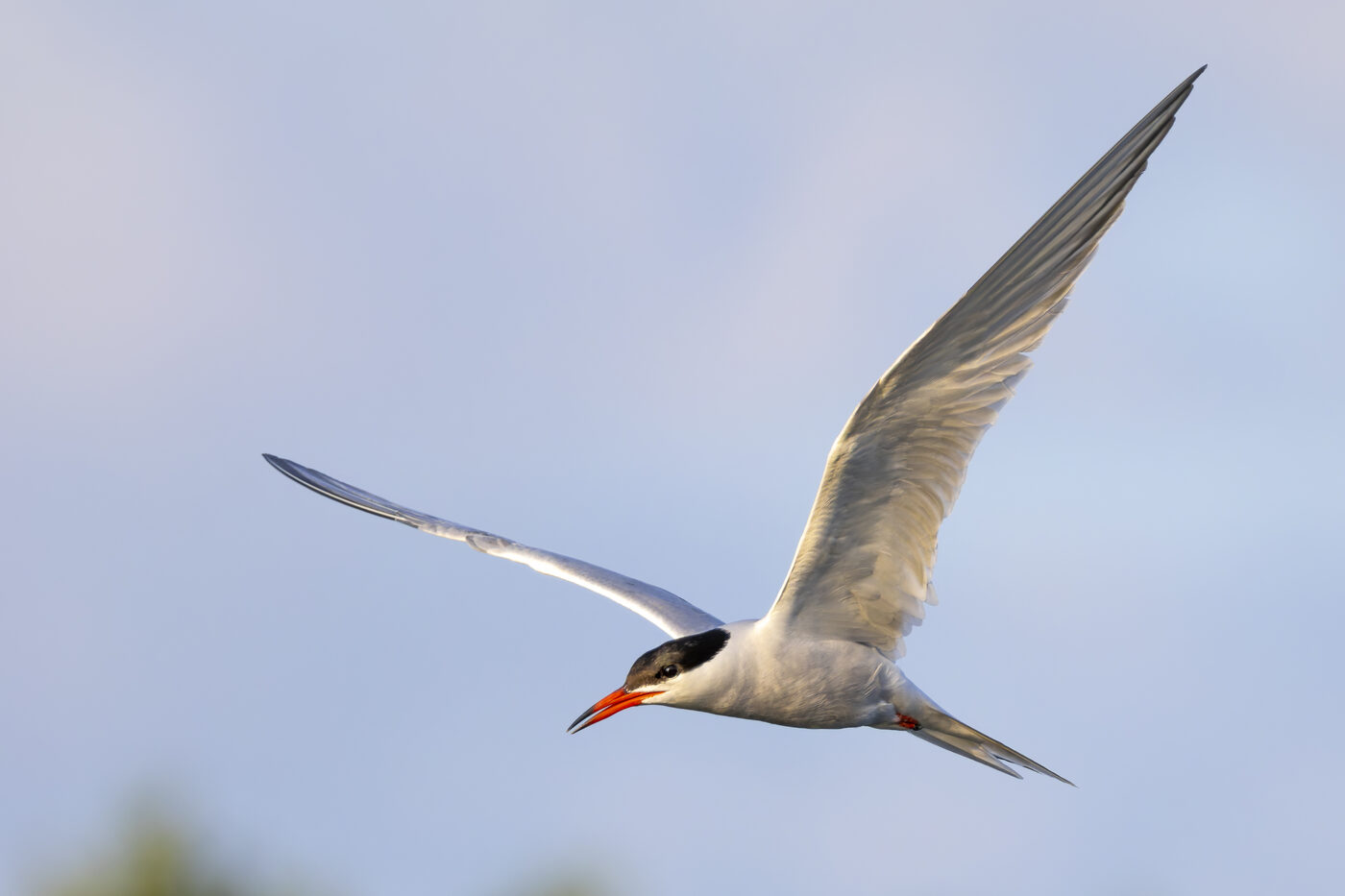
Common tern flying with pointed wings.M13 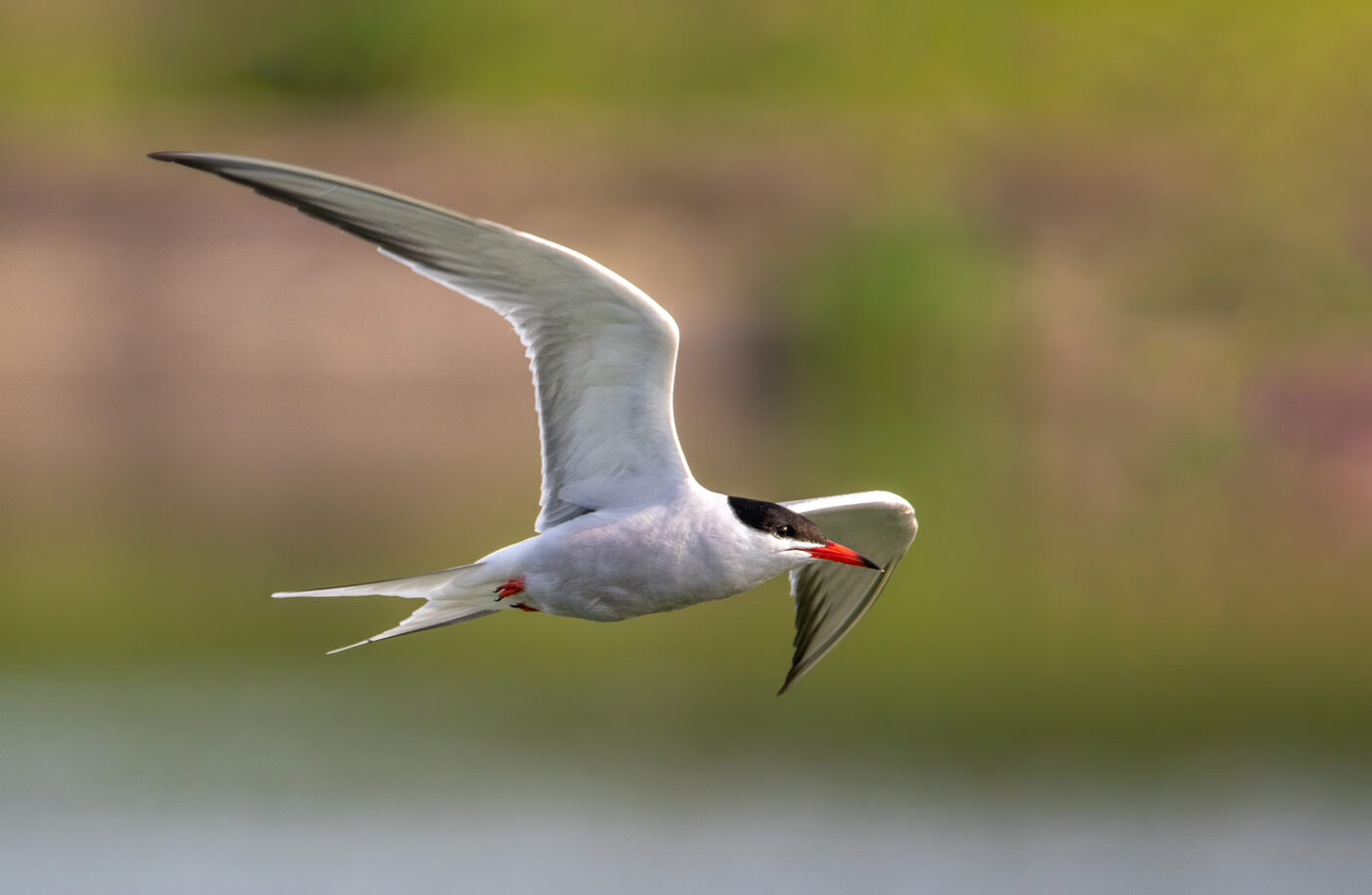
Common tern flying over water.M14 Hovering wings
- Imagine moving your arms backward and forward 80 times in one second! That’s how fast some hummingbirds flap their wings. Their wings are very small and super light.
- Their muscles are incredibly strong, and their reflexes are very sharp. Did you know they can fly backward too? If you ever get close to these birds, you can hear the sound they make when they flap their wings. It sounds like a high-speed fan. Hummingbirds move their wings in a figure-eight pattern, which helps them hover while drinking nectar from a flower.
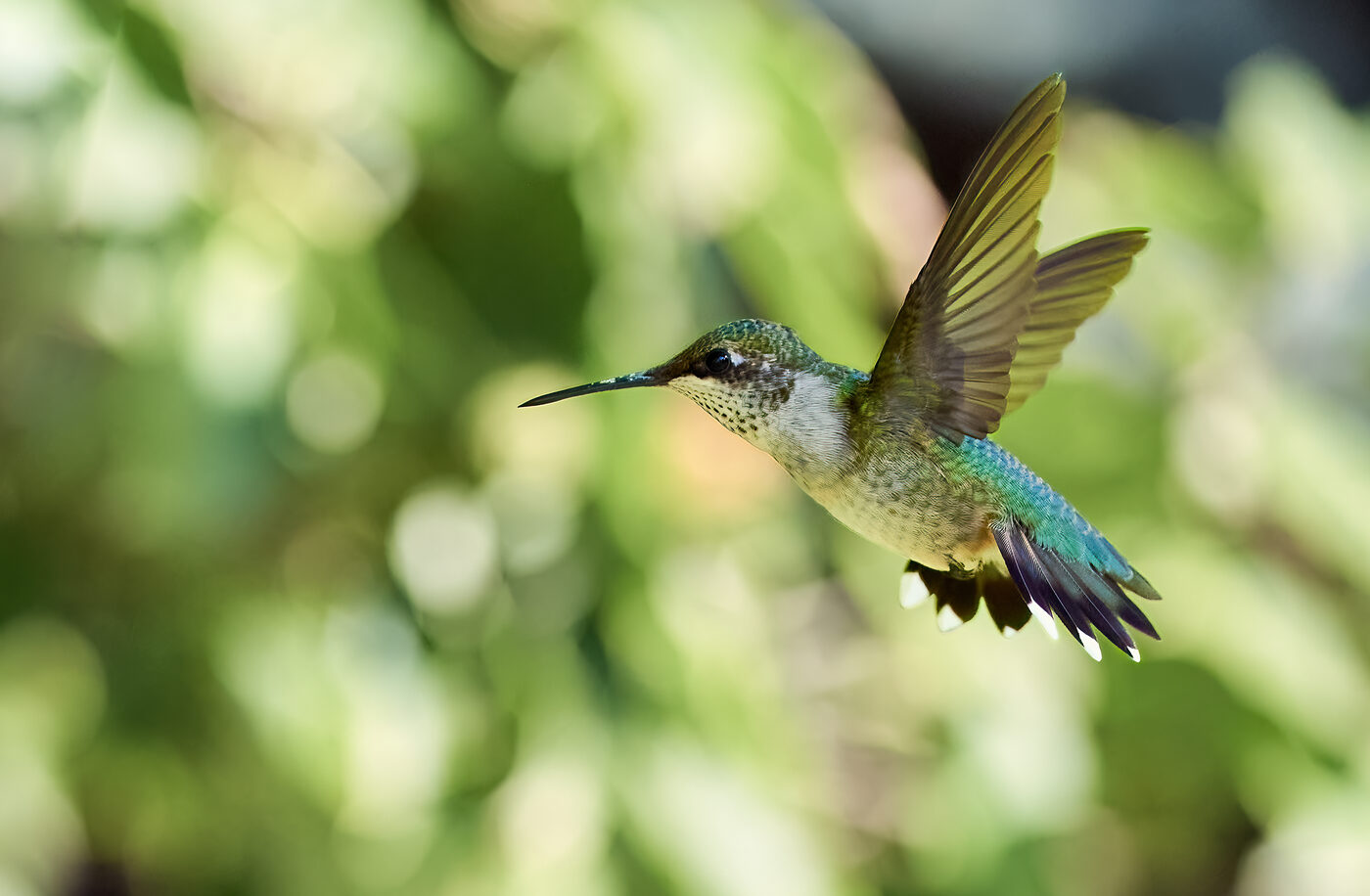
Ruby-throated hummingbird.M15 Black-chinned hummingbird hovering.M16 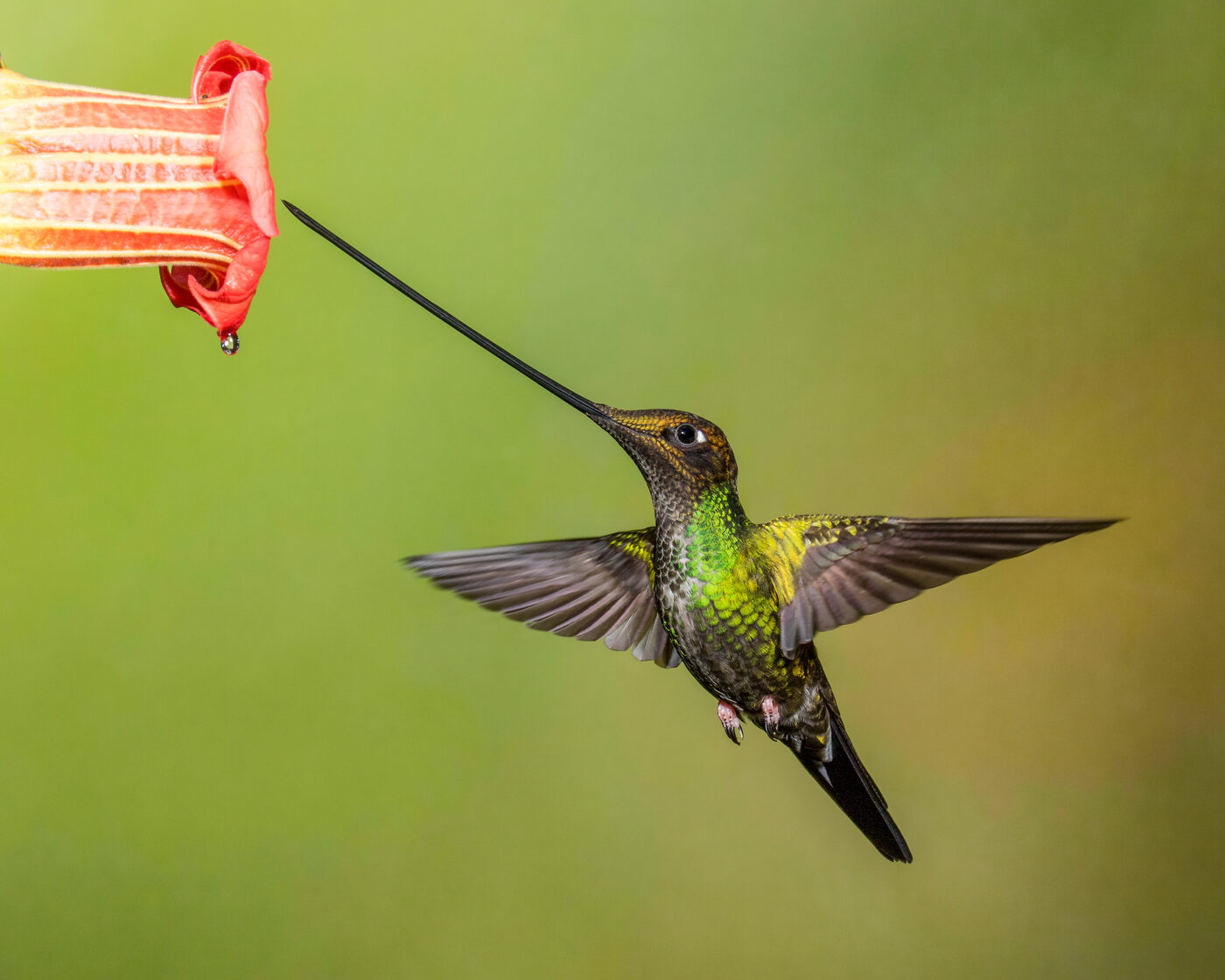
Sword-billed hummingbird.M17 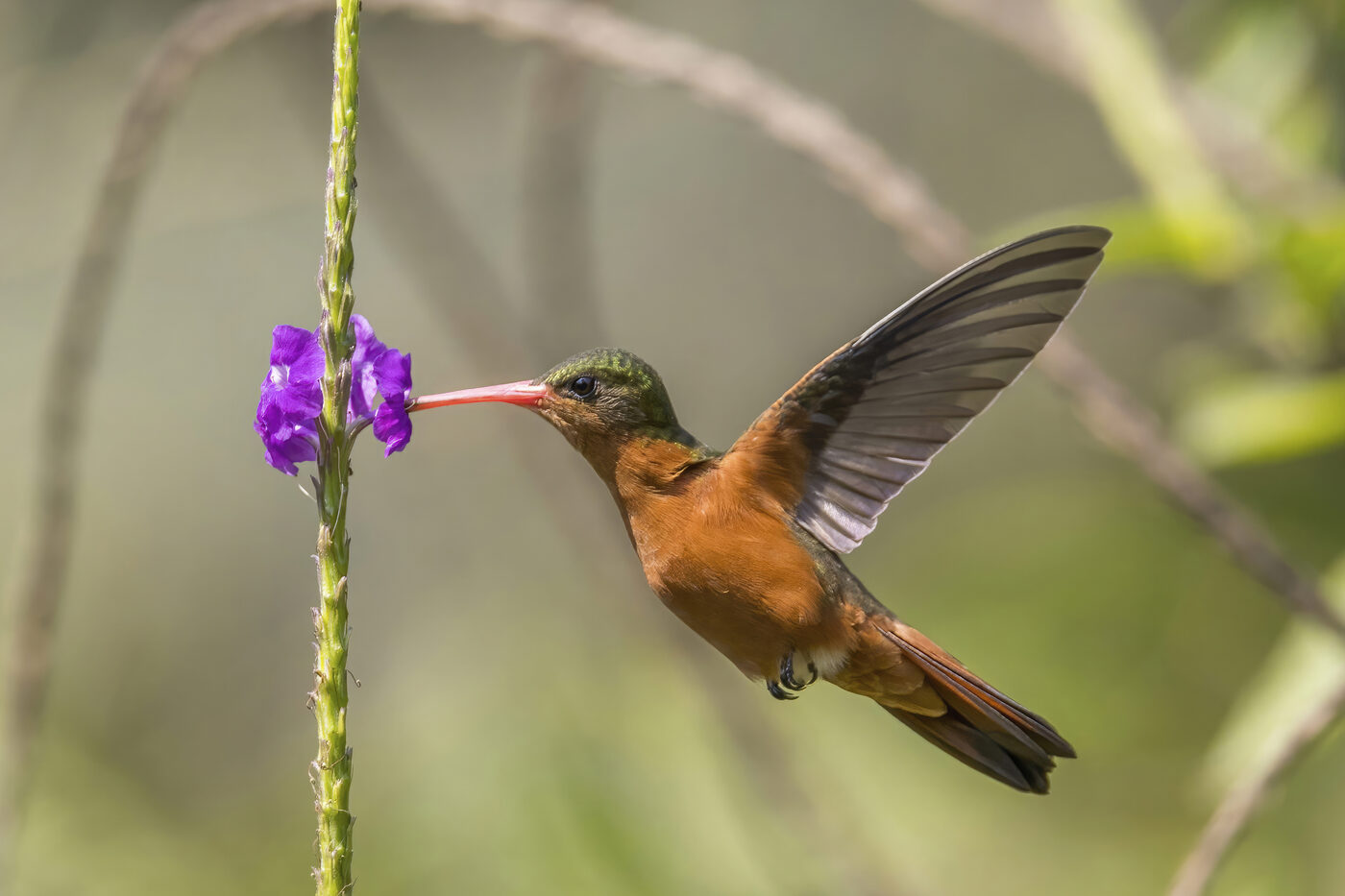
Cinnamon hummingbird in flight.M18 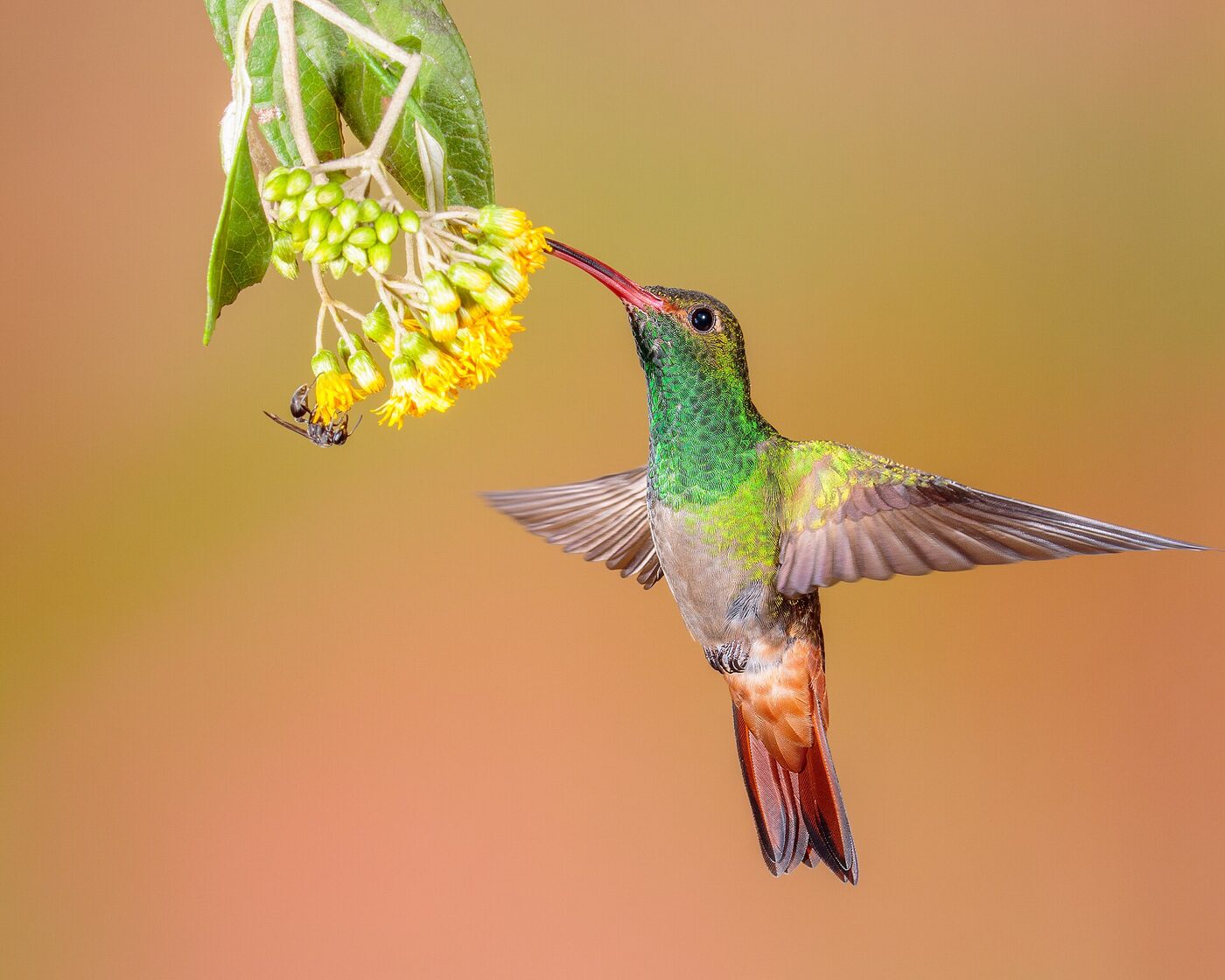
Rufous-tailed hummingbird.M19 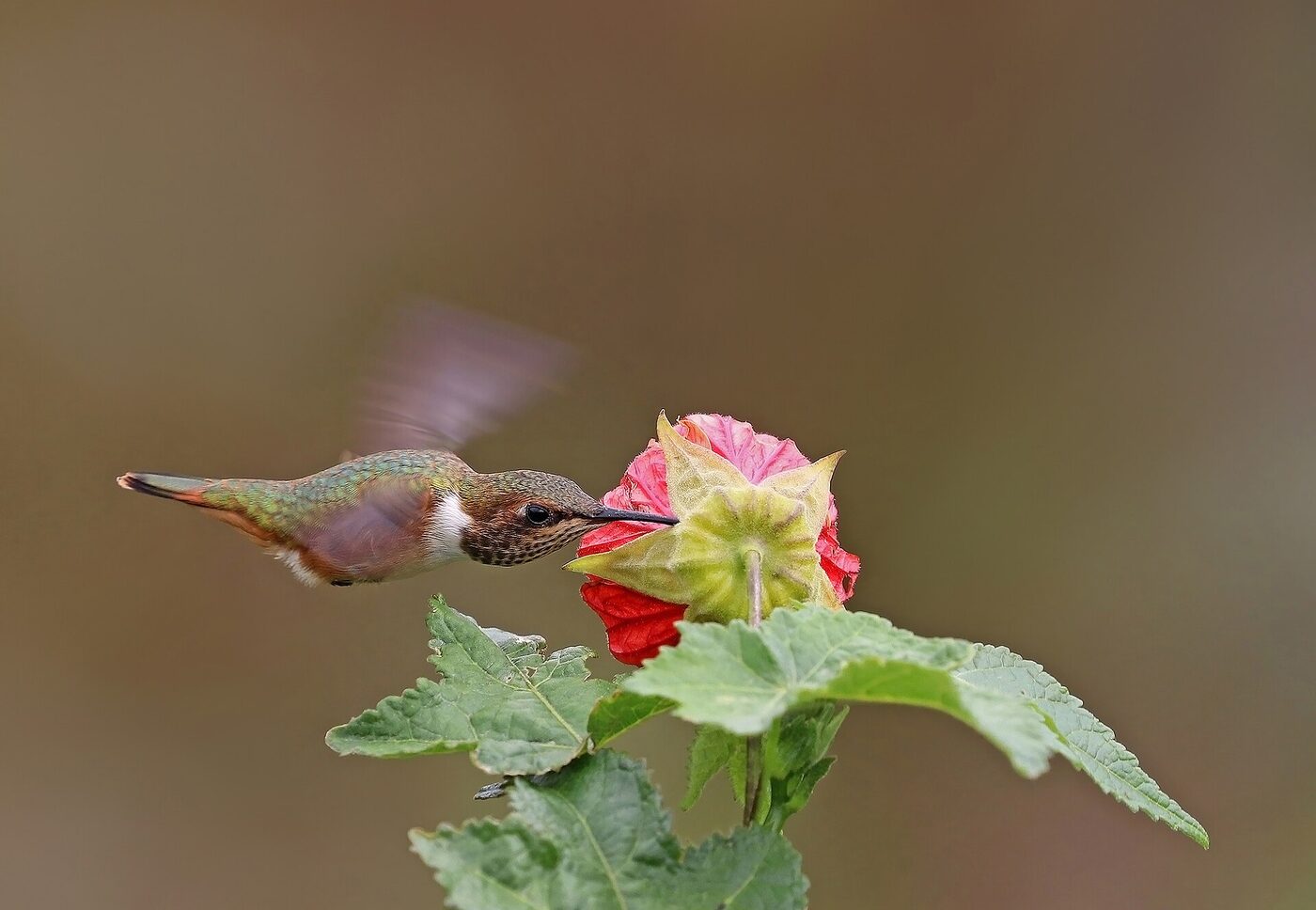
Volcano hummingbird female in flight.M20 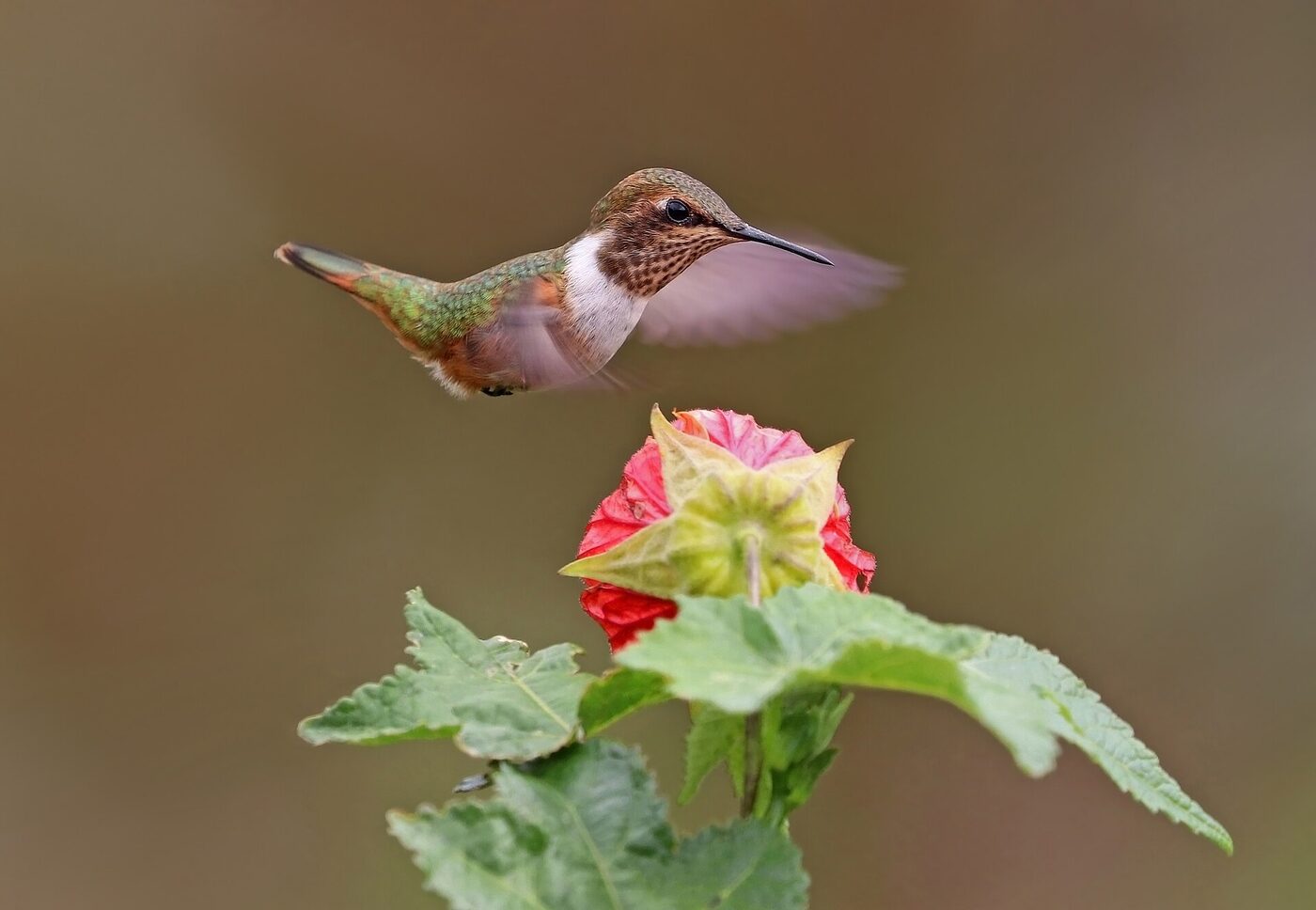
Volcano hummingbird female hovering.M21 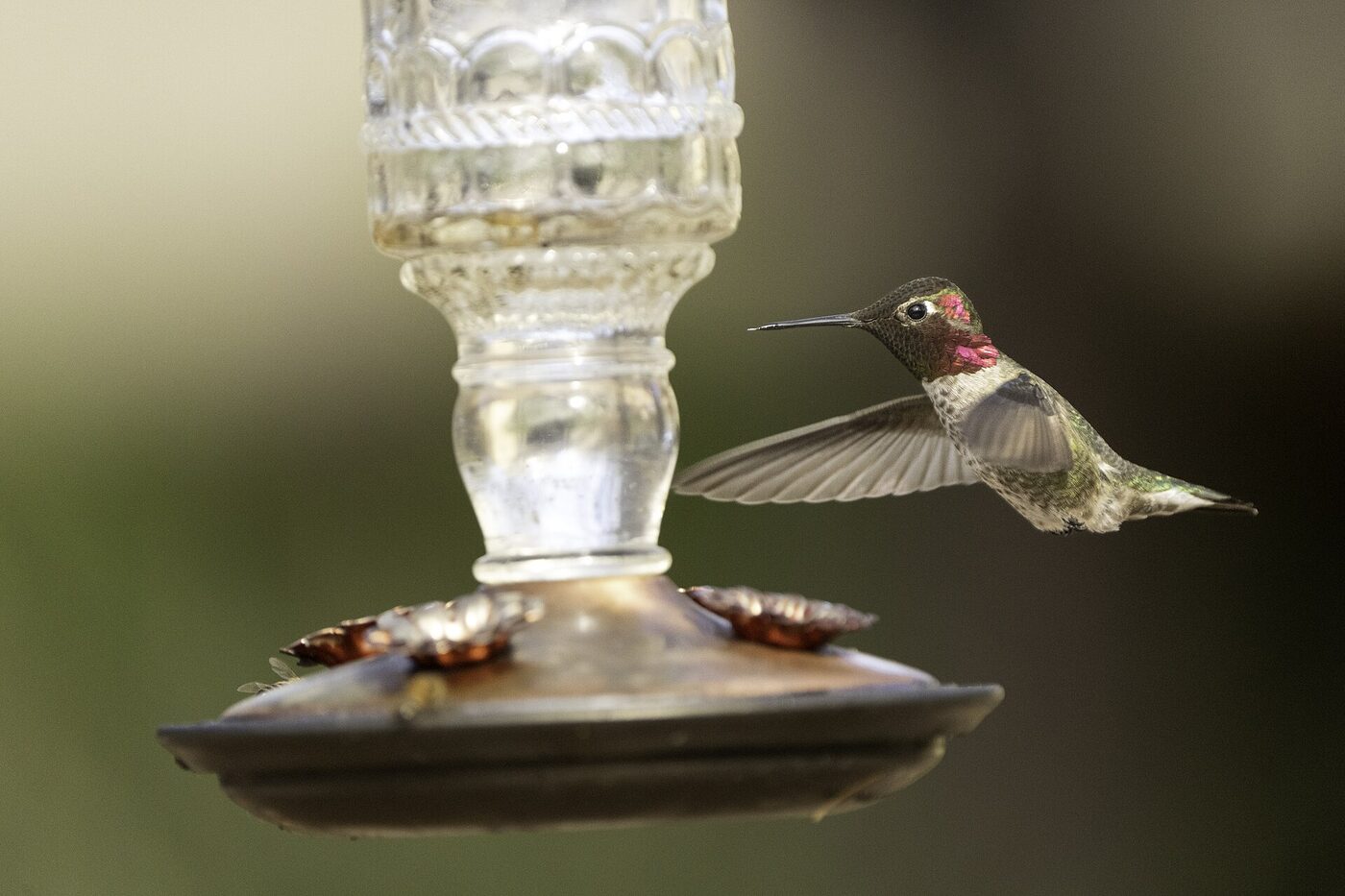
Anna's hummingbird hovering.M22 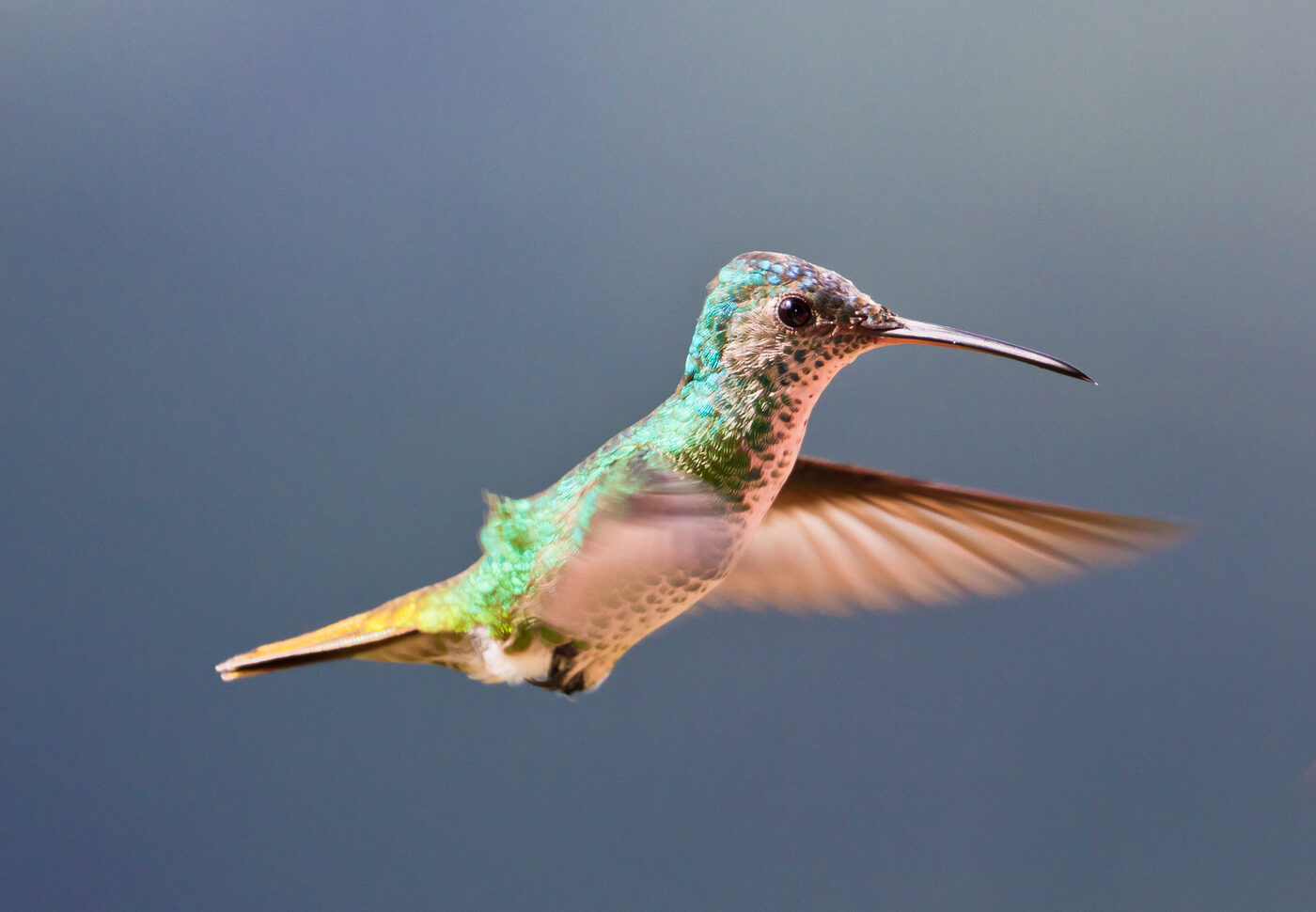
Golden-tailed sapphire hummingbird.M23 Ponder
- Why do birds have different wing shapes?
- What can we infer about a bird by looking at its wing shape?
Media Credits
-
M1Flight silhouettesL. Shyamal · Wikimedia Commons · 2007 · CC BY-SA 2.5
-
M2Bald eagle near Hockanum RiverPaul Danese · Wikimedia Commons · 2024 · CC BY-SA 4.0
-
M3Bald eagle portraitSteve Berardi · Wikimedia Commons · 2010 · CC BY-SA 2.0
-
M4Bald eagle in flightSteve Berardi · Wikimedia Commons · 2010 · CC BY-SA 2.0
-
M5Bald eagle soaringSteve Berardi · Wikimedia Commons · 2010 · CC BY-SA 2.0
-
M6Laysan albatross in flightForest & Kim Starr · Wikimedia Commons · 2008 · CC BY 3.0 US
-
M7Sparrow hoveringSuyeshakc · Wikimedia Commons · 2024 · CC BY-SA 4.0
-
M8Sparrow wingsRitesh Man Tamrakar · Wikimedia Commons · 2011 · CC BY-SA 2.0
-
M9Sparrow in flightBerkeley T. Compton · Wikimedia Commons · 2010 · CC BY-SA 2.0
-
M10Flying sparrowOdd Rune Falch · Pexels · 2023 · Pexels License
-
M11Common tern 2025 12Alexis Lours · Wikimedia Commons · 2025 · CC BY 4.0
-
M12Common tern 2024 04 28Alexis Lours · Wikimedia Commons · 2024 · CC BY 4.0
-
M13Common tern 2025 07 30Alexis Lours · Wikimedia Commons · 2025 · CC BY 4.0
-
M14Common tern 2022 04 24Alexis Lours · Wikimedia Commons · 2022 · CC BY 4.0
-
M15Ruby-throated hummingbirdPaul Danese · Wikimedia Commons · 2022 · CC BY-SA 2.0
-
M16Black-chinned hummingbirdUser:Mdf · Wikimedia Commons · 2006 · CC BY-SA 3.0
-
M17Sword-billed hummingbirdAndy Morffew · Wikimedia Commons · 2015 · CC BY 2.0
-
M18Cinnamon hummingbirdCharles J. Sharp · Wikimedia Commons · 2023 · CC BY-SA 4.0
-
M19Rufous-tailed hummingbirdAndy Morffew · Wikimedia Commons · 2015 · CC BY 2.0
-
M20Volcano hummingbird female in flight 3Charles J. Sharp · Wikimedia Commons · 2019 · CC BY-SA 4.0
-
M21Volcano hummingbird female in flight 1Charles J. Sharp · Wikimedia Commons · 2019 · CC BY-SA 4.0
-
M22Anna's hummingbirdLorie Shaull · Wikimedia Commons · 2023 · CC BY 2.0
-
M23Golden-tailed sapphire hummingbirdMarcial4 · Wikimedia Commons · 2011 · CC BY-SA 3.0
References
-
1.Types of Bird Wings: Functions, Descriptions, and Pictures!Valerie · Wild Earth Lab · 2024
-
2.Bird Wing Types HandoutCornell Lab of Ornithology · Cornell Lab · 2018
ReflectionIn your own words, what is the main idea of Wing Shapes?ReflectionSummarize what you have learned today.ReflectionWhat did you find most surprising or intriguing in this learning byte?Understanding CheckHow well do you understand: describe common wing types and connect each shape to a flight behavior?1 out of 5How to Cite: Sinha, R. (2026). Wing Shapes. Amazing Birds. https://amazing-birds.gitlab.io/GenAI Assistance: Some content and materials on this page may have been developed with GenAI assistance; all content was reviewed, edited, and integrated by the author(s).
This page is an open educational resource (OER) licensed under a Creative Commons Attribution-NonCommercial-ShareAlike 4.0 International License.Feel free to use, link, or embed this page for non-commercial educational purposes with attribution. Please share any adaptations under the same CC BY-NC-SA 4.0 license.This page may include third-party images, videos, and other materials that have their own licenses and terms of use. Please verify before reusing these materials.Feedback: If you notice any accessibility issues, incorrect information, or have suggestions for improvement, please use the feedback form. -
Bird Pictures (/birdgallery/)
Learning Byte Summary ▾
Learning Objectives (LOs): notice wing shapes and flight cues across many bird examplesGrade level: Middle schoolDuration: ~5 minKey ideas: Image-based observation; Wing shape variety; Flight cuesActive soaring wings
Laysan albatross with active soaring wings.M1 Passive soaring wings
Bald eagle with passive soaring wings.M2 Bald eagle portrait.M3 Bald eagle in flight.M4 Bald eagle soaring.M5 High-speed wings
Common tern with high-speed wings.M6 Common tern in flight.M7 Common tern flying with pointed wings.M8 Common tern flying over water.M9 Elliptical wings
Sparrow showing elliptical wings.M10 Sparrow wings in motion.M11 Sparrow in flight.M12 Close-up of a flying sparrow.M13 Hovering wings
Ruby-throated hummingbird.M14 Black-chinned hummingbird hovering.M15 Sword-billed hummingbird.M16 Cinnamon hummingbird in flight.M17 Rufous-tailed hummingbird.M18 Volcano hummingbird female in flight.M19 Volcano hummingbird female hovering.M20 Anna's hummingbird hovering.M21 Golden-tailed sapphire hummingbird.M22 Media Credits
-
M1Laysan albatross in flightForest & Kim Starr · Wikimedia Commons · 2008 · CC BY 3.0 US
-
M2Bald eagle near Hockanum RiverPaul Danese · Wikimedia Commons · 2024 · CC BY-SA 4.0
-
M3Bald eagle portraitSteve Berardi · Wikimedia Commons · 2010 · CC BY-SA 2.0
-
M4Bald eagle in flightSteve Berardi · Wikimedia Commons · 2010 · CC BY-SA 2.0
-
M5Bald eagle soaringSteve Berardi · Wikimedia Commons · 2010 · CC BY-SA 2.0
-
M6Common tern 2025 12Alexis Lours · Wikimedia Commons · 2025 · CC BY 4.0
-
M7Common tern 2024 04 28Alexis Lours · Wikimedia Commons · 2024 · CC BY 4.0
-
M8Common tern 2025 07 30Alexis Lours · Wikimedia Commons · 2025 · CC BY 4.0
-
M9Common tern 2022 04 24Alexis Lours · Wikimedia Commons · 2022 · CC BY 4.0
-
M10Sparrow hoveringSuyeshakc · Wikimedia Commons · 2024 · CC BY-SA 4.0
-
M11Sparrow wingsRitesh Man Tamrakar · Wikimedia Commons · 2011 · CC BY-SA 2.0
-
M12Sparrow in flightBerkeley T. Compton · Wikimedia Commons · 2010 · CC BY-SA 2.0
-
M13Flying sparrowOdd Rune Falch · Pexels · 2023 · Pexels License
-
M14Ruby-throated hummingbirdPaul Danese · Wikimedia Commons · 2022 · CC BY-SA 2.0
-
M15Black-chinned hummingbirdUser:Mdf · Wikimedia Commons · 2006 · CC BY-SA 3.0
-
M16Sword-billed hummingbirdAndy Morffew · Wikimedia Commons · 2015 · CC BY 2.0
-
M17Cinnamon hummingbirdCharles J. Sharp · Wikimedia Commons · 2023 · CC BY-SA 4.0
-
M18Rufous-tailed hummingbirdAndy Morffew · Wikimedia Commons · 2015 · CC BY 2.0
-
M19Volcano hummingbird female in flight 3Charles J. Sharp · Wikimedia Commons · 2019 · CC BY-SA 4.0
-
M20Volcano hummingbird female in flight 1Charles J. Sharp · Wikimedia Commons · 2019 · CC BY-SA 4.0
-
M21Anna's hummingbirdLorie Shaull · Wikimedia Commons · 2023 · CC BY 2.0
-
M22Golden-tailed sapphire hummingbirdMarcial4 · Wikimedia Commons · 2011 · CC BY-SA 3.0
ReflectionIn your own words, what is the main idea of Bird Images Gallery?ReflectionSummarize what you have learned today.ReflectionWhat did you find most surprising or intriguing in this learning byte?Understanding CheckHow well do you understand: notice wing shapes and flight cues across many bird examples?1 out of 5How to Cite: Sinha, R. (2026). Bird Images Gallery. Amazing Birds. https://amazing-birds.gitlab.io/GenAI Assistance: Some content and materials on this page may have been developed with GenAI assistance; all content was reviewed, edited, and integrated by the author(s).
This page is an open educational resource (OER) licensed under a Creative Commons Attribution-NonCommercial-ShareAlike 4.0 International License.Feel free to use, link, or embed this page for non-commercial educational purposes with attribution. Please share any adaptations under the same CC BY-NC-SA 4.0 license.This page may include third-party images, videos, and other materials that have their own licenses and terms of use. Please verify before reusing these materials.Feedback: If you notice any accessibility issues, incorrect information, or have suggestions for improvement, please use the feedback form. -


7. Let's design our sketch prototype!
Imagine, Design and Build
-
Birds in slow motion (/slowmotion/)
Learning Byte Summary ▾
Learning Objectives (LOs): In this learning byte, we will watch slow motion videos of bird flightGrade level: Middle schoolDuration: 8 minKey ideas: Observing flapping flight; Slow-motion video observationSlow motion bird flights
Watch the videos of birds flying in slow motion.
Albatross
Bald Eagle
Tern
Sparrow
Hummingbird
ObservationWhat are the similarities and differences you notice in how birds fly?Write down your observations below.ObservationHow do you think birds fly?Feedback
Was there any section that was difficult to understand?What is one new thing you learned?How to Cite: Sinha, R. (2026). Slow Motion Flights. Amazing Birds. https://amazing-birds.gitlab.io/GenAI Assistance: Some content and materials on this page may have been developed with GenAI assistance; all content was reviewed, edited, and integrated by the author(s).
This page is an open educational resource (OER) licensed under a Creative Commons Attribution-NonCommercial-ShareAlike 4.0 International License.Feel free to use, link, or embed this page for non-commercial educational purposes with attribution. Please share any adaptations under the same CC BY-NC-SA 4.0 license.This page may include third-party images, videos, and other materials that have their own licenses and terms of use. Please verify before reusing these materials.Feedback: If you notice any accessibility issues, incorrect information, or have suggestions for improvement, please use the feedback form. -
Act Like a Bird! (/interactive-resources/trail/pose-trail.html)
Interactive resource (print placeholder). See /interactive-resources/trail/pose-trail.html.
-
Design the Wing Arc (/interactive-resources/schema-proto/index.html)
Interactive resource (print placeholder). See /interactive-resources/schema-proto/index.html.
8. Can we use gears and popsicles to copy bird flapping motion?
Introduction to four-bar linkage
-
4-bar linkage (/fourbar/)
Learning Byte Summary ▾
Learning Objectives (LOs): explain a four-bar linkage and test how changing a link affects the motionGrade level: Middle schoolDuration: ~12 minKey ideas: Four-bar linkage; Motion transformation; Testing changesA four-bar linkage is a simple moving mechanism made from four connected parts. Even though it is simple, it can create rich motion, which is why it is useful for building flapping systems.
What is a 4-bar linkage?
In a four-bar linkage, four bars are connected with pivots so they can move relative to one another.
The four parts are often:
- a fixed bar, which stays in place
- an input bar, which is driven by a motor or gear
- a coupler bar, which connects motion across the system
- an output bar, which produces the final movement
Why is it useful?
A four-bar linkage helps engineers turn one kind of motion into another.
For example:
- a rotating crank can create an arc-like wing motion
- a small input movement can guide a larger output path
- the same mechanism can be adjusted by changing link lengths
How does this connect to bird-inspired design?
Bird wings do not simply move up and down. They follow arcs and change direction as they flap. A four-bar linkage gives us a way to copy part of that motion using simple parts such as gears, sticks, or popsicles.
This makes it a useful starting point for a bird-inspired prototype.
What should you notice?
When you study a four-bar linkage, pay attention to:
- which bar is fixed
- which bar is driving the motion
- the path traced by the output point
- how changing a bar length changes the final movement
Why engineers like it
Engineers often use four-bar linkages because they are:
- mechanically simple
- easy to prototype
- good for exploring motion design
- useful for both physical and digital models
Try it: predict the trace
Before you touch the mechanism, make a prediction.
If you increase Gear Size (OA), what do you think will happen to the output trace?
Now test your idea in the interactive mechanism below.
- Press
Start Log - Change only
Gear Size (OA) - Watch how the blue trace changes
- Compare what you predicted with what you observed
What should you notice after testing?
When you change only one value, the motion path does not simply get bigger or smaller in a perfectly simple way. The whole geometry of the linkage changes, so the trace can move, stretch, and change shape. That is part of what makes mechanisms powerful and also complex.
Quick recap
- A four-bar linkage has four connected bars.
- It helps transform motion from one form to another.
- Changing the link lengths changes the output motion.
- It is a useful mechanism for exploring bird-like flapping designs.
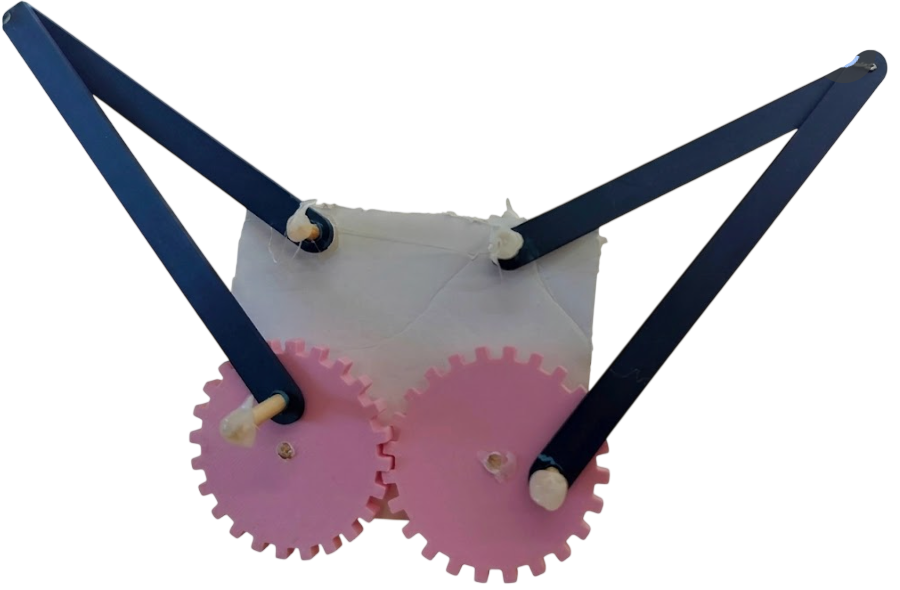
ReflectionIn your own words, what is the main idea of 4-bar linkage basics?ReflectionSummarize what you have learned today.ReflectionWhat did you find most surprising or intriguing in this learning byte?Understanding CheckHow well do you understand: explain a four-bar linkage and test how changing a link affects the motion?1 out of 5How to Cite: Sinha, R. (2026). 4-bar linkage basics. Amazing Birds. https://amazing-birds.gitlab.io/GenAI Assistance: Some content and materials on this page may have been developed with GenAI assistance; all content was reviewed, edited, and integrated by the author(s).
This page is an open educational resource (OER) licensed under a Creative Commons Attribution-NonCommercial-ShareAlike 4.0 International License.Feel free to use, link, or embed this page for non-commercial educational purposes with attribution. Please share any adaptations under the same CC BY-NC-SA 4.0 license.This page may include third-party images, videos, and other materials that have their own licenses and terms of use. Please verify before reusing these materials.Feedback: If you notice any accessibility issues, incorrect information, or have suggestions for improvement, please use the feedback form. -
Demo Prototype (/prototypes/)
Learning Byte Summary ▾
Learning Objectives (LOs): describe how digital and physical prototypes support the design processGrade level: Middle schoolDuration: ~5 minKey ideas: Digital prototype; Physical prototype; Design iterationOverview of our design process!
Example of a physical model and computer model
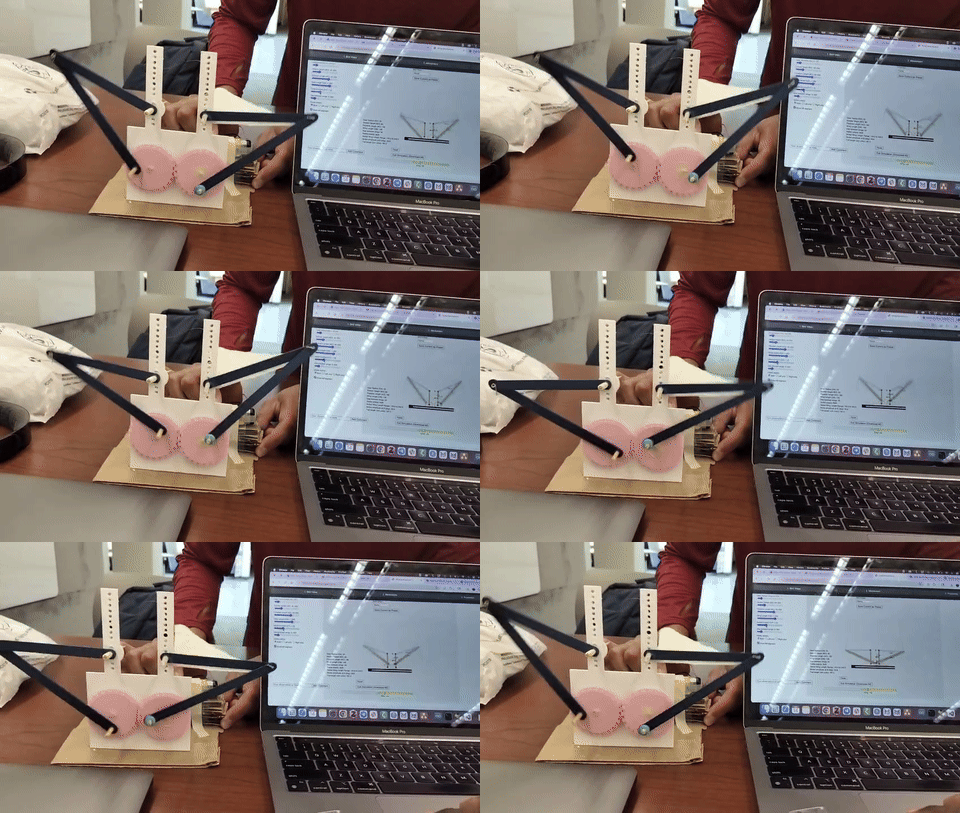
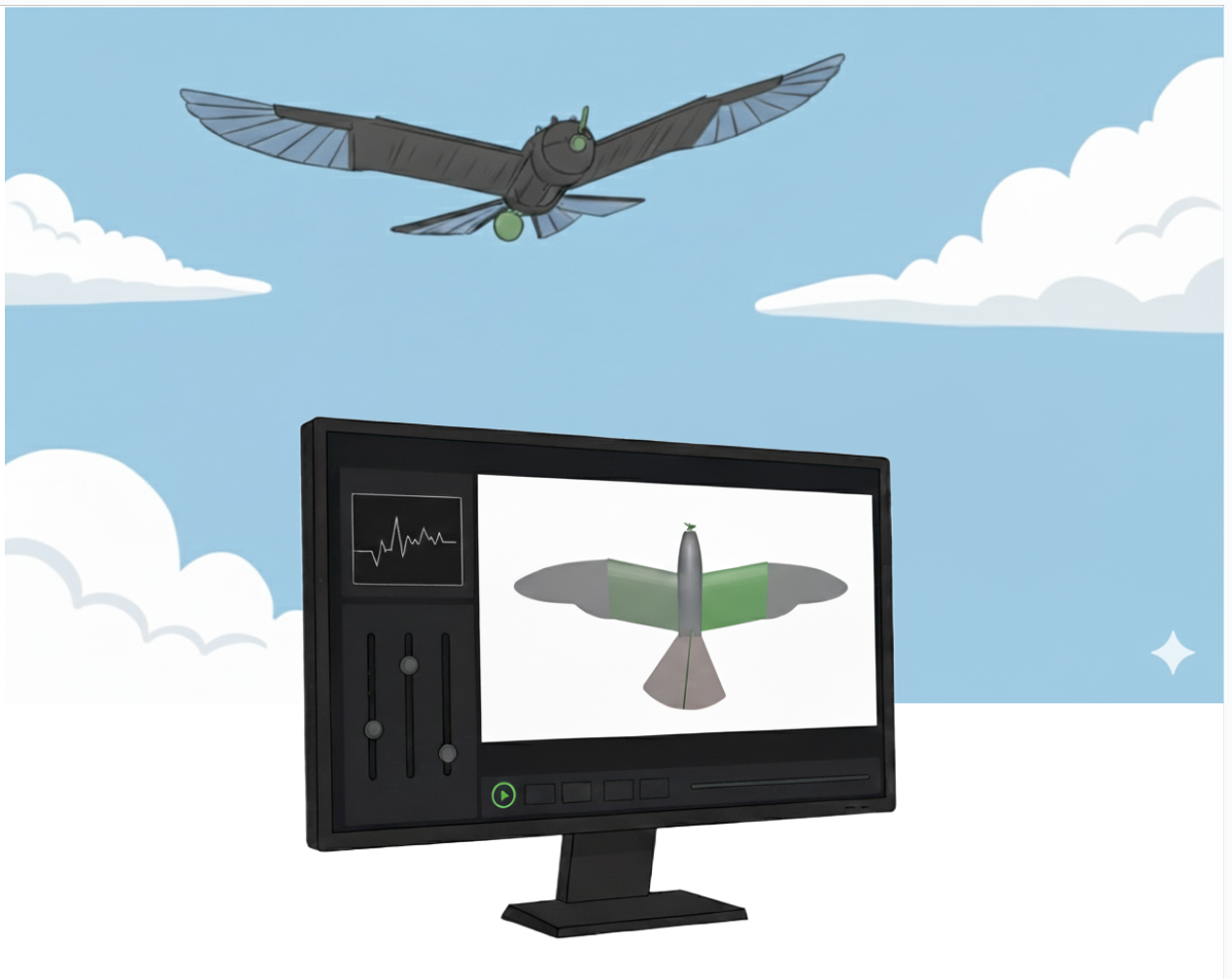
https://www.youtube.com/watch?v=1ma-Z0yRL4Q
ReflectionIn your own words, what is the main idea of Prototypes?ReflectionSummarize what you have learned today.ReflectionWhat did you find most surprising or intriguing in this learning byte?Understanding CheckHow well do you understand: describe how digital and physical prototypes support the design process?1 out of 5How to Cite: Sinha, R. (2026). Prototypes. Amazing Birds. https://amazing-birds.gitlab.io/GenAI Assistance: Some content and materials on this page may have been developed with GenAI assistance; all content was reviewed, edited, and integrated by the author(s).
This page is an open educational resource (OER) licensed under a Creative Commons Attribution-NonCommercial-ShareAlike 4.0 International License.Feel free to use, link, or embed this page for non-commercial educational purposes with attribution. Please share any adaptations under the same CC BY-NC-SA 4.0 license.This page may include third-party images, videos, and other materials that have their own licenses and terms of use. Please verify before reusing these materials.Feedback: If you notice any accessibility issues, incorrect information, or have suggestions for improvement, please use the feedback form.
9. Bird Simulation
Designing and simulating a four-bar linkage
-
Designing our digital bird (/simulations/flapping-bird/mechanism.html)
Content not embedded. See /simulations/flapping-bird/mechanism.html.
10. Check Bird
Measure prototype wing angles
-
Check Bird (/interactive-resources/check-bird/)
Interactive resource (print placeholder). See /interactive-resources/check-bird/.
10. Wing Shape
Design cut out of your bird wing
-
Wing shape design (/wingshapedesign/)
Learning Byte Summary ▾
Learning Objectives (LOs): Design Wing ShapeGrade level: Middle schoolDuration: 12 minKey ideas: Wing types; Shape and functionIntroduction
Common bird wing shapes
Common bird wing shape silhouettes.M1 Passive soaring wings
- These wing shapes are wide and have slots at the ends.
- Bald eagles have this wing type. These wings help them catch thermal updrafts and fly for long periods without much flapping.
Active soaring wings
- These wings are long and narrow.
- Albatrosses have this wing shape. It helps them fly long distances during migration without using much energy. These wings also help them use horizontal air currents, such as sea breezes.<
Elliptical wings
- These wings are more rounded and broad. They help birds make quick turns and escape when attacked by predators.
- Sparrows and turkeys have this wing type. To stay in the air, these birds need to spend a lot of energy because they flap their wings often.
High-speed wings
- These wings are not as long as passive or active soaring wings, but they are still pointed at the ends. They help birds fly very fast. Like the name implies, high-speed wings are great for rapid movement. However, birds must spend lots of energy flapping to reach high speeds. This makes these wings useful for short bursts of speed, such as chasing flying prey or insects.
Hovering wings
- Imagine moving your arms backward and forward 80 times in one second! That’s how fast some hummingbirds flap their wings. Their wings are very small and super light.
- Their muscles are incredibly strong, and their reflexes are very sharp. Did you know they can fly backward too? If you ever get close to these birds, you can hear the sound they make when they flap their wings. It sounds like a high-speed fan. Hummingbirds move their wings in a figure-eight pattern, which helps them hover while drinking nectar from a flower.
Ponder
- Why do birds have different wing shapes?
- What can we infer about a bird by looking at its wing shape?
Feedback
Was there any section that was difficult to understand?What is one new thing you learned?References
- Missing reference registry entry: .
Media Credits
-
M1Flight silhouettesL. Shyamal · Wikimedia Commons · 2007 · CC BY-SA 2.5
How to Cite: Sinha, R. (2026). Wing Shape Design. Amazing Birds. https://amazing-birds.gitlab.io/GenAI Assistance: Some content and materials on this page may have been developed with GenAI assistance; all content was reviewed, edited, and integrated by the author(s).
This page is an open educational resource (OER) licensed under a Creative Commons Attribution-NonCommercial-ShareAlike 4.0 International License.Feel free to use, link, or embed this page for non-commercial educational purposes with attribution. Please share any adaptations under the same CC BY-NC-SA 4.0 license.This page may include third-party images, videos, and other materials that have their own licenses and terms of use. Please verify before reusing these materials.Feedback: If you notice any accessibility issues, incorrect information, or have suggestions for improvement, please use the feedback form.
11. Time for Reflection!
Engineering Sciences Big Ideas
-
Prototypes (/prototypes/)
Learning Byte Summary ▾
Learning Objectives (LOs): describe how digital and physical prototypes support the design processGrade level: Middle schoolDuration: ~5 minKey ideas: Digital prototype; Physical prototype; Design iterationOverview of our design process!
Example of a physical model and computer model
https://www.youtube.com/watch?v=1ma-Z0yRL4Q
ReflectionIn your own words, what is the main idea of Prototypes?ReflectionSummarize what you have learned today.ReflectionWhat did you find most surprising or intriguing in this learning byte?Understanding CheckHow well do you understand: describe how digital and physical prototypes support the design process?1 out of 5How to Cite: Sinha, R. (2026). Prototypes. Amazing Birds. https://amazing-birds.gitlab.io/GenAI Assistance: Some content and materials on this page may have been developed with GenAI assistance; all content was reviewed, edited, and integrated by the author(s).
This page is an open educational resource (OER) licensed under a Creative Commons Attribution-NonCommercial-ShareAlike 4.0 International License.Feel free to use, link, or embed this page for non-commercial educational purposes with attribution. Please share any adaptations under the same CC BY-NC-SA 4.0 license.This page may include third-party images, videos, and other materials that have their own licenses and terms of use. Please verify before reusing these materials.Feedback: If you notice any accessibility issues, incorrect information, or have suggestions for improvement, please use the feedback form. -
Design Process (/designprocess/)
Learning Byte Summary ▾
Learning Objectives (LOs): describe the project design process and why iteration mattersGrade level: Middle schoolDuration: ~10 minKey ideas: Iterative design; Digital and physical prototypes; Reflection and revisionEngineering design is not only about building something at the end. It is also about observing, imagining, testing, revising, and reflecting. This project followed a design process that helped us move from bird observation to bird-inspired prototypes.
Overview of our design process
What were the main steps?
1. Observe
We started by looking closely at birds:
- how they flap
- how their wing shape looks
- what kind of wing arc they create
2. Imagine
Next, we thought about what kind of movement we wanted to copy and what kind of bird-inspired robot might capture that motion.
3. Design
We sketched ideas, compared birds, and made decisions about:
- wing shape
- target motion
- linkage form
- prototype structure
4. Build and simulate
We then explored both physical and digital prototypes to see how our ideas behaved when they actually moved.
A key idea: shifting between prototypes
One of the most important ideas in this project is shifting between prototypes. Design does not stay in only one form. We move back and forth between:
- a digital bird, where we can test motion, proportions, and wing arcs
-
a physical bird, where we can feel materials, joints, balance, and real movement
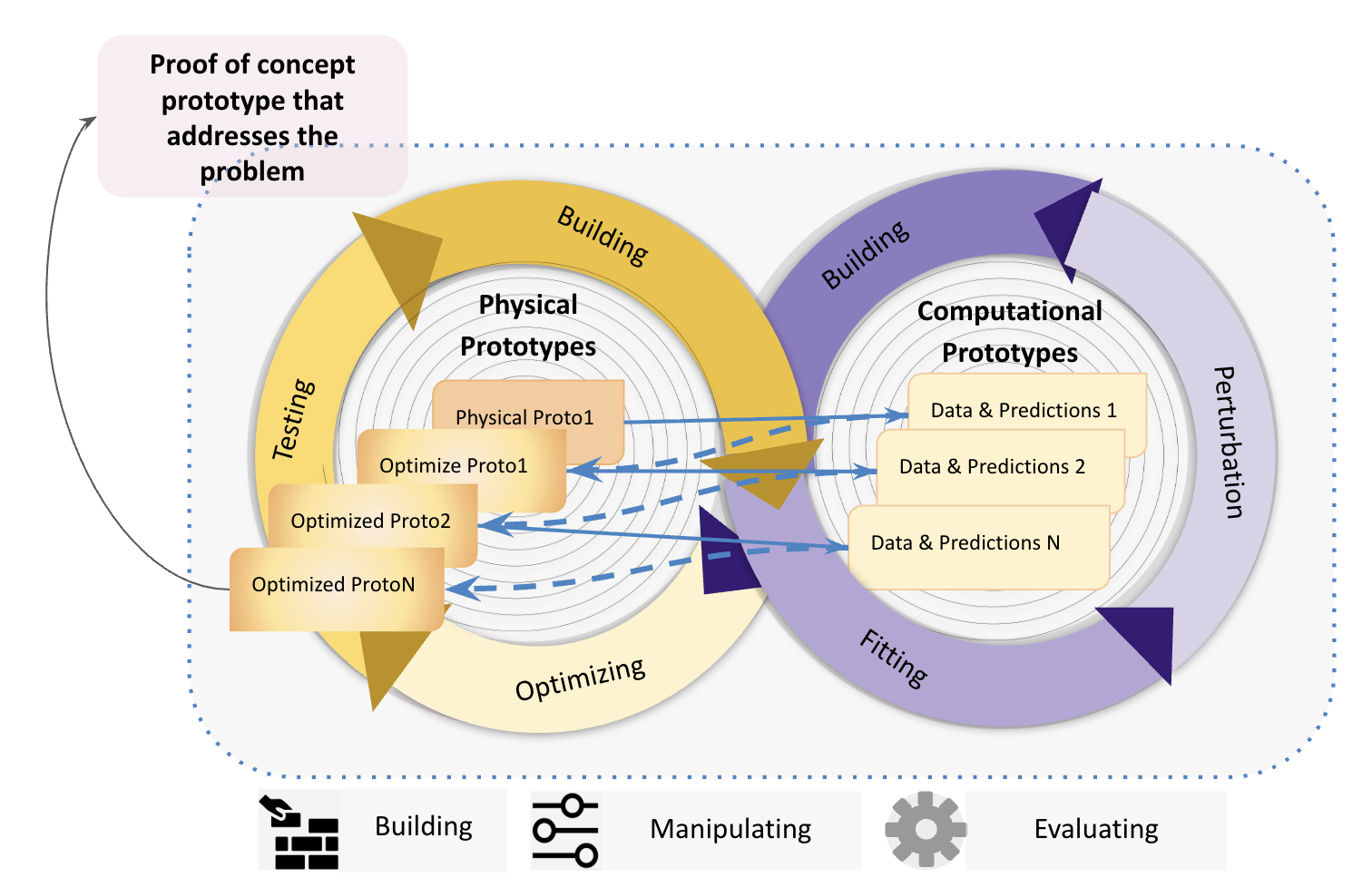 This shifting between prototypes is important because each one teaches us something different.
 - The digital bird helps us test ideas quickly.
- The physical bird helps us notice what is hard to build and what motion feels real.
- Going back and forth helps us revise the design more thoughtfully.
Instead of treating one version as more important than the other, we use both together as part of the design process. The key idea is not just to build a prototype, but to learn by shifting between different prototypes.
Example: a digital model and a physical model
Below are two examples that show how prototype ideas can move across different forms.
Digital prototype
The digital prototype helps us quickly test motion, wing arcs, linkage behavior, and proportions. It is useful for trying ideas before building them physically.Physical prototype
The physical prototype helps us notice how materials, joints, and real movement affect the design. It often reveals constraints that are harder to see in a digital model alone.Prototype demo
You can also view an example prototype demo here:
5. Reflect
Finally, we looked back at what worked, what was difficult, and what could be improved in the next design cycle.
Why this matters
The design process helps us connect science, engineering, and creativity. Instead of jumping straight to a final answer, we move through a sequence of choices, tests, and revisions.
Engineering Sciences Practices
This project also helps us experience some important engineering sciences practices:
- observing natural systems closely
- asking questions about how movement works
- comparing different kinds of flying systems
- building and testing models
- shifting between physical and digital prototypes
- revising designs based on evidence
- reflecting on what a design helps us understand
These practices matter because engineering science is not only about making something. It is also about using evidence, models, and design choices to understand complex systems and improve ideas over time.
Reflection questions
- Which step of the process helped you the most?
- Where did your design change the most?
- What did bird observation teach you that you would not have learned from building alone?
- If you redesigned your prototype, what would you change first?
Quick recap
- Good engineering design is iterative.
- Observation and reflection are just as important as building.
- Shifting between prototypes is a core design idea.
- Studying birds helps guide better prototype decisions.
- The design process helps turn ideas into tested solutions.
ReflectionIn your own words, what is the main idea of Design Process?ReflectionSummarize what you have learned today.ReflectionWhat did you find most surprising or intriguing in this learning byte?Understanding CheckHow well do you understand: describe the project design process and why iteration matters?1 out of 5How to Cite: Sinha, R. (2026). Design Process. Amazing Birds. https://amazing-birds.gitlab.io/GenAI Assistance: Some content and materials on this page may have been developed with GenAI assistance; all content was reviewed, edited, and integrated by the author(s).
This page is an open educational resource (OER) licensed under a Creative Commons Attribution-NonCommercial-ShareAlike 4.0 International License.Feel free to use, link, or embed this page for non-commercial educational purposes with attribution. Please share any adaptations under the same CC BY-NC-SA 4.0 license.This page may include third-party images, videos, and other materials that have their own licenses and terms of use. Please verify before reusing these materials.Feedback: If you notice any accessibility issues, incorrect information, or have suggestions for improvement, please use the feedback form. -
Coupling (/coupling/)
Learning Byte Summary ▾
Learning Objectives (LOs): describe how linked parts can affect each other in a flying systemGrade level: Middle schoolDuration: ~3 minKey ideas: Coupled motion; System interactions; Design tradeoffsReflectionIn your own words, what is the main idea of Coupling?ReflectionSummarize what you have learned today.ReflectionWhat did you find most surprising or intriguing in this learning byte?Understanding CheckHow well do you understand: describe how linked parts can affect each other in a flying system?1 out of 5How to Cite: Sinha, R. (2026). Coupling. Amazing Birds. https://amazing-birds.gitlab.io/GenAI Assistance: Some content and materials on this page may have been developed with GenAI assistance; all content was reviewed, edited, and integrated by the author(s).
This page is an open educational resource (OER) licensed under a Creative Commons Attribution-NonCommercial-ShareAlike 4.0 International License.Feel free to use, link, or embed this page for non-commercial educational purposes with attribution. Please share any adaptations under the same CC BY-NC-SA 4.0 license.This page may include third-party images, videos, and other materials that have their own licenses and terms of use. Please verify before reusing these materials.Feedback: If you notice any accessibility issues, incorrect information, or have suggestions for improvement, please use the feedback form. -
Design Rationale (/designrationale/)
Learning Byte Summary ▾
Learning Objectives (LOs): identify additional references that support bird-inspired design choicesGrade level: Middle schoolDuration: ~5 minKey ideas: Ornithopter background; Flapping mechanisms; Further readingsAdditional Readings
- Introduction to ornithopter : Link
- History of ornithopter: Link
- Flapping mechanisms ornithopters: Link
ReflectionIn your own words, what is the main idea of Design Rationale?ReflectionSummarize what you have learned today.ReflectionWhat did you find most surprising or intriguing in this learning byte?Understanding CheckHow well do you understand: identify additional references that support bird-inspired design choices?1 out of 5How to Cite: Sinha, R. (2026). Design Rationale. Amazing Birds. https://amazing-birds.gitlab.io/GenAI Assistance: Some content and materials on this page may have been developed with GenAI assistance; all content was reviewed, edited, and integrated by the author(s).
This page is an open educational resource (OER) licensed under a Creative Commons Attribution-NonCommercial-ShareAlike 4.0 International License.Feel free to use, link, or embed this page for non-commercial educational purposes with attribution. Please share any adaptations under the same CC BY-NC-SA 4.0 license.This page may include third-party images, videos, and other materials that have their own licenses and terms of use. Please verify before reusing these materials.Feedback: If you notice any accessibility issues, incorrect information, or have suggestions for improvement, please use the feedback form. -
Photo print (/interactive-resources/photo-booth/index2.html)
Interactive resource (print placeholder). See /interactive-resources/photo-booth/index2.html.