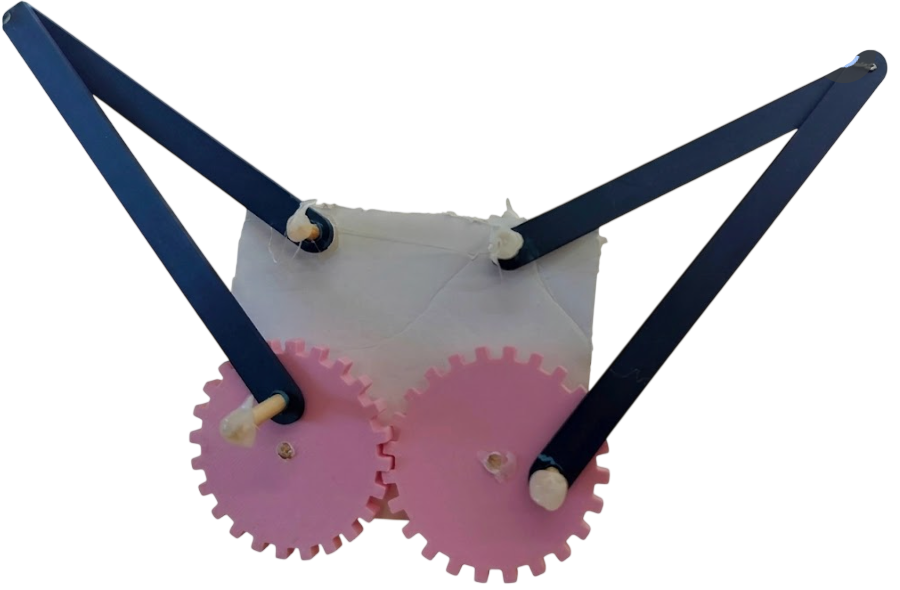
4-bar linkage basics
Learning Byte Summary ▾
A four-bar linkage is a simple moving mechanism made from four connected parts. Even though it is simple, it can create rich motion, which is why it is useful for building flapping systems.
What is a 4-bar linkage?
In a four-bar linkage, four bars are connected with pivots so they can move relative to one another.
The four parts are often:
- a fixed bar, which stays in place
- an input bar, which is driven by a motor or gear
- a coupler bar, which connects motion across the system
- an output bar, which produces the final movement
Why is it useful?
A four-bar linkage helps engineers turn one kind of motion into another.
For example:
- a rotating crank can create an arc-like wing motion
- a small input movement can guide a larger output path
- the same mechanism can be adjusted by changing link lengths
How does this connect to bird-inspired design?
Bird wings do not simply move up and down. They follow arcs and change direction as they flap. A four-bar linkage gives us a way to copy part of that motion using simple parts such as gears, sticks, or popsicles.
This makes it a useful starting point for a bird-inspired prototype.
What should you notice?
When you study a four-bar linkage, pay attention to:
- which bar is fixed
- which bar is driving the motion
- the path traced by the output point
- how changing a bar length changes the final movement
Why engineers like it
Engineers often use four-bar linkages because they are:
- mechanically simple
- easy to prototype
- good for exploring motion design
- useful for both physical and digital models
Try it: predict the trace
Before you touch the mechanism, make a prediction.
If you increase Gear Size (OA), what do you think will happen to the output trace?
Now test your idea in the interactive mechanism below.
- Press
Start Log - Change only
Gear Size (OA) - Watch how the blue trace changes
- Compare what you predicted with what you observed
What should you notice after testing?
When you change only one value, the motion path does not simply get bigger or smaller in a perfectly simple way. The whole geometry of the linkage changes, so the trace can move, stretch, and change shape. That is part of what makes mechanisms powerful and also complex.
Quick recap
- A four-bar linkage has four connected bars.
- It helps transform motion from one form to another.
- Changing the link lengths changes the output motion.
- It is a useful mechanism for exploring bird-like flapping designs.